
 A SCHOLARLY BOOK REPOSITORY
7 start with E start with E
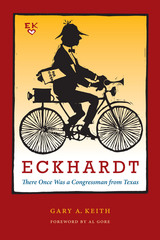
Runner-up, Violet Crown Award, Writer's League of Texas, 2008
Renowned for his "brilliant legislative mind" and political oratory—as well as for bicycling to Congress in a rumpled white linen suit and bow tie—U.S. Congressman Bob Eckhardt was a force to reckon with in Texas and national politics from the 1940s until 1980. A liberal Democrat who successfully championed progressive causes, from workers' rights to consumer protection to environmental preservation and energy conservation, Eckhardt won the respect of opponents as well as allies. Columnist Jack Anderson praised him as one of the most effective members of Congress, where Eckhardt was a national leader and mentor to younger congressmen such as Al Gore.
In this biography of Robert Christian Eckhardt (1913-2001), Gary A. Keith tells the story of Eckhardt's colorful life and career within the context of the changing political landscape of Texas and the rise of the New Right and the two-party state. He begins with Eckhardt's German-American family heritage and then traces his progression from labor lawyer, political organizer, and cofounder of the progressive Texas Observer magazine to Texas state legislator and U.S. congressman. Keith describes many of Eckhardt's legislative battles and victories, including the passage of the Open Beaches Act and the creation of the Big Thicket National Preserve, the struggle to limit presidential war-making ability through the War Powers Act, and the hard fight to shape President Carter's energy policy, as well as Eckhardt's work in Texas to tax the oil and gas industry.
The only thorough recounting of the life of a memorable, important, and flamboyant man, Eckhardt also recalls the last great era of progressive politics in the twentieth century and the key players who strove to make Texas and the United States a more just, inclusive society.
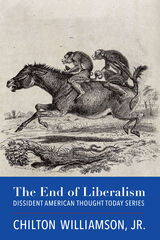
Williamson observes that this liberalism to nevertheless be collapsing, given the obvious opposition to the idea that it is essential to modernity. Liberalism is ironically a kind of unyielding control, "a relativist persuasion that discourages and resists fixed beliefs and certainties and the idea of truth itself." Williamson offers commentary on the present state of liberal ideas and their crimes against better judgment, and vindicates conservatism from being labeled reactionary. Liberalism is exposed as a faith we cannot accept, for it contains nothing to be believed and what it says about the order of things is pure fiction.
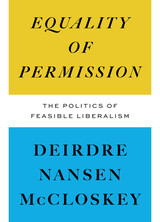
From a revered public intellectual, an essential argument for the political preconditions of a liberal society.
Liberalism has always suffered from messaging challenges. It simultaneously implies a pursuit of individual liberty and social equality, two projects often regarded as at odds. Or: Liberal means the opposite of conservative. Except when it doesn’t. The list goes on.
Liberal bard Deirdre Nansen McCloskey understands these rhetorical troubles. Equality of Permission is her stirring and career-defining intervention on this essentially contested yet critical topic—a forceful case for liberalism as our best hope, and an essential vision of the political conditions necessary for its survival. McCloskey prescribes a liberalism built around liberty from the bottom up: “equality before the law and equality of political and economic permissions,” lightly administered.
The state, McCloskey argues, is increasingly the source of our discontents—an illiberal institution, hindered by a quixotic fixation on pursuing equality of wealth or opportunity. Equality of Permission evangelizes for a better, and earlier, version of liberalism—that of John Locke, Adam Smith, Mary Wollstonecraft, and Henry David Thoreau—as against a top-down quest for an unattainable utopia. McCloskey shows that statism in pursuit of a chimerical general will, even when well-intentioned, leads to tyranny.
Brimming with energy and erudition, drawing on wisdoms from Alexis de Tocqueville to Mae West, Equality of Permission is McCloskey at the peak of her powers—brilliant, lacerating, garrulous, funny, worldly, and warm. Amid intense debate over the use and abuse of government institutions, McCloskey shares her singular vision for a true democracy, one grounded in respect and conducive to universal human flourishing.
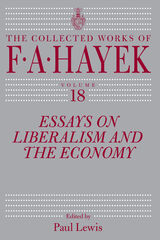
Across seventeen volumes to date, the University of Chicago Press’s Collected Works of F. A. Hayek series has anthologized the diverse and prolific writings of the Austrian economist synonymous with classical liberalism. Essays on Liberalism and the Economy traces the author’s long and evolving writings on the cluster of beliefs he championed most: liberalism, its core tenets, and how its tradition represents the best hope for Western civilization.
This volume contains material from almost the entire span of Hayek’s career, the earliest from 1931 and the last from 1984. The works were written for a variety of purposes and audiences, and they include—along with conventional academic papers—encyclopedia entries, after-dinner addresses, a lecture for graduate students, a book review, newspaper articles, and letters to the editors of national newspapers. While many are available elsewhere, two have never appeared in print, and two others have not been published in English.
The varied formats collected here are enriched by Hayek’s changing voice at different stages of his life. Some of the pieces resonate as high-minded and noble; some are meant as cuts to “intellectuals” (a pejorative term when used by Hayek) like Keynes and Galbraith. All serve to distill important threads of his worldview.

In the mid-1800s, Judson argues, German liberal activists built an effective political movement whose ideology was rooted in its members' social experience in voluntary associations. The liberals were committed to the creation of a market economy based on personal property rights, to a society based on the values of individual self-improvement and personal respectability, and to a fundamental distinction between active and passive citizenship. They were determined to achieve a harmonious community of free peoples, in which personal enlightenment would bring an end to the divisive influence of localism, ethnicity, religion, and feudal social hierarchy.
Yet after 1880, as newer, more radical mass political movements threatened their political fortunes, the liberals forged a German nationalist politics based increasingly on ethnic identity. Their emphasis on national identity became a way for former liberals to hold together an increasingly diverse coalition of German speakers who had little in common outside of their shared language. Only "Germanness" bridged the dangerous gulf between social classes. This nationalism helped the liberals to compete for power in the multinational, multicultural Austrian Empire down to 1914, but it left a legacy of nationalist extremism and tolerance of anti-Semitism that continues to influence political cultures in the former lands of the Habsburg Monarchy today.
READERS
Browse our collection.
PUBLISHERS
See BiblioVault's publisher services.
STUDENT SERVICES
Files for college accessibility offices.
RECENTLY PUBLISHED





UChicago Accessibility Resources
home | accessibility | search | about | contact us
BiblioVault ® 2001 - 2026
The University of Chicago Press