
 A SCHOLARLY BOOK REPOSITORY
7 start with E start with E
Essential research for students and scholars of Second Temple Judaism and the New Testament
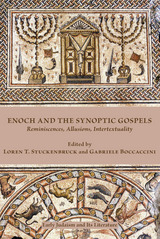
Since Richard Laurence published the first English translation of 1 Enoch in 1821, its importance for an understanding of early Christianity has been generally recognized. The present volume is the first book of essays contributed by international specialists in Second Temple Judaism devoted to the significance of traditions found in 1 Enoch for the interpretation of the Synoptic Gospels in the New Testament. Areas covered by the contributions include demonology, Christology, angelology, cosmology, birth narratives, forgiveness of sins, veneration, wisdom, and priestly tradition. The contributors are Joseph L. Angel, Daniel Assefa, Leslie Baynes, Gabriele Boccaccini, Kelley Coblentz Bautch, Henryk Drawnel, André Gagné, Lester L. Grabbe, Daniel M. Gurtner, Andrei A. Orlov, Anders Klostergaard Petersen, Amy E. Richter, Loren T. Stuckenbruck, Benjamin Wold, and Archie T. Wright.
Features:
- Multiple approaches to thinking about the relationship between 1 Enoch and the Synoptic Gospels
- Exploration of the common socio-cultural and religious framework within which the traditions concerning Enoch and Jesus developed
- Articles presented at the Seventh Enoch Seminar in 2013
Enter the world of an academic trailblazer
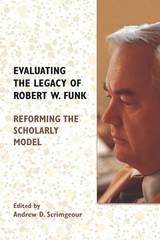
Robert W. Funk, professor of New Testament, former Executive Secretary of the Society of Biblical Literature, and founder of Scholars Press and the Jesus Seminar, was one of the most gifted, controversial figures in modern biblical scholarship. The volume includes nineteen of his essays, correspondences, interviews, and administrative papers pertaining to the Society of Biblical Literature and Scholars Press. Colleagues introduce each section with reflections on the life and contributions of Funk.
Features:
- Evaluation of the changes to scholarly societies and to scholarly research that Funk advocated
- Exploration of the shift in the interpretation of Jesus’s parables initiated by Funk
- Previously unpublished writings
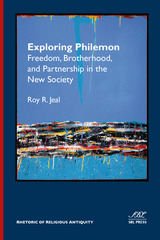
A new, sociorhetorical interpretation of the Letter to Philemon
Exploring Philemon shows how this letter entered the world of the ancient Mediterranean and the early church with a dramatic and powerful rhetorical force by analyzing the range of textures interwoven with each other to produce a profound effect on an early Christian (Philemon) and on the church that met in his home. It demonstrates that many striking and subtle features work together to present a rhetorical argument that the new Christian society must be one of freedom, brotherhood, and partnership not just for the powerful, but for all.
Features:
- An analysis of the visual imagery of the letter
- Application of up-to-date rhetorical, sensory-aesthetic, and intertextual interpretive methods
- Use of Social and cultural, ideological, and theological strategies

A multi-faceted commentary that breathes fresh insight into Paul's letter
In Second Corinthians, Paul responds to reports of the Corinthian congregation questioning his competency as a divinely sent messenger. Through apologetic demegoria and the use of graphic imagery related to triumphal processions, siege warfare, and emissary travels and negotiation, Paul defends his constancy, persona, and speaking abilities as he extends the offer of clemency and reconciliation to his auditors. Oropeza combines rhetorical pictures (rhetography) with interpretative layers (literary features, intertextuality, socio-cultural, ideological, and sacred textures) to arrive at the rhetorical impact of Paul's message for ancient Mediterranean discourse.
Features:- A visual, sensory, and imaginative interpretation of the scripture
- A comprehensive commentary
- An avant-garde approach to biblical interpretation
READERS
Browse our collection.
PUBLISHERS
See BiblioVault's publisher services.
STUDENT SERVICES
Files for college accessibility offices.
RECENTLY PUBLISHED




UChicago Accessibility Resources
home | accessibility | search | about | contact us
BiblioVault ® 2001 - 2026
The University of Chicago Press