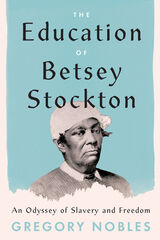
front cover of The Education of Betsey Stockton
The Education of Betsey Stockton
An Odyssey of Slavery and Freedom
Gregory Nobles
University of Chicago Press, 2022
A perceptive and inspiring biography of an extraordinary woman born into slavery who, through grit and determination, became a historic social and educational leader.
                          
The life of Betsey Stockton (ca. 1798–1865) is a remarkable story of a Black woman’s journey from slavery to emancipation, from antebellum New Jersey to the Hawai‘ian Islands, and from her own self-education to a lifetime of teaching others—all told against the backdrop of the early United States’ pervasive racism. It’s a compelling chronicle of a critical time in American history and a testament to the courage and commitment of a woman whose persistence grew into a potent form of resistance.

When Betsey Stockton was a child, she was “given, as a slave” to the household of Rev. Ashbel Green, a prominent pastor and later the president of what is now Princeton University. Although she never went to school, she devoured the books in Green’s library. After being emancipated, she used that education to benefit other people of color, first in Hawai‘i as a missionary, then Philadelphia, and, for the last three decades of her life, Princeton—a college town with a genteel veneer that never fully hid its racial hostility. Betsey Stockton became a revered figure in Princeton’s sizeable Black population, a founder of religious and educational institutions, and a leader engaged in the day-to-day business of building communities.

In this first book-length telling of Betsey Stockton’s story, Gregory Nobles illuminates both a woman and her world, following her around the globe, and showing how a determined individual could challenge her society’s racial obstacles from the ground up. It’s at once a revealing lesson on the struggles of Stockton’s times and a fresh inspiration for our own.
[more]


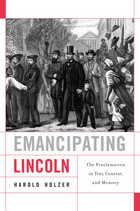
front cover of Emancipating Lincoln
Emancipating Lincoln
The Proclamation in Text, Context, and Memory
Harold Holzer
Harvard University Press, 2012

Emancipating Lincoln seeks a new approach to the Emancipation Proclamation, a foundational text of American liberty that in recent years has been subject to woeful misinterpretation. These seventeen hundred words are Lincoln’s most important piece of writing, responsible both for his being hailed as the Great Emancipator and for his being pilloried by those who consider his once-radical effort at emancipation insufficient and half-hearted.

Harold Holzer, an award-winning Lincoln scholar, invites us to examine the impact of Lincoln’s momentous announcement at the moment of its creation, and then as its meaning has changed over time. Using neglected original sources, Holzer uncovers Lincoln’s very modern manipulation of the media—from his promulgation of disinformation to the ways he variously withheld, leaked, and promoted the Proclamation—in order to make his society-altering announcement palatable to America. Examining his agonizing revisions, we learn why a peerless prose writer executed what he regarded as his “greatest act” in leaden language. Turning from word to image, we see the complex responses in American sculpture, painting, and illustration across the past century and a half, as artists sought to criticize, lionize, and profit from Lincoln’s endeavor.

Holzer shows the faults in applying our own standards to Lincoln’s efforts, but also demonstrates how Lincoln’s obfuscations made it nearly impossible to discern his true motives. As we approach the 150th anniversary of the Proclamation, this concise volume is a vivid depiction of the painfully slow march of all Americans—white and black, leaders and constituents—toward freedom.

[more]


Send via email Share on Facebook Share on Twitter