
 A SCHOLARLY BOOK REPOSITORY
164 books about Social Theory and 10
start with E
164 books about Social Theory and 10
164 books about Social Theory
10 start with E start with E
10 start with E start with E
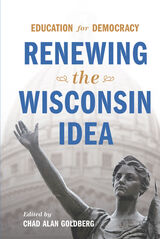
Education for Democracy
Renewing the Wisconsin Idea
Edited by Chad Alan Goldberg
University of Wisconsin Press, 2020
American public universities were founded in a civic tradition that differentiated them from their European predecessors—steering away from the pursuit of knowledge for its own sake. Like many such higher education institutions across the United States, the University of Wisconsin’s mission, known as the Wisconsin Idea, emphasizes a responsibility to serve the needs of the state and its people. This commitment, which necessarily requires a pledge to academic freedom, has recently been openly threatened by state and federal actors seeking to dismantle a democratic and expansive conception of public service.
Using the Wisconsin Idea as a lens, Education for Democracy argues that public higher education institutions remain a bastion of collaborative problem solving. Examinations of partnerships between the state university and people of the state highlight many crucial and lasting contributions to issues of broad public concern such as conservation, LGBTQ+ rights, and poverty alleviation. The contributors restore the value of state universities and humanities education as a public good, contending that they deserve renewed and robust support.
Using the Wisconsin Idea as a lens, Education for Democracy argues that public higher education institutions remain a bastion of collaborative problem solving. Examinations of partnerships between the state university and people of the state highlight many crucial and lasting contributions to issues of broad public concern such as conservation, LGBTQ+ rights, and poverty alleviation. The contributors restore the value of state universities and humanities education as a public good, contending that they deserve renewed and robust support.
[more]

Emergency
COVID-19 and the Uneven Valuation of Life
Claire Laurier Decoteau
University of Chicago Press, 2024
A forceful critique of how and why states failed to protect marginalized communities in their responses to the COVID-19 pandemic and the implications of ignoring the existing emergencies that exacerbated the pandemic’s devastating effects.
The COVID-19 pandemic inaugurated a state of emergency unprecedented for most Americans. Some could observe this emergency from the relative safety of their homes, but those in marginalized communities, without access to the same privileges, were forced to risk their health and well-being.
In Emergency, sociologist Claire Laurier Decoteau documents and theorizes the emergencies of COVID-19 by looking at the experiences of Chicagoans and the policies that shaped their lives. She describes the uneven racial impact of COVID-19 on Black and Latinx Chicagoans as a crisis within a crisis, caused by a convergence of emergencies: a state of emergency that protected white supremacy and wealth, the slow emergencies racially marginalized populations have faced for decades due to the long-term gutting of care infrastructure and deindustrialization, and the sacrifice “essential workers” were asked to make to protect the United States economy. As Decoteau shows, the city’s “racial equity” project used data to determine which communities would be given scarce resources, but once positivity or death rates declined, resources were retracted and redistributed elsewhere. City officials thus attempted to manage these converging emergencies by manipulating epidemiological data and orchestrating systems for interpreting that data. Decoteau makes clear that the emergencies precipitated by COVID-19 long predated the pandemic, and that we will continue to live with their compounding crises if we do not tackle their structural underpinnings.
The COVID-19 pandemic inaugurated a state of emergency unprecedented for most Americans. Some could observe this emergency from the relative safety of their homes, but those in marginalized communities, without access to the same privileges, were forced to risk their health and well-being.
In Emergency, sociologist Claire Laurier Decoteau documents and theorizes the emergencies of COVID-19 by looking at the experiences of Chicagoans and the policies that shaped their lives. She describes the uneven racial impact of COVID-19 on Black and Latinx Chicagoans as a crisis within a crisis, caused by a convergence of emergencies: a state of emergency that protected white supremacy and wealth, the slow emergencies racially marginalized populations have faced for decades due to the long-term gutting of care infrastructure and deindustrialization, and the sacrifice “essential workers” were asked to make to protect the United States economy. As Decoteau shows, the city’s “racial equity” project used data to determine which communities would be given scarce resources, but once positivity or death rates declined, resources were retracted and redistributed elsewhere. City officials thus attempted to manage these converging emergencies by manipulating epidemiological data and orchestrating systems for interpreting that data. Decoteau makes clear that the emergencies precipitated by COVID-19 long predated the pandemic, and that we will continue to live with their compounding crises if we do not tackle their structural underpinnings.
[more]
Emergency
Reading the Popol Vuh in a Time of Crisis
Edgar Garcia
University of Chicago Press, 2022
Nine short essays exploring the K’iche’ Maya story of creation, the Popol Vuh.
Written during the lockdown in Chicago in the depths of the COVID-19 pandemic, these essays consider the Popol Vuh as a work that was also written during a time of feverish social, political, and epidemiological crisis as Spanish missionaries and colonial military deepened their conquest of indigenous peoples and cultures in Mesoamerica. What separates the Popol Vuh from many other creation texts is the disposition of the gods engaged in creation. Whereas the book of Genesis is declarative in telling the story of the world’s creation, the Popol Vuh is interrogative and analytical: the gods, for example, question whether people actually need to be created, given the many perfect animals they have already placed on earth.
Emergency uses the historical emergency of the Popol Vuh to frame the ongoing emergencies of colonialism that have surfaced all too clearly in the global health crisis of COVID-19. In doing so, these essays reveal how the authors of the Popol Vuh—while implicated in deep social crisis—nonetheless insisted on transforming emergency into scenes of social, political, and intellectual emergence, translating crisis into creativity and world creation.
Written during the lockdown in Chicago in the depths of the COVID-19 pandemic, these essays consider the Popol Vuh as a work that was also written during a time of feverish social, political, and epidemiological crisis as Spanish missionaries and colonial military deepened their conquest of indigenous peoples and cultures in Mesoamerica. What separates the Popol Vuh from many other creation texts is the disposition of the gods engaged in creation. Whereas the book of Genesis is declarative in telling the story of the world’s creation, the Popol Vuh is interrogative and analytical: the gods, for example, question whether people actually need to be created, given the many perfect animals they have already placed on earth.
Emergency uses the historical emergency of the Popol Vuh to frame the ongoing emergencies of colonialism that have surfaced all too clearly in the global health crisis of COVID-19. In doing so, these essays reveal how the authors of the Popol Vuh—while implicated in deep social crisis—nonetheless insisted on transforming emergency into scenes of social, political, and intellectual emergence, translating crisis into creativity and world creation.
[more]

Engaging Mbembe
Sindre Bandstad and Bjørn Enge Bertelsen, editors. Foreword by Arjun Appadurai.
Duke University Press, 2027
Equaliberty
Political Essays
Étienne Balibar
Duke University Press, 2014
First published in French in 2010, Equaliberty brings together essays by Étienne Balibar, one of the preeminent political theorists of our time. The book is organized around equaliberty, a term coined by Balibar to connote the tension between the two ideals of modern democracy: equality (social rights and political representation) and liberty (the freedom citizens have to contest the social contract). He finds the tension between these different kinds of rights to be ingrained in the constitution of the modern nation-state and the contemporary welfare state. At the same time, he seeks to keep rights discourse open, eschewing natural entitlements in favor of a deterritorialized citizenship that could be expanded and invented anew in the age of globalization. Deeply engaged with other thinkers, including Arendt, Rancière, and Laclau, he posits a theory of the polity based on social relations. In Equaliberty Balibar brings both the continental and analytic philosophical traditions to bear on the conflicted relations between humanity and citizenship.
[more]
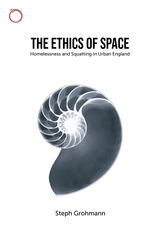
The Ethics of Space
Homelessness and Squatting in Urban England
Steph Grohmann
HAU, 2020
Across the Western world, full membership of society is established through entitlements to space and formalized in the institutions of property and citizenship. Those without such entitlements are deemed less than fully human as they struggle to find a place where they can symbolically and physically exist. Written by an anthropologist who accidentally found herself homeless, The Ethics of Space is an unprecedented account of what happens when homeless people organize to occupy abandoned properties.
Set against the backdrop of economic crisis, austerity, and a disintegrating British state, Steph Grohmann tells the story of a flourishing squatter community in the city of Bristol and how it was eventually outlawed by the state. The first ethnography of homelessness done by a researcher who was formally homeless throughout fieldwork, this volume explores the intersection between spatial existence, subjectivity, and ethics. The result is a book that rethinks how ethical views are shaped and constructed through our own spatial existences.
Set against the backdrop of economic crisis, austerity, and a disintegrating British state, Steph Grohmann tells the story of a flourishing squatter community in the city of Bristol and how it was eventually outlawed by the state. The first ethnography of homelessness done by a researcher who was formally homeless throughout fieldwork, this volume explores the intersection between spatial existence, subjectivity, and ethics. The result is a book that rethinks how ethical views are shaped and constructed through our own spatial existences.
[more]

Evacuation
The Politics and Aesthetics of Movement in Emergency
Peter Adey
Duke University Press, 2024
In Evacuation, Peter Adey examines the politics, aesthetics, and practice of moving people and animals from harm during emergencies. He outlines how the governance and design of evacuation are recursive, operating on myriad political, symbolic, and affective levels in ways that reflect and reinforce social hierarchies. Drawing on a wide range of case studies, from the retrieval of wounded soldiers from the battlefield during World War I and escaping the World Trade Center on 9/11 to the human and animal evacuations in response to the 2009 Australian bushfires and the 2010 Haiti earthquake, Adey demonstrates that evacuation is not an equal process. Some people may choose not to move while others are forced; some may even be brought into harm through evacuation. Often the poorest, racialized, and most marginalized communities hold the least power in such moments. At the same time, these communities can generate compassionate, creative, and democratic forms of care that offer alternative responses to crises. Ultimately, Adey contends, understanding the practice of evacuation illuminates its importance to power relations and everyday governance.
[more]

Experienced Life and Narrated Life Story
Gestalt and Structure of Biographical Self-Presentations
Gabriele Rosenthal
Campus Verlag, 2024
A new edition of sociologist Gabriele Rosenthal’s classic 1995 work on phenomenology and Gestalt theory.
How do people narrate events in their life stories and the history of their family or families? How are narratives and experiences in the present related to experiences and narratives in the past? In this foundational work by sociologist Gabriele Rosenthal, he answers these questions with a theoretical and empirical study of the interconnections between remembering, experiencing, and presenting what was experienced at different points of the life course and of the associated collective histories. He also discusses rules for conducting interviews that support processes of remembering and for carrying out an analysis that does justice to this dialectic.
This edition contains a new introduction and a new chapter that explores the later expansion of Rosenthal’s approach to sociological biographical research, reflecting the inspiration she took from the figurational sociology of Norbert Elias. With its analysis of the complex relationships between experiencing, remembering, and presenting, Experienced Life and Narrated Life Story makes an important contribution to the theoretical foundations of biographical research.
How do people narrate events in their life stories and the history of their family or families? How are narratives and experiences in the present related to experiences and narratives in the past? In this foundational work by sociologist Gabriele Rosenthal, he answers these questions with a theoretical and empirical study of the interconnections between remembering, experiencing, and presenting what was experienced at different points of the life course and of the associated collective histories. He also discusses rules for conducting interviews that support processes of remembering and for carrying out an analysis that does justice to this dialectic.
This edition contains a new introduction and a new chapter that explores the later expansion of Rosenthal’s approach to sociological biographical research, reflecting the inspiration she took from the figurational sociology of Norbert Elias. With its analysis of the complex relationships between experiencing, remembering, and presenting, Experienced Life and Narrated Life Story makes an important contribution to the theoretical foundations of biographical research.
[more]
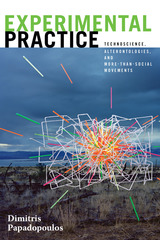
Experimental Practice
Technoscience, Alterontologies, and More-Than-Social Movements
Dimitris Papadopoulos
Duke University Press, 2018
In Experimental Practice Dimitris Papadopoulos explores the potential for building new forms of political and social movements through the reconfiguration of the material conditions of existence. Rather than targeting existing institutions in demands for social justice, Papadopoulos calls for the creation of alternative ontologies of everyday life that would transform the meanings of politics and justice. Inextricably linked to technoscience, these “alterontologies”—which Papadopoulos examines in a variety of contexts, from AIDS activism and the financialization of life to hacker communities and neuroscience—form the basis of ways of life that would embrace the more-than-social interdependence of the human and nonhuman worlds. Speaking to a matrix of concerns about politics and justice, social movements, matter and ontology, everyday practice, technoscience, the production of knowledge, and the human and nonhuman, Papadopoulos suggests that the development of alterontologies would create more efficacious political and social organizing.
[more]

Explaining Modern Social Reality
The Basic Concepts in Norbert Elias’s Figurational Sociology
Kire Sharlamanov
Central European University Press, 2026
Few thinkers have shaped our understanding of modern civilization as profoundly as Norbert Elias. This book offers an accessible introduction to his major ideas, presenting his complex concepts in a clear and engaging way. Through a biographical account of Elias’s life (1897–1990), the book situates his thought within the historical and intellectual context that shaped it.
At the center of the discussion is Elias’s landmark work, The Civilizing Process, with particular attention to class structures, changing patterns of behavior, and the development of the modern state. The book also explores figurational sociology, one of Elias’s most influential contributions to social theory.
An innovative and original thinker, Elias challenged established concepts and introduced new analytical tools, including the influential notion of habitus. The chapters examine his theory of knowledge, his reflections on violence and de-civilization, his analyses of nations and nationalism, and his work on emotions and shame. The book further traces Elias’s dialogue with major thinkers such as Edmund Husserl, Karl Mannheim, Max Weber, Sigmund Freud, and Talcott Parsons, showing how he reinterpreted their ideas in distinctive ways. The book concludes with an overview of the most important critiques of Elias’s work and its continuing relevance today.
At the center of the discussion is Elias’s landmark work, The Civilizing Process, with particular attention to class structures, changing patterns of behavior, and the development of the modern state. The book also explores figurational sociology, one of Elias’s most influential contributions to social theory.
An innovative and original thinker, Elias challenged established concepts and introduced new analytical tools, including the influential notion of habitus. The chapters examine his theory of knowledge, his reflections on violence and de-civilization, his analyses of nations and nationalism, and his work on emotions and shame. The book further traces Elias’s dialogue with major thinkers such as Edmund Husserl, Karl Mannheim, Max Weber, Sigmund Freud, and Talcott Parsons, showing how he reinterpreted their ideas in distinctive ways. The book concludes with an overview of the most important critiques of Elias’s work and its continuing relevance today.
[more]
READERS
Browse our collection.
PUBLISHERS
See BiblioVault's publisher services.
STUDENT SERVICES
Files for college accessibility offices.
RECENTLY PUBLISHED



UChicago Accessibility Resources
home | accessibility | search | about | contact us
BiblioVault ® 2001 - 2026
The University of Chicago Press