front cover of The Echoes of L'Arbre Croche
The Echoes of L'Arbre Croche
Donald A. Johnston
University of Michigan Press, 2009

The year is 1915, and Benjamin Corvet, founder of the ship-owning firm Corvet, Sherrill and Spearman, suddenly disappears, sparking events and questions that baffle even those who are close to him.

Constance Sherrill, an attractive, sheltered young woman, feels strangely responsible for what may have happened to him---her father's best friend and coworker. Alan Conrad arrives in Chicago searching for his identity and an unknown benefactor and is swept into a maelstrom of mystery and intrigue that tests his intelligence and athleticism to the fullest. Henry Spearman, the firm's junior partner, is the most eligible bachelor along Chicago's Lake Shore Drive as a result of his catapult from ships' ranks to successful owner.

When a ship sinks off the coast of Beaver Island in Michigan, the intertwining lives of these characters unlock the mystery of the disappearance of another ship twenty years earlier, in a riveting whodunit set on the stormy waters of the Great Lakes.

Donald A. Johnston was born and raised in Detroit, served in World War II as a U.S. Navy Reserve officer, and was decorated for service in the Philippines and in the invasions of Iwo Jima and Okinawa. His career includes forty years in the insurance business. An ardent sailing enthusiast, he has cruised the Great Lakes extensively and has sailed winners in class boats and in offshore competition.

Jacket photograph © Yuriz / iStockphoto.com

[more]

logo for The Institution of Engineering and Technology
The Electric Car
Development and future of battery, hybrid and fuel-cell cars
Mike H. Westbrook
The Institution of Engineering and Technology, 2001
This book covers the development of electric cars from their early days to pure electric, fuel-cell and new hybrid models in production. It covers the latest technological issues faced by automotive engineers working on electric cars, including charging, infrastructure, safety and costs, as well as making predictions about future developments and vehicle numbers. Considerable work has gone into electric car and battery development in the last ten years, with the prospect of substantial improvements in range and performance in battery cars as well as in hybrids and those using fuel cells. The book comprehensively covers this important subject and will be of particular interest to engineers working on electric vehicle design, development and use, as well as managers interested in the key business factors vital for the successful transfer of electric cars into the mass market.
[more]

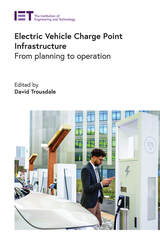
front cover of Electric Vehicle Charge Point Infrastructure
Electric Vehicle Charge Point Infrastructure
From planning to operation
David Trousdale
The Institution of Engineering and Technology, 2025
The use of electric vehicles (EVs) is a topic of great importance, given the continued drive towards net zero and the phase out of the sale of new petrol and diesel vehicles. However, a key concern is the need to install enough charge point infrastructure to grow in tandem with increasing EV adoption. Lack of EV charge point infrastructure and range anxiety are often cited as barriers to EV uptake. Therefore, a closer look is needed to understand how to model and build suitable EV charge point infrastructure, and how this can contribute to the broader aim of decarbonising transport.
[more]

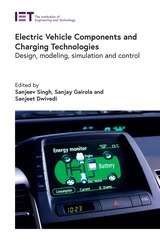
front cover of Electric Vehicle Components and Charging Technologies
Electric Vehicle Components and Charging Technologies
Design, modeling, simulation and control
Sanjeev Singh
The Institution of Engineering and Technology, 2024
In order to create a reliable, safe and cost-effective electric vehicle with acceptable range, battery charging time, battery life and driving performance, it is important to design optimised and compatible components and charging systems.
[more]

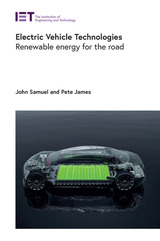
front cover of Electric Vehicle Technologies
Electric Vehicle Technologies
Renewable energy for the road
John Samuel
The Institution of Engineering and Technology, 2025
Electric Vehicle Technologies: Renewable energy for the road traces electric vehicle technology from its beginnings through the current state-of-the-art and onwards to future possibilities. Bringing together insights from technical and commercial perspectives, this book is collated and written by two experts - one a pioneer in the field of EV whose career spans decades of design and development, the other a highly experienced technical specialist in EV drive system and megawatt rapid charge system design.
[more]

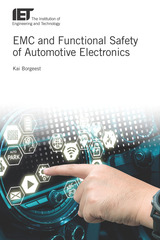
front cover of EMC and Functional Safety of Automotive Electronics
EMC and Functional Safety of Automotive Electronics
Kai Borgeest
The Institution of Engineering and Technology, 2018
Electromagnetic compatibility (EMC) deals with the unintentional propagation and reception of electromagnetic energy which may cause disturbances or even physical damage in electronic or electromechanical systems. With the increase in number and density of electronic devices and systems in modern vehicles, EMC has become a substantial concern and a key cause of malfunction of automotive electronics.
[more]

front cover of Energy Systems for Electric and Hybrid Vehicles
Energy Systems for Electric and Hybrid Vehicles
K.T. Chau
The Institution of Engineering and Technology, 2016
Electric and hybrid vehicles have been globally identified to be the most environmental friendly road transportation. Energy Systems for Electric and Hybrid Vehicles provides comprehensive coverage of the three main energy system technologies of these vehicles - energy sources, battery charging and vehicle-to-grid systems.
[more]

front cover of Engines of Rebellion
Engines of Rebellion
Confederate Ironclads and Steam Engineering in the American Civil War
Saxon T. Bisbee
University of Alabama Press, 2018
A challenge to the prevailing idea that Confederate ironclads were inherently defective
 
The development of steam propulsion machinery in warships during the nineteenth century, in conjunction with iron armor and shell guns, resulted in a technological revolution in the world’s navies. Warships utilizing all of these technologies were built in France and Great Britain in the 1850s, but it was during the American Civil War that large numbers of ironclads powered solely by steam proved themselves to be quite capable warships.  
 
Historians have given little attention to the engineering of Confederate ironclads, although the Confederacy was often quite creative in building and obtaining marine power plants. Engines of Rebellion: Confederate Ironclads and Steam Engineering in the American Civil War focuses exclusively on ships with American built machinery, offering a detailed look at marine steam-engineering practices in both northern and southern industry prior to and during the Civil War.
 
Beginning with a contextual naval history of the Civil War, the creation of the ironclad program, and the advent of various technologies, Saxon T. Bisbee analyzes the armored warships built by the Confederate States of America that represented a style adapted to scarce industrial resources and facilities. This unique historical and archaeological investigation consolidates and expands on the scattered existing information about Confederate ironclad steam engines, boilers, and propulsion systems.
 
Through analysis of steam machinery development during the Civil War, Bisbee assesses steam plants of twenty-seven ironclads by source, type, and performance, among other factors. The wartime role of each vessel is discussed, as well as the stories of the people and establishments that contributed to its completion and operation. Rare engineering diagrams never before published or gathered in one place are included here as a complement to the text.
[more]

front cover of English Electric Canberra
English Electric Canberra
Mick Gladwin
Amsterdam University Press, 2023
From 1949 to 2006 the English Electric Canberra has served in the frontline of the Royal Air Force around the world. The Canberra became the UK's first jet bomber, although that was not its only role, undertaking other tasks such as, pilot/navigator training, photographic reconnaissance, target-tag and electronic countermeasures duties to name a few.

The story of the Canberra came to a close for the RAF on the 22nd June 2006 when the last remaining Canberra PR.9s retiring from service life after returning from operational duties. The author had the honour to serve with them in their twilight days of their careers.
[more]

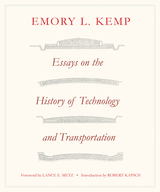
front cover of Essays on the History of Transportation and Technology
Essays on the History of Transportation and Technology
EMORY L. KEMP
West Virginia University Press, 2014

Emory Kemp is the founder and director of the Institute for the History of Technology and Industrial Archaeology at West Virginia University, where he also served as a chair and professor of civil engineering and a professor of history. This collection of essays encompasses over fifty years of his research in the field of the history of technology.

Within these twelve essays, Kemp describes and analyzes nineteenth century improvements in building materials such as iron, steel, and cement; roads and bridges, especially the evolution of the suspension bridge; canals and navigable rivers, including the Ohio River and its tributaries; and water supply systems. As one of the few practicing American engineers who also researches and writes as an academic, Kemp adds an important historical context to his work by focusing not only on the construction of a structure but also on the analytical science that heralds a structure’s design and development.
[more]

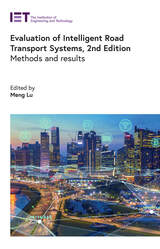
front cover of Evaluation of Intelligent Road Transport Systems
Evaluation of Intelligent Road Transport Systems
Methods and results
Meng Lu
The Institution of Engineering and Technology, 2024
Intelligent transport systems (ITS) use ICT to deliver transport system improvements as an alternative to expanding physical infrastructure, thereby saving on investments and reducing environmental impact. ITS applications contribute to cleaner and safer transport, enhance economic growth, and hold the promise for sustainable mobility solutions for a future flourishing society.
[more]

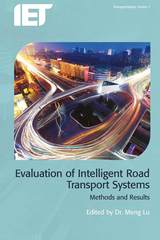
front cover of Evaluation of Intelligent Road Transport Systems
Evaluation of Intelligent Road Transport Systems
Methods and results
Meng Lu
The Institution of Engineering and Technology, 2016
Intelligent Transport Systems (ITS) use information and communications technologies (ICT) to deliver transport improvements instead of extending physical infrastructure, thereby saving money and reducing environmental impact. This book provides an overview of ICT-based intelligent road transport systems with an emphasis on evaluation methods and recent evaluation results of ITS development and deployment. Topics covered include: ITS evaluation policy; frameworks and methods for ITS evaluation; ITS impact evaluation; the network perspective; field operational tests (FOTs); assessing transport measures using cost-benefit and multicriteria analysis; technical assessment of the performance of in-vehicle systems; opportunities and challenges in the era of new pervasive technology; evaluation of automated driving functions; user-related evaluation of ADAS (Advanced Driver Assistance Systems) and automated driving; evaluation of traffic management; performance assessment of a wet weather pilot system; case studies from China; heavy vehicle overload control benefit and cost. With chapters from an international panel of leading experts, this book is essential reading for researchers and advanced students from academia, industry and government working in intelligent road transport systems.
[more]


Send via email Share on Facebook Share on Twitter