
 A SCHOLARLY BOOK REPOSITORY
10 start with E start with E

Each year, hundreds of thousands of high school seniors compete in a game they’ll play only once, whose rules they do not fully understand, yet whose consequences are enormous. The game is college admissions, and applying early to an elite school is one way to win. But the early admissions process is enigmatic and flawed. It can easily lead students toward hasty or misinformed decisions.
This book—based on the careful examination of more than 500,000 college applications to fourteen elite colleges and hundreds of interviews with students, counselors, and admissions officers—provides an extraordinarily thorough analysis of early admissions. In clear language it details the advantages and pitfalls of applying early as it provides a map for students and parents to navigate the process. Unlike college admissions guides, The Early Admissions Game reveals the realities of early applications, how they work and what effects they have. The authors frankly assess early applications. Applying early is not for everyone, but it will improve—sometimes double, even triple—the chances of being admitted to a prestigious college.
An early decision program can greatly enhance a college’s reputation by skewing statistics, such as selectivity, average SAT scores, or percentage of admitted applicants who matriculate. But these gains come at the expense of distorting applicants’ decisions and providing disparate treatment of students who apply early and regular admissions. The system, in short, is unfair, and the authors make recommendations for improvement.
The Early Admissions Game is sure to be the definitive work on the subject. It is must reading for admissions officers, guidance counselors, and high school seniors and their parents.

Drawing on case studies of leading schools of education, the authors offer a bold, controversial agenda for reform: ed schools must reorient themselves toward teachers and away from the quest for prestige in academe; they must also adhere to national professional standards, abandon the undergraduate education major, and reject the Ph.D. in education in favor of the Ed.D.

A former third-grade teacher in rural Tennessee, education researcher Mara Casey Tieken watched as her former students graduated high school. She was shocked at how few were heading to college—and none were going to elite four-year schools. These students were representative of a larger national phenomenon: In 2021, 31 percent of rural adults aged twenty-five and older held a postsecondary degree, compared to 45 percent of urban adults, and rural students are especially unlikely to pursue degrees from private, selective schools. Why, Tieken wondered? And what happens to the handful of rural students who do attend elite colleges, colleges that may feel worlds away from home?
Tieken addresses these questions in Educated Out—a study that shows how geography shapes rural, first-generation students’ access to college, their college experiences, and their postgraduation plans and opportunities. Tieken closely follows a group of nine students for their college years and beyond at an elite New England private school that she calls Hilltop. Interviews with these students reveal the critical moments in the students’ educational careers when their rural origins mattered most: when applying to college, she shows how students are hindered by limited college counseling resources. Once on campus, they learn that many of the school’s opportunities are not available to them: they cannot access spring break trips, job networks, or low-pay-but-important internships. These students discover that home and college are very different worlds with different academic, social, and political climates—and, over time, they start to question both. As they near graduation and navigate a job market in which the highest-paying and most prestigious opportunities are located in urban centers, they begin to feel the complicated burden of their schooling: they’ve been “educated out.” Their stories show the costs of college for rural students: If they do not pursue higher education, they lose the opportunity for social mobility; if they do, they face a more permanent departure. These costs are individual, but rural families and communities also suffer—they lose young people with talent and skills.
In addition to advocating for a higher education landscape that truly includes rural students, Tieken critiques a system that requires people to leave their rural homes in search of opportunities. Our current economy depends on inexpensive rural labor. Without meaningful change, some students will have to make the impossible decision to leave home—and far more will remain there, undereducated and overlooked.
Both engaging and accessible, Educated Out presents important and timely questions about rurality, identity, education, and inequality.
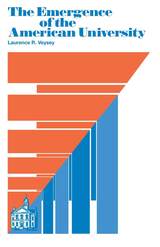
What did the men living in this formative period want the American university to become? How did they differ in defining the ideal university? And why did the institution acquire a form that only partially corresponded with these definitions? These are the questions Mr. Veysey seeks to answer.

Drawing on rich materials gathered from in-depth field research in China during the Xi Jinping era, Engineering Stability invites scholars of comparative politics, state theory, contentious politics, and political development to rethink and reimagine how what Yan calls “a compromised autocratic state” is rebuilt within and from itself after overcoming a traumatic moment of vulnerability. The book further details the four types of infrastructure — institutional, significative, regulatory, and incentivizing — that state rebuilders need to overhaul, and looks into the campaign of state rebuilding in post-Tiananmen Chinese universities and its implications for our understanding of politics in general.

Envisioning Brazil is a comprehensive and sweeping assessment of Brazilian studies in the United States. Focusing on synthesis and interpretation and assessing trends and perspectives, this reference work provides an overview of the writings on Brazil by United States scholars since 1945.
"The Development of Brazilian Studies in the United States," provides an overview of Brazilian Studies in North American universities. "Perspectives from the Disciplines" surveys the various academic disciplines that cultivate Brazilian studies: Portuguese language studies, Brazilian literature, art, music, history, anthropology, Amazonian ethnology, economics, politics, and sociology. "Counterpoints: Brazilian Studies in Britain and France" places the contributions of U.S. scholars in an international perspective. "Bibliographic and Reference Sources" offers a chronology of key publications, an essay on the impact of the digital age on Brazilian sources, and a selective bibliography.
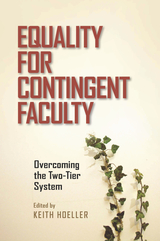
Equality for Contingent Faculty brings together eleven activists from the United States and Canada to describe the problem, share case histories, and offer concrete solutions. The book begins with three accounts of successful organizing efforts within the two-track system. The second part describes how the two-track system divides the faculty into haves and have-nots and leaves the majority without the benefit of academic freedom or the support of their institutions. The third part offers roadmaps for overcoming the deficiencies of the two-track system and providing equality for all professors, regardless of status or rank.
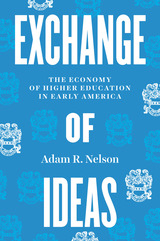
Exchange of Ideas launches a breathtakingly ambitious new economic history of American higher education. In this volume, Adam R. Nelson focuses on the early republic, explaining how knowledge itself became a commodity, as useful ideas became salable goods and American colleges were drawn into transatlantic commercial relations. American scholars might once have imagined that higher education could sit beyond the sphere of market activity—that intellectual exchange could transcend vulgar consumerism—but already by the end of the eighteenth century, they saw how ideas could be factored into the nation’s balance of trade. Moreover, they concluded that it was the function of colleges to oversee the complex process whereby knowledge could be priced and purchased. The history of capitalism and the history of higher education, Nelson reveals, are intimately intertwined—which raises a host of important and strikingly urgent questions. How do we understand knowledge and education as commercial goods? Who should pay for them? And, fundamentally, what is the optimal system of higher education in a capitalist democracy?
READERS
Browse our collection.
PUBLISHERS
See BiblioVault's publisher services.
STUDENT SERVICES
Files for college accessibility offices.
RECENTLY PUBLISHED





UChicago Accessibility Resources
home | accessibility | search | about | contact us
BiblioVault ® 2001 - 2025
The University of Chicago Press