
 A SCHOLARLY BOOK REPOSITORY
541 start with F start with F

Frontiers of Possession asks how territorial borders were established in Europe and the Americas during the early modern period and challenges the standard view that national boundaries are largely determined by military conflicts and treaties. Focusing on Spanish and Portuguese claims in the New and Old Worlds, Tamar Herzog reconstructs the different ways land rights were negotiated and enforced, sometimes violently, among people who remembered old possessions or envisioned new ones: farmers and nobles, clergymen and missionaries, settlers and indigenous peoples.
Questioning the habitual narrative that sees the Americas as a logical extension of the Old World, Herzog portrays Spain and Portugal on both sides of the Atlantic as one unified imperial space. She begins in the Americas, where Iberian conquerors had to decide who could settle the land, who could harvest fruit and cut timber, and who had river rights for travel and trade. The presence of indigenous peoples as enemies to vanquish or allies to befriend, along with the vastness of the land, complicated the picture, as did the promise of unlimited wealth. In Europe, meanwhile, the formation and re-formation of boundaries could last centuries, as ancient entitlements clashed with evolving economic conditions and changing political views and juridical doctrines regarding how land could be acquired and maintained.
Herzog demonstrates that the same fundamental questions had to be addressed in Europe and in the Americas. Territorial control was always subject to negotiation, as neighbors and outsiders, in their quotidian interactions, carved out and defended new frontiers of possession.


The Frontline presents a selection of essays drawn together for the first time to form a companion volume to Serhii Plokhy’s The Gates of Europe and Chernobyl. Here he expands upon his analysis in earlier works of key events in Ukrainian history, including Ukraine’s complex relations with Russia and the West, the burden of tragedies such as the Holodomor and World War II, the impact of the Chernobyl nuclear disaster, and Ukraine’s contribution to the collapse of the Soviet Union.
Juxtaposing Ukraine’s history to the contemporary politics of memory, this volume provides a multidimensional image of a country that continues to make headlines around the world. Eloquent in style and comprehensive in approach, the essays collected here reveal the roots of the ongoing political, cultural, and military conflict in Ukraine, the largest country in Europe.

This is a study of a man who was the presiding genius of Latin letters in the second century, the leading orator and lawyer of his day, a prominent senator and consul, the close friend of four emperors and the teacher of two, including the philosopher-emperor Marcus Aurelius. It is a history that tells as much about the age as the man.
The book begins in Roman North Africa, with an account of Fronto's family and education and the province's influence on his career. After a brief glance at his Italian milieu, Champlin examines Fronto's letters for what they reveal about Fronto and about literary life in the second century. Next come portrayals of Fronto as lawyer, as senator, and as courtier--chapters in Fronto's life that yield a full picture of Antonine society. A final chapter discusses what Marcus Aurelius learned from the orator.
The fragmentary nature of Fronto's letters has seriously hampered their use as a historical source. By close analysis of many of the letters and by the deployment of formidable prosopographical skills, Champlin has coaxed information out of this rich material, and he weaves it into a clear social history.
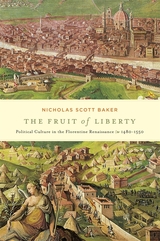
In the middle decades of the sixteenth century, the republican city-state of Florence--birthplace of the Renaissance--failed. In its place the Medici family created a principality, becoming first dukes of Florence and then grand dukes of Tuscany. The Fruit of Liberty examines how this transition occurred from the perspective of the Florentine patricians who had dominated and controlled the republic. The book analyzes the long, slow social and cultural transformations that predated, accompanied, and facilitated the institutional shift from republic to principality, from citizen to subject.
More than a chronological narrative, this analysis covers a wide range of contributing factors to this transition, from attitudes toward office holding, clothing, and the patronage of artists and architects to notions of self, family, and gender. Using a wide variety of sources including private letters, diaries, and art works, Nicholas Baker explores how the language, images, and values of the republic were reconceptualized to aid the shift from citizen to subject. He argues that the creation of Medici principality did not occur by a radical break with the past but with the adoption and adaptation of the political culture of Renaissance republicanism.

From the temptation of Eve to the venomous murder of the mighty Thor, the serpent appears throughout time and cultures as a figure of mischief and misery. The worldwide prominence of snakes in religion, myth, and folklore underscores our deep connection to the serpent—but why, when so few of us have firsthand experience? The surprising answer, this book suggests, lies in the singular impact of snakes on primate evolution. Predation pressure from snakes, Lynne Isbell tells us, is ultimately responsible for the superior vision and large brains of primates—and for a critical aspect of human evolution.
Drawing on extensive research, Isbell further speculates how snakes could have influenced the development of a distinctively human behavior: our ability to point for the purpose of directing attention. A social activity (no one points when alone) dependent on fast and accurate localization, pointing would have reduced deadly snake bites among our hominin ancestors. It might have also figured in later human behavior: snakes, this book eloquently argues, may well have given bipedal hominins, already equipped with a non-human primate communication system, the evolutionary nudge to point to communicate for social good, a critical step toward the evolution of language, and all that followed.

The engineering of plants has a long history on this continent. Fields, forests, orchards, and prairies are the result of repeated campaigns by amateurs, tradesmen, and scientists to introduce desirable plants, both American and foreign, while preventing growth of alien riff-raff. These horticulturists coaxed plants along in new environments and, through grafting and hybridizing, created new varieties. Over the last 250 years, their activities transformed the American landscape.
"Horticulture" may bring to mind white-glove garden clubs and genteel lectures about growing better roses. But Philip J. Pauly wants us to think of horticulturalists as pioneer "biotechnologists," hacking their plants to create a landscape that reflects their ambitions and ideals. Those standards have shaped the look of suburban neighborhoods, city parks, and the "native" produce available in our supermarkets.
In telling the histories of Concord grapes and Japanese cherry trees, the problem of the prairie and the war on the Medfly, Pauly hopes to provide a new understanding of not only how horticulture shaped the vegetation around us, but how it influenced our experiences of the native, the naturalized, and the alien--and how better to manage the landscapes around us.
For 1,300 years, Chinese calligraphy was based on the elegant art of Wang Xizhi (A.D. 303–361). But the seventeenth-century emergence of a style modeled on the rough, broken epigraphs of ancient bronzes and stone artifacts brought a revolution in calligraphic taste. By the eighteenth century, this led to the formation of the stele school of calligraphy, which continues to shape Chinese calligraphy today.
A dominant force in this school was the eminent calligrapher and art theorist Fu Shan (1607–1685). Because his work spans the late Ming–early Qing divide, it is an ideal prism through which to view the transformation in calligraphy.
Rather than seek a single explanation for the change in calligraphic taste, the author demonstrates and analyzes the heterogeneity of the cultural, social, and political processes behind it. Among other subjects, the book covers the late Ming interaction between high and low culture; the role of publishing; the Ming loyalist response to the Qing; and early Qing changes in intellectual discourse. In addition to the usual approach of art historians, it adopts the theoretical perspectives of such fields as material culture, print culture, and social and intellectual history.
Fueling Growth examines post-World War II economic development in Japan through the prism of the energy sector. Energy, always a key problem for Japan, is an appropriate angle from which to view the changing economy and the development of economic policy during the Occupation years and after.
Between 1945 and 1960, Japan moved from a primary reliance on domestic coal and hydroelectricity to a dependence on imported oil. The debates over energy very quickly became debates over the viability and direction of the nation's entire economic strategy. Not surprisingly, given the high stakes involved, consensus on plans for economic growth was not attained automatically. Rancorous arguments, uncertainty, and ambivalence about development strategies were the precursors to the eventual forging of a workable policy. Hein describes in detail both the events in this process and the players: government officials, businessmen, labor unionists, and another, often under-emphasized contributor to Japanese postwar economic policy—the United States government, which set the parameters within which the Japanese could operate.
The leading Polish poet still residing in his native land, Zbigniew Herbert as not been the subject of a book-length study in English until now. Stanislaw Baranczak, himself a poet, critic, and translator, emigrated from Poland only in 1981, and is therefore eminently qualified to supply a politico-cultural context for Herbert while describing and analyzing the texts and themes of his poems.
Herbert's poetry is based on permanent confrontation--the confrontation of Western tradition with the experience of a "barbarian" from Eastern Europe, of the classical past with the modern era, of cultural myth with a practical, empirical point of view. Baranczak illustrates these oppositions by examining, first, the complex relations between "disinheritance" and "heritage" as they appear in Herbert's work on various structural levels, from symbolic key words to lyrical characters; second, the forms and functions of Herbert's "unmasking metaphor"; third, his uses of irony; fourth, his ethical system, which enables him to be both ironist and moralist. Baranczak pays special attention to irony as the most conspicuous feature of Herbert's poetic method.
A Fugitive from Utopia makes Herbert's poetic ideas fully accessible to the general reader, and will also be of interest to students of Polish literature, of East European culture and society, and of modern poetry. Those who have already encountered Herbert's poetry in one of the several translations into English currently available will welcome this lucid explication of his work.
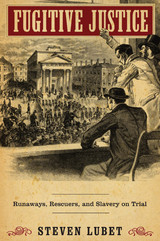
During the tumultuous decade before the Civil War, no issue was more divisive than the pursuit and return of fugitive slaves—a practice enforced under the Fugitive Slave Act of 1850. When free Blacks and their abolitionist allies intervened, prosecutions and trials inevitably followed. These cases involved high legal, political, and—most of all—human drama, with runaways desperate for freedom, their defenders seeking recourse to a “higher law” and normally fair-minded judges (even some opposed to slavery) considering the disposition of human beings as property.
Fugitive Justice tells the stories of three of the most dramatic fugitive slave trials of the 1850s, bringing to vivid life the determination of the fugitives, the radical tactics of their rescuers, the brutal doggedness of the slavehunters, and the tortuous response of the federal courts. These cases underscore the crucial role that runaway slaves played in building the tensions that led to the Civil War, and they show us how “civil disobedience” developed as a legal defense. As they unfold we can also see how such trials—whether of rescuers or of the slaves themselves—helped build the northern anti-slavery movement, even as they pushed southern firebrands closer to secession.
How could something so evil be treated so routinely by just men? The answer says much about how deeply the institution of slavery had penetrated American life even in free states. Fugitive Justice powerfully illuminates this painful episode in American history, and its role in the nation’s inexorable march to war.

A fresh portrayal of one of the architects of the African American intellectual tradition, whose faith in the subversive power of education will inspire teachers and learners today.
“As departments…scramble to decolonize their curriculum, Givens illuminates a longstanding counter-canon in predominantly black schools and colleges.”
—Boston Review
“Informative and inspiring…An homage to the achievement of an often-forgotten racial pioneer.”
—Glenn C. Altschuler, Florida Courier
“A long-overdue labor of love and analysis…that would make Woodson, the ever-rigorous teacher, proud.”
—Randal Maurice Jelks, Los Angeles Review of Books
“Fascinating, and groundbreaking. Givens restores Carter G. Woodson, one of the most important educators and intellectuals of the twentieth century, to his rightful place alongside figures like W. E. B. Du Bois and Ida B. Wells.”
—Imani Perry, author of May We Forever Stand: A History of the Black National Anthem
Black education was subversive from its inception. African Americans pursued education through clandestine means, often in defiance of law and custom, even under threat of violence. They developed what Jarvis Givens calls a tradition of “fugitive pedagogy”—a theory and practice of Black education epitomized by Carter G. Woodson—groundbreaking historian, founder of Black History Month, and legendary educator under Jim Crow.
Givens shows that Woodson succeeded because of the world of Black teachers to which he belonged. Fugitive Pedagogy chronicles his ambitious efforts to fight what he called the “mis-education of the Negro” by helping teachers and students to see themselves and their mission as set apart from an anti-Black world. Teachers, students, families, and communities worked together, using Woodson’s materials and methods as they fought for power in schools. Forged in slavery and honed under Jim Crow, the vision of the Black experience Woodson articulated so passionately and effectively remains essential for teachers and students today.

A new history shows that, despite Marxism’s rejection of money, the ruble was critical to the Soviet Union’s promise of shared prosperity for its citizens.
In spite of Karl Marx’s proclamation that money would become obsolete under Communism, the ruble remained a key feature of Soviet life. In fact, although Western economists typically concluded that money ultimately played a limited role in the Soviet Union, Kristy Ironside argues that money was both more important and more powerful than most histories have recognized. After the Second World War, money was resurrected as an essential tool of Soviet governance. Certainly, its importance was not lost on Soviet leaders, despite official Communist Party dogma. Money, Ironside demonstrates, mediated the relationship between the Soviet state and its citizens and was at the center of both the government’s and the people’s visions for the maturing Communist project. A strong ruble—one that held real value in workers’ hands and served as an effective labor incentive—was seen as essential to the economic growth that would rebuild society and realize Communism’s promised future of abundance.
Ironside shows how Soviet citizens turned to the state to remedy the damage that the ravages of the Second World War had inflicted upon their household economies. From the late 1940s through the early 1960s, progress toward Communism was increasingly measured by the health of its citizens’ personal finances, such as greater purchasing power, higher wages, better pensions, and growing savings. However, the increasing importance of money in Soviet life did not necessarily correlate to improved living standards for Soviet citizens. The Soviet government’s achievements in “raising the people’s material welfare” continued to lag behind the West’s advances during a period of unprecedented affluence. These factors combined to undermine popular support for Soviet power and confidence in the Communist project.

Investigations of Maya architecture have been among the chief vehicles for contemplating a great art tradition, the hieroglyphic writing system, and evaluating issues of comparative sociology. The powerful attraction of Maya architecture as an evocation of lost worlds, as a medium for the carved glyph and idol, and as a yardstick for measuring evolutionary complexity, makes it appropriate that attention be given to the buildings themselves, rather than simply treating them as media for the investigation of other issues, as valuable as these might be. The articles in this volume are of special value and importance in making architecture itself the focus of attention. At the same time that they give appropriate attention to the great architectural achievements of the Maya, they do not ignore the often evanescent residences of commoners. Rather than privileging cross-cultural comparisons or the anthropology of prehistoric peoples, however, structures remain at the forefront. In this, we reaffirm Maya architecture as one of the world’s great building traditions, allow for meaningful interdisciplinary exchange between archaeology, art history, and anthropology, and provide new ways of appreciating Maya culture, from a unique perspective.
The contributions presented here will surely mark a significant stage in the study of Maya architecture and the society that built it. These articles represent the advances that have been achieved in our understandings of the past, point toward avenues for further studies, and note the distance we have yet to travel in fully appreciating and understanding this ancient American culture and its material remains.

Most of Chester Barnard’s career was spent in executive practice. A Mount Hermon and Harvard education, cut off short of the bachelor’s degree, was followed by nearly forty years in the American Telephone & Telegraph Company. His career began in the Statistical Department, took him to technical expertness in the economics of rates and administrative experience in the management of commercial operations, and culminated in the presidency of the New Jersey Bell Telephone Company. He was not directly involved in the Western Electric experiments conducted chiefly at the Hawthorne plant in Cicero, but his association with Elton Mayo and the latter’s colleagues at the Harvard Business School had an important bearing on his most original ideas.
Barnard’s executive experience at AT&T was paralleled and followed by a career in public service unusual in his own time and hardly routine today. He was at various times president of the United Services Organization (the USO of World War II), head of the General Education Board and later president of the Rockefeller Foundation (after Raymond Fosdick and before Dean Rusk), chairman of the National Science Foundation, an assistant to the Secretary of the Treasury, a consultant to the American representative in the United Nations Atomic Energy Committee, to name only some of his public interests. He was a director of a number of companies, a fellow of the American Association for the Advancement of Science and of the American Academy of Arts and Sciences. He was a lover of music and a founder of the Bach Society of New Jersey.
In a remarkable synthesis of the research of the last two decades, a leading developmental neuroscientist provides psychologists with a sophisticated introduction to the brain—the system that underpins the functions that they study.
In clear terms, with ample illustrations, Joan Stiles explains the complexities of genetic variation and transcription, and the variable paths of neural development, from embryology through early childhood. She describes early developmental processes from gene expression to physiology to behavior. Sections on clinical correlations show the consequences for later physiological, neurological, or psychological disturbances in neural development.
As Stiles shows, brain development is far more complex and dynamic than is often assumed in debates about nature vs. nurture, nativism vs. cultural learning. Inherited and experienced factors interact constantly in an ever-changing organism. The key question is, what developmental processes give rise to particular structures or mechanisms?
A landmark of synthesis and interdisciplinary illumination, The Fundamentals of Brain Development will enrich discussion of developmental processes and more rigorously define the terms that are central to psychological debates.

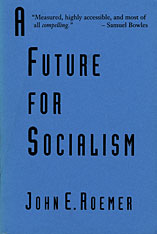
Many people point to recent events—the collapse of the Soviet Union, the electoral defeat of the Sandinistas—as proof that capitalism has triumphed over socialism once and for all. In A Future for Socialism, a noted economist argues that socialism is not dead but merely in need of modernizing. John Roemer believes that the hallmark of socialism is egalitarianism—equality of opportunity for self-realization and welfare, for political influence, and for social status—and he reminds us that capitalist societies face increasingly difficult problems of poverty and social inequality. Reenergizing a debate that began with Oskar Lange and Friedrich Hayek in the late 1930s, he brings to important questions of political economy a new level of sophistication in line with contemporary theories of justice and equality.
Roemer sees the solution of the principal-agent problem as the key to developing a decentralized market-socialist economy. This would be capable of maintaining efficiency and technological innovation while supporting a substantively more equal distribution of income than is achieved in capitalist economies. Roemer defends his views against skeptics on the right, who believe that efficiency and innovation are incompatible with egalitarianism, and skeptics on the left, who believe that socialism is incompatible with markets.
Because of its interdisciplinary approach, A Future for Socialism will appeal to a general social science audience, including economists, political scientists, sociologists, and political philosophers. It is also accessible to the interested reader.

Lisa Steinberg. Elisa Izquierdo. Lance Helms. These are just a few of the names drawn from recent headlines, revealing cases of horrendous child abuse and neglect. Such cases have led to a crisis of confidence in the current child protective services (CPS) system, and to frequent calls for reform.
The public is right to be concerned, shows Jane Waldfogel, but many perceptions of the CPS system and the problems it is designed to alleviate are inaccurate. This book goes beyond the headlines, using historical, comparative, and specific case data to formulate a new approach to protecting children.
Currently, Waldfogel argues, the CPS system is overwhelmed by referrals. As a result, neither high-risk nor low-risk families are adequately served.
Waldfogel examines the underlying assumptions of CPS, compares the U.S. record with those of Britain, Canada, and Australia, and offers a "new paradigm" in which CPS joins with other public and private partners to provide a differential response to the broad range of children in need of protection. She highlights reforms underway in several states and in Britain.
This book's analytical clarity and straightforward policy recommendations will make it mandatory reading for policymakers, practitioners, and others interested in the future of child protection.

Americans are understandably concerned about the runaway costs of medical care and the fact that one citizen out of seven is without health insurance coverage. Solving these problems is a top priority for the Clinton administration, but as Victor Fuchs shows, the task is enormously complex. In this book Fuchs, America's foremost health economist, provides the reader with the necessary concepts, facts, and analyses to comprehend the complicated issues of health policy. He shows why health care reform that benefits society as a whole will unavoidably burden certain individuals and groups.
Fuchs addresses such central questions as cost containment, managed competition, technology assessment, poverty and health, children's health, and national health insurance. The future of U.S. health policy, he argues, is tightly linked to three basic questions; First, how can we disengage health insurance from employment? Second, how can we tame technological change in health care? And finally how can we cope with the runaway medical costs of an aging society?

An Economist Best Book of the Year
A Financial Times Best Book of the Year
A Foreign Affairs Best Book of the Year
A ProMarket Best Political Economy Book of the Year
One of The Week’s Ten Best Business Books of the Year
A cutting-edge look at how accelerating financial change, from the end of cash to the rise of cryptocurrencies, will transform economies for better and worse.
We think we’ve seen financial innovation. We bank from laptops and buy coffee with the wave of a phone. But these are minor miracles compared with the dizzying experiments now underway around the globe, as businesses and governments alike embrace the possibilities of new financial technologies. As Eswar Prasad explains, the world of finance is at the threshold of major disruption that will affect corporations, bankers, states, and indeed all of us. The transformation of money will fundamentally rewrite how ordinary people live.
Above all, Prasad foresees the end of physical cash. The driving force won’t be phones or credit cards but rather central banks, spurred by the emergence of cryptocurrencies to develop their own, more stable digital currencies. Meanwhile, cryptocurrencies themselves will evolve unpredictably as global corporations like Meta and Amazon join the game. The changes will be accompanied by snowballing innovations that are reshaping finance and have already begun to revolutionize how we invest, trade, insure, and manage risk.
Prasad shows how these and other changes will redefine the very concept of money, unbundling its traditional functions as a unit of account, medium of exchange, and store of value. The promise lies in greater efficiency and flexibility, increased sensitivity to the needs of diverse consumers, and improved market access for the unbanked. The risk is instability, lack of accountability, and erosion of privacy. A lucid, visionary work, The Future of Money shows how to maximize the best and guard against the worst of what is to come.

An Economist Book of the Year
A Financial Times Book of the Year
A Foreign Affairs Book of the Year
A ProMarket Book of the Year
One of The Week’s Ten Best Business Books of the Year
“A road map for money managers, market strategists, and others seeking to understand this new world.”—Barron’s
“Money shapes economies, economies shape nations, nations shape history. It follows that the future of money is profoundly important. Here is a definitive report on where we are and where we are going.”—Lawrence H. Summers, former Secretary of the Treasury
“Prasad manages to make the financial system intelligible and interesting without resorting to shortcuts and exaggeration…Previous overhauls mainly improved existing systems, he notes. The end of cash—likely within a decade or two—is revolutionary.”—The Economist
The world of finance is on the cusp of a major disruption that will affect corporations, bankers, states—indeed, all of us. As Eswar Prasad makes clear, the end of physical cash will fundamentally rewrite how we live. Bitcoin, Ethereum, and other cryptocurrencies are just the beginning: spurred by their emergence, central banks will increasingly develop their own, more stable digital currencies. Meanwhile, cryptocurrencies themselves will evolve dramatically as global corporations like Meta, Apple, and Amazon join the game.
Prasad shows how these innovations will redefine the very concept of money, unbundling its traditional functions. This transformation promises greater efficiency and flexibility, but also carries the risk of instability, lack of accountability, and erosion of privacy. A lucid, visionary work, The Future of Money shows how to maximize the best and guard against the worst of what is to come.
In this passionate and challenging book, a distinguished historian of Zionism argues that the world of Jewry is coming apart, that the old reality of Jewish nationhood lies shattered, that Israel is increasingly isolated, fated to go its separate way disengaged from Jewish communities in the Diaspora—most especially the Jewish community in the United States.
David Vital traces the roots of this disarray to the revolution—still unfinished—that began with the emancipation of the Jews in France after the Revolution, continued with the movement of Jews out of Europe and the decimation of European Jewry in the Holocaust, and culminated in the establishment of the state of Israel. For the first time in centuries the Jews have emerged as actors in history, with a nation-state of their own, but the political interests of Jews in Israel and of Jews in the Diaspora appear to be irreparably divided. The Jews are no longer a cohesive people, Vital claims; contemporary Jewry is profoundly fractured and dysfunctional, a fact that is nowhere more apparent than in the growing gap between the two largest Jewish communities in the world, the ones in Israel and in the United States.
This incisive book describes the waning of the Jewish nation, in an effort to lay the groundwork for a cool, clear, and more hardheaded view of the future of the Jews. Anyone with a serious interest in contemporary politics, and in the history and problematics of the Jews and Judaism, will find much to consider in this gripping book.

Ukraine is in the midst of the worst international crisis in East-West relations since the Cold War, and history itself has become a battleground in Russia-Ukraine relations. Can history and historical narratives be blamed for what has happened in the region, or can they show the path to peace and reconciliation, helping to integrate the history of the region in the broader European context?
The essays collected here address these questions, rethinking the meaning of Ukrainian history by venturing outside boundaries established by the national paradigm, and demonstrating how research on the history of Ukraine can benefit from both regional and global perspectives. The Future of the Past shows how the study of Ukraine’s past enhances our understanding of Europe, Eurasia, and the world—past, present, and future.
READERS
Browse our collection.
PUBLISHERS
See BiblioVault's publisher services.
STUDENT SERVICES
Files for college accessibility offices.
RECENTLY PUBLISHED







UChicago Accessibility Resources
home | accessibility | search | about | contact us
BiblioVault ® 2001 - 2026
The University of Chicago Press