logo for American Library Association
From A to Zine
Building a Winning Zine Collection in Your Library
Julie Bartel
American Library Association, 2004

front cover of From Forest to Steppe
From Forest to Steppe
The Russian Art of Building in Wood
William Craft Brumfield
Duke University Press, 2025
Throughout Russian history, local craftsmen have shown remarkable skill in fashioning wood into items of daily use, from bridges and street paving to carts and boats to household utensils and combs. Russia has the largest forested zone on the planet, so its architecture was also traditionally made from timber. From homes to churches to forts, Russian buildings are almost all, underneath, constructed with logs, often covered by plank siding or by lathing and plaster.
In From Forest to Steppe, renowned scholar and photographer William Craft Brumfield offers a panoramic survey of Russia’s centuries-long heritage of wooden architecture. Lavishly illustrated with more than 400 color photographs, the volume links log-built barns, windmills, houses, and churches in the Far North; Buddhist shrines in the Transbaikal region; and eighteenth-century palaces on the outskirts of Moscow. Brumfield also takes readers to the estate houses of many Russian literary giants, from Chekhov and Tolstoy to Dostoevsky and Pushkin. Spanning thousands of photographed sites, five decades of field work, and seven time zones, Brumfield’s photographs offer compelling evidence of the adaptability of log construction and its ability to transcend class, cultural, and aesthetic boundaries.
In the decades since Brumfield began photographing Russian architecture, many of the buildings he has documented have been demolished or abandoned and left to rot at alarming rates. Brumfield observes a contradiction in contemporary Russia: It acknowledges the cultural importance of wooden buildings yet struggles to find and dedicate the resources and solutions needed to save them. A hymn and elegy to the long Russian practice of building with wood, From Forest to Steppe is an unparalleled look into one of the world’s most singular architectural traditions.
[more]

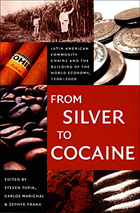
front cover of From Silver to Cocaine
From Silver to Cocaine
Latin American Commodity Chains and the Building of the World Economy, 1500-2000
Steven Topik, Carlos Marichal, and Zephyr Frank, eds.
Duke University Press, 2006
Demonstrating that globalization is a centuries-old phenomenon, From Silver to Cocaine examines the commodity chains that have connected producers in Latin America with consumers around the world for five hundred years. In clear, accessible essays, historians from Latin America, England, and the United States trace the paths of many of Latin America’s most important exports: coffee, bananas, rubber, sugar, tobacco, silver, henequen (fiber), fertilizers, cacao, cocaine, indigo, and cochineal (insects used to make dye). Each contributor follows a specific commodity from its inception, through its development and transport, to its final destination in the hands of consumers. The essays are arranged in chronological order, according to when the production of a particular commodity became significant to Latin America’s economy. Some—such as silver, sugar, and tobacco—were actively produced and traded in the sixteenth century; others—such as bananas and rubber—only at the end of the nineteenth century; and cocaine only in the twentieth.

By focusing on changing patterns of production and consumption over time, the contributors reconstruct complex webs of relationships and economic processes, highlighting Latin America’s central and interactive place in the world economy. They show how changes in coffee consumption habits, clothing fashions, drug usage, or tire technologies in Europe, Asia, and the Americas reverberate through Latin American commodity chains in profound ways. The social and economic outcomes of the continent’s export experience have been mixed. By analyzing the dynamics of a wide range of commodities over a five-hundred-year period, From Silver to Cocaine highlights this diversity at the same time that it provides a basis for comparison and points to new ways of doing global history.

Contributors. Marcelo Bucheli, Horacio Crespo, Zephyr Frank, Paul Gootenberg, Robert Greenhill, Mary Ann Mahony, Carlos Marichal, David McCreery, Rory Miller, Aldo Musacchio, Laura Nater, Ian Read, Mario Samper, Steven Topik, Allen Wells


[more]


Send via email Share on Facebook Share on Twitter