front cover of Fact or Fluke?
Fact or Fluke?
A Critical Look at Statistical Evidence
Ronald Meester
Amsterdam University Press, 2022
Statistics is more topical than ever. Numerous decisions depend on statistical considerations: just think of the Corona crisis or decisions about approving new drugs or other products. If researchers announce they have proved some fact using statistical tests, can we then always be sure that their claim is correct? How, and more importantly why, does statistics work? What can we expect from statistics and what not? 'Fact or Fluke?' is not a textbook that explains statistical tests to the reader; instead, it discusses what comes before those tests: the philosophy behind the statistics. Should one carry out tests, or are there other ways to look at statistics?

Ronald Meester and Klaas Slooten use a variety of examples – from court cases to theoretical physics – to present different views on statistics and provide arguments for what they think is the best point of view. This book is meant for anyone who is in some way concerned with, or interested in, statistical evidence: scientific researchers, students, teachers, mathematicians, philosophers, lawyers, managers, and no doubt many others.
[more]

front cover of Federated Learning for Multimedia Data Processing and Security in Industry 5.0
Federated Learning for Multimedia Data Processing and Security in Industry 5.0
Gautam Srivastava
The Institution of Engineering and Technology, 2025
Industry 5.0 is the upcoming industrial revolution where people will be working together with smart machines and robots, thereby bringing human touch and intelligence back to the decision-making process. Challenges include the security and privacy of sensitive multimedia data and near zero latency for mission critical applications.
[more]

front cover of Finite-State Morphology
Finite-State Morphology
Kenneth R. Beesley and Lauri Karttunen
CSLI, 2003
The finite-state paradigm of computer science has provided a basis for natural-language applications that are efficient, elegant, and robust. This volume is a practical guide to finite-state theory and the affiliated programming languages lexc and xfst. Readers will learn how to write tokenizers, spelling checkers, and especially morphological analyzer/generators for words in English, French, Finnish, Hungarian, and other languages.

Included are graded introductions, examples, and exercises suitable for individual study as well as formal courses. These take advantage of widely-tested lexc and xfst applications that are just becoming available for noncommercial use via the Internet.

[more]

front cover of Flame Wars
Flame Wars
The Discourse of Cyberculture
Mark Dery
Duke University Press, 1994
"Flame Wars," the verbal firefights that take place between disembodied combatants on electronic bulletin boards, remind us that our interaction with the world is increasingly mediated by computers. Bit by digital bit we are being "Borged," as devotees of Star Trek: The Next Generation would have it—transformed into cyborgian hybrids of technology and biology through our ever more frequent interaction with machines, or with one another through technological interfaces.
The subcultural practices of the "incurably informed," to borrow the cyberpunk novelist Pat Cadigan’s coinage, offer a precognitive glimpse of mainstream culture in the near future, when many of us will be part-time residents in virtual communities. Yet, as the essays in this expanded edition of a special issue of the South Atlantic Quarterly confirm, there is more to fringe computer culture than cyberspace. Within these pages, readers will encounter flame warriors; new age mutant ninja hackers; technopagans for whom the computer is an occult engine; and William Gibson’s "Agrippa," a short story on software that can only be read once because it gobbles itself up as soon as the last page is reached. Here, too, is Lady El, an African American cleaning woman reincarnated as an all-powerful cyborg; devotees of on-line swinging, or "compu-sex"; the teleoperated weaponry and amok robots of the mechanical performance art group, Survival Research Laboratories; an interview with Samuel Delany, and more.
Rallying around Fredric Jameson’s call for a cognitive cartography that "seeks to endow the individual subject with some new heightened sense of place in the global system," the contributors to Flame Wars have sketched a corner of that map, an outline for a wiring diagram of a terminally wired world.

Contributors. Anne Balsamo, Gareth Branwyn, Scott Bukatman, Pat Cadigan, Gary Chapman, Erik Davis, Manuel De Landa, Mark Dery, Julian Dibbell, Marc Laidlaw, Mark Pauline, Peter Schwenger, Vivian Sobchack, Claudia Springer
[more]

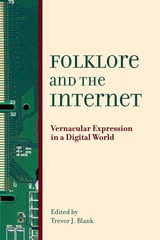
front cover of Folklore and the Internet
Folklore and the Internet
Vernacular Expression in a Digital World
Trevor J. Blank
Utah State University Press, 2009

A pioneering examination of the folkloric qualities of the World Wide Web, e-mail, and related digital media. These stuidies show that folk culture, sustained by a new and evolving vernacular, has been a key, since the Internet's beginnings, to language, practice, and interaction online. Users of many sorts continue to develop the Internet as a significant medium for generating, transmitting, documenting, and preserving folklore.

In a set of new, insightful essays, contributors Trevor J. Blank, Simon J. Bronner, Robert Dobler, Russell Frank, Gregory Hansen, Robert Glenn Howard, Lynne S. McNeill, Elizabeth Tucker, and William Westerman showcase ways the Internet both shapes and is shaped by folklore

[more]

front cover of Formalizing the Dynamics of Information
Formalizing the Dynamics of Information
Edited by Martina Faller, Stefan Kaufmann, and Marc Pauly
CSLI, 2000
The papers collected in this volume exemplify some of the trends in current approaches to logic, language and computation. Written by authors with varied academic backgrounds, the contributions are intended for an interdisciplinary audience. The first part of this volume addresses issues relevant for multi-agent systems: reasoning with incomplete information, reasoning about knowledge and beliefs, and reasoning about games. Proofs as formal objects form the subject of Part II. Topics covered include: contributions on logical frameworks, linear logic, and different approaches to formalized reasoning. Part III focuses on representations and formal methods in linguistic theory, addressing the areas of comparative and temporal expressions, modal subordination, and compositionality.
[more]

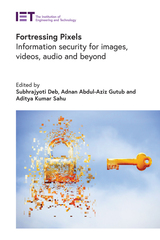
front cover of Fortressing Pixels
Fortressing Pixels
Information security for images, videos, audio and beyond
Subhrajyoti Deb
The Institution of Engineering and Technology, 2025
Emerging and pivotal technologies such as artificial intelligence and deep learning, cloud computing, internet of things, blockchain, encryption, and quantum cryptography are required to meet multimedia data's evolving needs and security requirements. In digital imaging, a pixel is the smallest element of an image that can be manipulated through software. Pixels within a digital image or graphical user interface must be secured to control unauthorized access or manipulation.
[more]

front cover of Foundations for Model-based Systems Engineering
Foundations for Model-based Systems Engineering
From patterns to models
Jon Holt
The Institution of Engineering and Technology, 2016
The practice of Model-based Systems Engineering is becoming more widely adopted in industry, academia and commerce and, as the use of modelling matures in the real world, so the need for more guidance on how to model effectively and efficiently becomes more prominent. This book describes a number of systems-level 'patterns' (pre-defined, reusable sets of views) that may be applied using the systems modelling language SysML for the development of any number of different applications and as the foundations for a system model.
[more]

front cover of Foundations of Real World Intelligence
Foundations of Real World Intelligence
Edited by Yoshinori Uesaka, Pentti Kanerva, and Hideki Asoh
CSLI, 2001
Real-world intelligence includes the ability to handle complex, uncertain, dynamic, multi-modal information in real time. In order to pursue the artificial realization of such "human" or "intelligent" information processing, a novel system of representing and interpreting knowledge must first be developed. This book collects the results of ten years of research at six laboratories, focusing on the theoretical and algorithmic foundations of the intelligence we find in the real world.
[more]

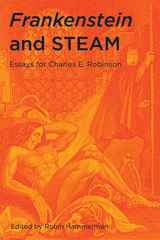
front cover of Frankenstein and STEAM
Frankenstein and STEAM
Essays for Charles E. Robinson
Robin Hammerman
University of Delaware Press, 2022

Charles E. Robinson, Professor Emeritus of English at The University of Delaware, definitively transformed study of the novel Frankenstein with his foundational volume The Frankenstein Notebooks and, in nineteenth century studies more broadly, brought heightened attention to the nuances of writing and editing. Frankenstein and STEAM consolidates the generative legacy of his later work on the novel's broad relation to topics in science, technology, engineering, arts, and mathematics (STEAM). Seven chapters written by leading and emerging scholars pay homage to Robinson's later perspectives of the novel and a concluding postscript contains remembrances by his colleagues and students. This volume not only makes explicit the question of what it means to be human, a question Robinson invited students and colleagues to examine throughout his career, but it also illustrates the depth of the field and diversity of those who have been inspired by Robinson's work. Frankenstein and STEAM offers direction for continuing scholarship on the intersections of literature, science, and technology.

Published by the University of Delaware Press. Distributed worldwide by Rutgers University Press.
[more]

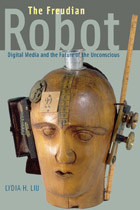
front cover of The Freudian Robot
The Freudian Robot
Digital Media and the Future of the Unconscious
Lydia H. Liu
University of Chicago Press, 2011

The identity and role of writing has evolved in the age of digital media. But how did writing itself make digital media possible in the first place? Lydia H. Liu offers here the first rigorous study of the political history of digital writing and its fateful entanglement with the Freudian unconscious.

Liu’s innovative analysis brings the work of theorists and writers back into conversation with one another to document significant meetings of minds and disciplines. She shows how the earlier avant-garde literary experiments with alphabetical writing and the word-association games of psychoanalysis contributed to the mathematical making of digital media. Such intellectual convergence, she argues, completed the transformation of alphabetical writing into the postphonetic, ideographic system of digital media, which not only altered the threshold of sense and nonsense in communication processes but also compelled a new understanding of human-machine interplay at the level of the unconscious.

Ranging across information theory, cybernetics, modernism, literary theory, neurotic machines, and psychoanalysis, The Freudian Robot rewrites the history of digital media and the literary theory of the twentieth century.
[more]

front cover of Friending the Past
Friending the Past
The Sense of History in the Digital Age
Alan Liu
University of Chicago Press, 2018
Can today’s society, increasingly captivated by a constant flow of information, share a sense of history? How did our media-making forebears balance the tension between the present and the absent, the individual and the collective, the static and the dynamic—and how do our current digital networks disrupt these same balances? Can our social media, with its fleeting nature, even be considered social at all?   
          In Friending the Past, Alan Liu proposes fresh answers to these innovative questions of connection. He explores how we can learn from the relationship between past societies whose media forms fostered a communal and self-aware sense of history—such as prehistorical oral societies with robust storytelling cultures, or the great print works of nineteenth-century historicism—and our own instantaneous present. He concludes with a surprising look at how the sense of history exemplified in today’s JavaScript timelines compares to the temporality found in Romantic poetry.
          Interlaced among these inquiries, Liu shows how extensive “network archaeologies” can be constructed as novel ways of thinking about our affiliations with time and with each other. These conceptual architectures of period and age are also always media structures, scaffolded with the outlines of what we mean by history. Thinking about our own time, Liu wonders if the digital, networked future can sustain a similar sense of history.
[more]

front cover of From Counterculture to Cyberculture
From Counterculture to Cyberculture
Stewart Brand, the Whole Earth Network, and the Rise of Digital Utopianism
Fred Turner
University of Chicago Press, 2006

In the early 1960s, computers haunted the American popular imagination. Bleak tools of the cold war, they embodied the rigid organization and mechanical conformity that made the military-industrial complex possible. But by the 1990s—and the dawn of the Internet—computers started to represent a very different kind of world: a collaborative and digital utopia modeled on the communal ideals of the hippies who so vehemently rebelled against the cold war establishment in the first place. 

From Counterculture to Cyberculture is the first book to explore this extraordinary and ironic transformation. Fred Turner here traces the previously untold story of a highly influential group of San Francisco Bay–area entrepreneurs: Stewart Brand and the Whole Earth network. Between 1968 and 1998, via such familiar venues as the National Book Award–winning Whole Earth Catalog, the computer conferencing system known as WELL, and, ultimately, the launch of the wildly successful Wired magazine, Brand and his colleagues brokered a long-running collaboration between San Francisco flower power and the emerging technological hub of Silicon Valley. Thanks to their vision, counterculturalists and technologists alike joined together to reimagine computers as tools for personal liberation, the building of virtual and decidedly alternative communities, and the exploration of bold new social frontiers. 

Shedding new light on how our networked culture came to be, this fascinating book reminds us that the distance between the Grateful Dead and Google, between Ken Kesey and the computer itself, is not as great as we might think.
[more]

front cover of From Russia with Code
From Russia with Code
Programming Migrations in Post-Soviet Times
Mario Biagioli and Vincent Antonin Lepinay, editors
Duke University Press, 2019
While Russian computer scientists are notorious for their interference in the 2016 US presidential election, they are ubiquitous on Wall Street and coveted by international IT firms and often perceive themselves as the present manifestation of the past glory of Soviet scientific prowess. Drawing on over three hundred in-depth interviews, the contributors to From Russia with Code trace the practices, education, careers, networks, migrations, and lives of Russian IT professionals at home and abroad, showing how they function as key figures in the tense political and ideological environment of technological innovation in post-Soviet Russia. Among other topics, they analyze coders' creation of both transnational communities and local networks of political activists; Moscow's use of IT funding to control peripheral regions; brain drain and the experiences of coders living abroad in the United Kingdom, United States, Israel, and Finland; and the possible meanings of Russian computing systems in a heterogeneous nation and industry. Highlighting the centrality of computer scientists to post-Soviet economic mobilization in Russia, the contributors offer new insights into the difficulties through which a new entrepreneurial culture emerges in a rapidly changing world.

Contributors. Irina Antoschyuk, Mario Biagioli, Ksenia Ermoshina, Marina Fedorova, Andrey Indukaev, Alina Kontareva, Diana Kurkovsky, Vincent Lépinay, Alexandra Masalskaya, Daria Savchenko, Liubava Shatokhina, Alexandra Simonova, Ksenia Tatarchenko, Zinaida Vasilyeva, Dimitrii Zhikharevich

[more]

front cover of Furious
Furious
Technological Feminism and Digital Futures
Caroline Bassett
Pluto Press, 2019
As digital transformations continue to accelerate in the world, discourses of big data have come to dominate in a number of fields, from politics and economics, to media and education. But how can we really understand the digital world, ask the authors of Furious, when so much of the writing through which we grapple with it remains deeply problematic? In a compelling new work of feminist critical theory, Bassett, Kember and O'Riordan scrutinise many of the assumptions of a masculinist digital world, highlighting the tendency of digital humanities scholarship to venerate and essentialise technical forms, and to adopt gendered writing and citation practices. Contesting these writings, practices and politics, the authors foreground feminist traditions and contributions to the field, offering alternative modes of knowledge production, and a radically different, poetic writing style. Through this prism, Furious brings into focus themes including the automation of home and domestic work, the Anthropocene, and intersectional feminist technofutures.
[more]

logo for Pluto Press
Furious
Technological Feminism and Digital Futures
Caroline Bassett
Pluto Press, 2019
As digital transformations continue to accelerate in the world, discourses of big data have come to dominate in a number of fields, from politics and economics, to media and education. But how can we really understand the digital world, ask the authors of Furious, when so much of the writing through which we grapple with it remains deeply problematic? In a compelling new work of feminist critical theory, Bassett, Kember and O'Riordan scrutinise many of the assumptions of a masculinist digital world, highlighting the tendency of digital humanities scholarship to venerate and essentialise technical forms, and to adopt gendered writing and citation practices. Contesting these writings, practices and politics, the authors foreground feminist traditions and contributions to the field, offering alternative modes of knowledge production, and a radically different, poetic writing style. Through this prism, Furious brings into focus themes including the automation of home and domestic work, the Anthropocene, and intersectional feminist technofutures.
[more]

front cover of Fuzzy Logic Control in Energy Systems with design applications in MATLAB®/Simulink®
Fuzzy Logic Control in Energy Systems with design applications in MATLAB®/Simulink®
Ismail H. Altaş
The Institution of Engineering and Technology, 2017
Modern electrical power systems are facing complex challenges, arising from distributed generation and intermittent renewable energy. Fuzzy logic is one approach to meeting this challenge and providing reliability and power quality.
[more]

front cover of Fuzzy Logic Control in Energy Systems
Fuzzy Logic Control in Energy Systems
With design examples in MATLAB®/Simulink®
İsmail Hakkı Altaş
The Institution of Engineering and Technology, 2024
Fuzzy models have the capability of recognising, representing, and working with data that is vague or lacks certainty, making them suitable for managing electrical energy systems involving intermittent distributed generation and varying distributed loads.
[more]


Send via email Share on Facebook Share on Twitter