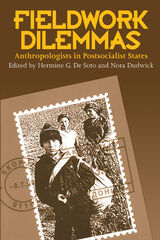
front cover of Fieldwork Dilemmas
Fieldwork Dilemmas
Anthropologists In Postsocialist States
Hermine G. De Soto
University of Wisconsin Press, 2000

In Fieldwork Dilemmas ten anthropologists disclose the political and physical dangers inherent in field research. Focusing on former socialist states, they vividly depict the upheavals of everyday life in eastern Euorpe, revealing how their informants and the communities in which they live undergo political and economic dislocations, plummeting living standards, emerging gender inequalities, and ethnic and nationalist violence.

Reports from Armenia, Bulgaria, eastern Germany, Kyrgyzstan, Macedonia, Russia, Serbia, and Uzbekistan show how fieldworkers struggle to reconcile previous experiences with postsocialist stereotypes about Soviet culture, the West, and the effects of the penetration of capitalism into noncapitalist societies. These fieldwork dilemmas are analyzed by anthropologists who are learning to position themselves professionally and personally in the field under often unstable, unpredictable situations. This volume will interest not only anthropologists but fieldworkers of all kinds, and not only scholars of eastern Europe but all those who study rapid societal changes.

[more]

logo for Pluto Press
First the Transition, then the Crash
Eastern Europe in the 2000s
Edited by Gareth Dale
Pluto Press, 2011

The 1989-91 upheavals in Eastern Europe sparked a turbulent process of social and economic transition. Two decades on, with the global economic crisis of 2008-10, a new phase has begun.

This book explores the scale and trajectory of the crisis through case studies of the Czech Republic, Hungary, Latvia, Poland, Russia, Ukraine and the former Yugoslavia. The contributors focus upon the relationships between geopolitics, the world economy and class restructuring.

The book covers the changing relationship between business and states; foreign capital flows; financialisation and asset price bubbles; austerity and privatisation; and societal responses, in the form of reactionary populism and progressive social movements.

Challenging neoliberal interpretations that envisage the transition as a process of unfolding liberty, the dialectic charted in these pages reveals uneven development, attenuated freedoms and social polarisation.
[more]

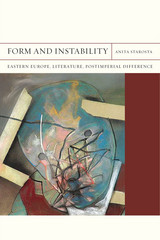
front cover of Form and Instability
Form and Instability
Eastern Europe, Literature, Postimperial Difference
Anita Starosta
Northwestern University Press, 2015
Form and Instability: Eastern Europe, Literature, and Post-Imperial Difference busies itself with the work of accounting for this discrepancy between ostensible historical change and the persistence of anachronistic ways of thinking, a discrepancy that remains unaddressed and eludes attention; and it goes on to propose that literature—not simply as an archive of representations or a source of cultural capital but as a critical perspective in its own right—offers a way to apprehend and to redress this problem.Historical situations such as the post-1989 transitions to capitalism and liberal democracy, as well as the “Eastern” enlargement of the E.U., not only entail empirical change; they also call for and provoke intense renegotiations of cultural values and analytical concepts. Through rhetoric, reading, and translation—terms central to this book—literature will be seen to expedite and redirect such re-arrangements. It will be shown to destabilize discursively fixed categories without imposing, in turn, its own fixity.

Located at the intersection of comparative literature, area studies, and literary theory, this interdisciplinary study has a twofold commitment: to Eastern Europe on the one hand and to literature on the other. It aims to intervene in the way we conceive of Eastern Europe by seeking to develop a more equitable way of thinking, one that avoids subordinating it to Eurocentric narratives of progress. At the same time, it marshals literature as both object and method of this rethinking, in order to extend existing conceptions of the usefulness and of the proper organization of literary studies. The three terms in the title of this book mark a passage—via literature—from “Eastern Europe” as an inadequate and obsolescent category to “post-imperial difference” as a more accurate, if provisional, account of the region. By way of original readings of particular texts, and by attending to literature as a critical

[more]

front cover of Free Market in Its Twenties
Free Market in Its Twenties
Modern Business Decision Making in Central and Eastern Europe
George Soros
Central European University Press, 2014
This book provides a broadly managerial perspective on key trends that affect business decision-making in Central and Eastern Europe twenty years after the beginning of the region's transition to market economy. Reflecting different viewpoints, including economic, social, and political approaches, the essays helps managers of the region to understand better both regional and the global forces influencing their businesses – as well as to bring to their attention relevant cutting-edge approaches to business thinking and decision-making.
[more]

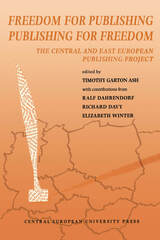
front cover of Freedom for Publishing, Publishing for Freedom
Freedom for Publishing, Publishing for Freedom
Timothy Garton Ash
Central European University Press, 1995
This is an assessment of the Central and East European Publishing Project, an initiative designed to support embattled Central and East European publishers and journals, and to punch holes through the cultural Iron Curtain by encouraging translations. The nine years of its existence straddle the largest watershed in European history since 1945, and the Project's history - told here by some of its leading participants - illuminates the nature of the recent changes in Central and Eastern Europe.
[more]

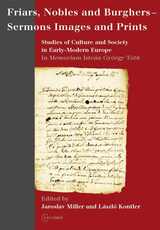
front cover of Friars, Nobles and Burghers – Sermons, Images and Prints
Friars, Nobles and Burghers – Sermons, Images and Prints
Studies of Culture and Society in Early-Modern Europe - In Memoriam István György Tóth
László Kontler
Central European University Press, 2010
The essays in this volume reflect the broader interpretation of culture as a system of shared meanings, values, attitudes and symbolic forms in any sphere of human life. Although thematically diverse, all these studies adhere to the concept of what is sometimes termed the new cultural history or socio-cultural history. The work opens with a cluster of methodological and historiographical reflections. Topics covered by the thematic sections include confessional and religious life in early modern Europe, symbolism and representation, strife and accommodation among different denominations compelled to live in a common space, order and hierarchy, cracks in the machinery of authority and the threat of disintegration as well as the history of alphabetization, literacy and reading and writing practices. This book pays tribute to István György Tóth (1956–2005), Head of the Department of Early-Modern History at the Institute of History of the Hungarian Academy of Sciences, and Professor of History at Central European University (both in Budapest), until his premature death in 2005.
[more]


Send via email Share on Facebook Share on Twitter