
 A SCHOLARLY BOOK REPOSITORY
9 start with F start with F
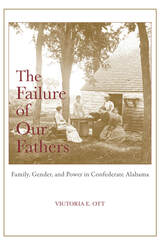
An in-depth study of non-elite white families in Alabama—from the state’s creation through the end of the Civil War
The Failure of Our Fathers: Family, Gender, and Power in Confederate Alabama examines the evolving position of non-elite white families in Alabama during one of the most pivotal epochs in the state’s history. Drawing on a wide range of personal and public documents reflecting the state’s varied regions and economies, Victoria E. Ott uses gender and family as a lens to examine the yeomanry and poor whites, a constituency that she collectively defines as “common whites,” who identified with the Confederate cause.
Ott provides a nuanced examination of how these Alabamians fit within the antebellum era’s paternalistic social order, eventually identifying with and supporting the Confederate mission to leave the Union and create an independent, slaveholding state. But as the reality of the war slowly set in and the Confederacy began to fray, the increasing dangers families faced led Alabama’s common white men and women to find new avenues to power as a distinct socioeconomic class.
Ott argues that family provided the conceptual framework necessary to understand why common whites supported a war to protect slavery despite having little or no investment in the institution. Going to war meant protecting their families from outsiders who threatened to turn their worlds upside down. Despite class differences, common whites envisioned the Confederacy as a larger family and the state as paternal figures who promised to protect its loyal dependents throughout the conflict. Yet, as the war ravaged many Alabama communities, devotion to the Confederacy seemed less a priority as families faced continued separations, threats of death, and the potential for starvation. The construct of a familial structure that once created a sense of loyalty to the Confederacy now gave them cause to question its leadership. Ott shows how these domestic values rooted in highly gendered concepts ultimately redefined Alabama’s social structure and increased class distinctions after the war.

The remarkable and improbable story of the utopian single-tax social experiment that gave rise to one of the most unique and colorful communities along the Gulf Coast
Paul E. and Blanche R. Alyea’s Fairhope, 1894–1954, first published in 1954, is the history of this unique and improbable community and the single-tax social experiment that gave rise to it. This new edition offers an introduction by historian and Fairhope resident Tennant McWilliams, giving invaluable context and entertaining anecdotes not just regarding Fairhope’s founding but about the Alyeas themselves—all to the abiding value of their story for today’s residents and visitors.
On November 15, 1894, a small group of men and women met on a remote stretch of Mobile Bay’s eastern shore to establish a colony. It was a decidedly utopian undertaking in a period characterized by many similar social experiments and ideal communities, most of them failures. This group, which gathered at “Stapleton’s pasture” to found Fairhope, hoped to demonstrate the benefits of the single tax as a means of curing social and economic evils, making a practical test of the doctrines of economist Henry George.
Today, the wealth of parks, public and private schools, art galleries, and restaurants, combined with quaint shops and residential areas and a vibrant nautical life, all attest to Fairhope’s unique position among many older communities in the same region. Its residents represent a diverse array of interests and talents, and with a strong civic regard for individualism and creativity, Fairhope is also a haven for painters, potters, writers, and musicians.

How does religion—or the lack of it—pass from one generation to the next? Families and Religion studies the intergenerational shifts in faith and secularism in Germany, Italy, Hungary, Finland, and Canada, depicting when, how, and why religious beliefs change.
Using a mixed-methods approach, the book looks into the role of family and historical context in shaping religious affiliation and identity, specifically focusing on adolescence as a key period of transformation. Comparing diverse social settings, the authors uncover the subtle yet powerful forces influencing whether religious traditions persist or fade across generations. A vital contribution to the study of religious change, this volume offers new insights for scholars of sociology and religious studies, and for those interested in understanding how faith may be passed down within families.



Fear of Small Numbers is Arjun Appadurai’s answer to that question. A leading theorist of globalization, Appadurai turns his attention to the complex dynamics fueling large-scale, culturally motivated violence, from the genocides that racked Eastern Europe, Rwanda, and India in the early 1990s to the contemporary “war on terror.” Providing a conceptually innovative framework for understanding sources of global violence, he describes how the nation-state has grown ambivalent about minorities at the same time that minorities, because of global communication technologies and migration flows, increasingly see themselves as parts of powerful global majorities. By exacerbating the inequalities produced by globalization, the volatile, slippery relationship between majorities and minorities foments the desire to eradicate cultural difference.
Appadurai analyzes the darker side of globalization: suicide bombings; anti-Americanism; the surplus of rage manifest in televised beheadings; the clash of global ideologies; and the difficulties that flexible, cellular organizations such as Al-Qaeda present to centralized, “vertebrate” structures such as national governments. Powerful, provocative, and timely, Fear of Small Numbers is a thoughtful invitation to rethink what violence is in an age of globalization.

Fifth Business is a biography of the English chemist, educator, and scientific critic Henry Edward Armstrong. Today, Armstrong, who was a central figure in the development of the science of chemistry between 1885 and 1914, is more remembered for his campaigns to improve the teaching of chemistry, and science generally, and less for his theory of residual affinity and reverse electrolysis—or his hostility toward physical chemistry. However, right up until his retirement, Armstrong was a significant and prolific organic chemist, as well as a major figure in the academic and social life of the Chemical Society.
Fifth Business is structured as chronologically as possible, with Armstrong’s life and achievements as an active chemist in Part I (1848–1911) and as a critic in his long retirement in Part II (1911–1937). Brock’s authoritative biography provides a unique inside look at its subject, allowing us to better understand the history of British science, scientific institutions, scientific education, pedagogical theory, and social relations of science during the last third of the nineteenth century and the first third of the twentieth.
Surin begins by examining the current regime of accumulation—the global domination of financial markets over traditional industrial economies—which is used as an instrument for the subordination and dependency of poorer nations. He then moves to the constitution of subjectivity, or the way humans are produced as social beings, which he casts as the key arena in which struggles against dispossession occur. Surin critically engages with the major philosophical positions that have been posed as models of liberation, including Derrida’s notion of reciprocity between a subject and its other, a reinvigorated militancy in political reorientation based on the thinking of Badiou and Zizek, the nomad politics of Deleuze and Guattari, and the politics of the multitude suggested by Hardt and Negri. Finally, Surin specifies the material conditions needed for liberation from the economic, political, and social failures of our current system. Seeking to illuminate a route to a better life for the world’s poorer populations, Surin investigates the philosophical possibilities for a Marxist or neo-Marxist concept of liberation from capitalist exploitation and the regimes of power that support it.

READERS
Browse our collection.
PUBLISHERS
See BiblioVault's publisher services.
STUDENT SERVICES
Files for college accessibility offices.
RECENTLY PUBLISHED




UChicago Accessibility Resources
home | accessibility | search | about | contact us
BiblioVault ® 2001 - 2026
The University of Chicago Press