
 A SCHOLARLY BOOK REPOSITORY
6 start with F start with F
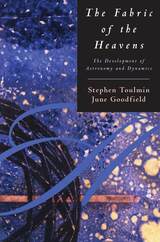
Praise for The Fabric of the Heavens:
"I cannot remember when I last went through a book, any book, with such all-devouring zest. What is more, even the most complex technicalities are reduced to a positively crystalline clarity: If I can understand them, anyone can. The Fabric of the Heavens is, in every sense of the word, an eye-opener."—Peter Green, The Yorkshire Post
"Not until the last chapter of the book is [the reader] allowed to think again wholly as a modern man has become accustomed, by common sense, to think. The discipline is admirably suited to the authors' task, and cunningly devised for the reader's edification—and, indeed, for his delight."—Physics Today
Praise for The Architecture of Matter:
"The Architecture of Matter is to be warmly recommended. It is that rare achievement, a lively book which at the same time takes the fullest possible advantage of scholarly knowledge."—Charles C. Gillespie, New York Times Book Review
"One is impressed by the felicity of the examples and by the lively clarity with which significant experiments and ideas are explained. . . . No other history of science is so consistently challenging."—Scientific American
Praise for The Discovery of Time:
"A subject of absorbing interest . . . is presented not as a history of science, but as a chapter in the history of ideas from the ancient Greeks to our own time."—Times Literary Supplement

Mars and its secrets have fascinated and mystified humans since ancient times. For the Love of Mars surveys the red planet’s place in the human imagination, beginning with ancient astrologers and skywatchers and ending in our present moment of exploration and virtual engagement.
National Air and Space Museum curator Matthew Shindell describes how historical figures across eras and around the world have made sense of this mysterious planet. We meet Mayan astrologer priests who incorporated Mars into seasonal calendars and religious ceremonies, Babylonian astrologers who discerned bad omens, figures of the Scientific Revolution who struggled to comprehend Mars as a world, Victorian astronomers who sought signs of intelligent life, and twentieth- and twenty-first-century scientists who have established a technological presence on the planet’s surface. Along the way, we encounter writers and artists from each of these periods who took readers and viewers along on imagined journeys to Mars.
By focusing on the diverse human stories behind the telescopes and behind the robots we know and love, Shindell shows how Mars exploration has evolved in ways that have also expanded knowledge about other facets of the universe. Captained by an engaging and erudite expert, For the Love of Mars is a captivating voyage through time and space for anyone curious about Curiosity and the red planet.
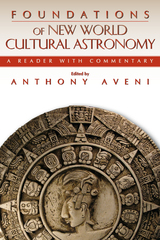
Cultural astronomy, first called archaeoastronomy, has evolved at ferocious speed since its genesis in the 1960s, with seminal essays and powerful rebuttals published in far-flung, specialized journals. Until now, only the most closely involved scholars could follow the intellectual fireworks. In Foundations of New World Cultural Astronomy, Anthony Aveni, one of cultural astronomy's founders and top scholars, offers a selection of the essays that built the field, from foundational works to contemporary scholarship.
Including four decades of research throughout the Americas by linguists, archaeologists, historians, ethnologists, astronomers, and engineers, this reader highlights the evolution of the field through thematic organization and point-counterpoint articles. Aveni - an award-winning author and former National Professor of the Year - serves up incisive commentary, background for the uninitiated, and suggested reading, questions, and essay topics. Students, readers, and scholars will relish this collection and its tour of a new field in which discoveries about ancient ways of looking at the skies cast light on our contemporary views.

In this learned romp of science writing, Cambridge professor Simon Conway Morris cheerfully challenges six assumptions—what he calls ‘myths’—that too often pass as unquestioned truths amongst the evolutionary orthodox.
His convivial tour begins with the idea that evolution is boundless in the kinds of biological systems it can produce. Not true, he says. The process is highly circumscribed and delimited. Nor is it random. This popular notion holds that evolution proceeds blindly, with no endgame. But Conway Morris suggests otherwise, pointing to evidence that the processes of evolution are “seeded with inevitabilities.”
If that is so, then what about mass extinctions? Don’t they steer the development of life in radically new directions? Rather the reverse, claims Conway Morris. Such cataclysms accelerate evolutionary developments that were going to happen anyway. And what about that other evolutionary canard: the “missing link”? There is plenty to choose from in the fossil record, but persistently overlooked is that in any group, there is not one but a phalanx of “missing links.” Once again, we under-score the near-inevitability of evolutionary outcomes.
Turning from fossils to minds, Conway Morris critically examines the popular tenet that the intelligence of humans and animals are the same thing, a difference of degree, not kind. A closer scrutiny of our minds shows that, in reality, an unbridgeable gulf separates us from even the chimpanzees, so begging questions of consciousness and Mind.
Finally, Conway Morris tackles the question of extraterrestrials. Undoubtedly, the size and scale of the universe suggest that alien life must exist somewhere beyond Earth and our tiny siloed solar system? After all, evolutionary convergence more than hints that human-like forms are universal. But Dr. Conway Morris has serious doubts. The famous Fermi Paradox (“Where are they?”) appears to hold: Alone in the cosmos—and unique, but not quite in the way one might expect.

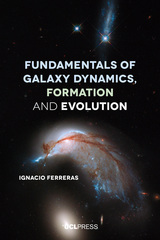
Fundamentals of Dark Matter provides a comprehensive and accessible introduction to one of the greatest mysteries in astrophysics. Designed for advanced undergraduates and graduate students, this textbook presents the key discoveries that led to the dark matter hypothesis and also fosters critical thinking with thought-provoking “How about…?” questions in each chapter.
Ignacio Ferreras guides readers through the historical challenges in galactic astrophysics and the cosmic microwave background, outlining the evidence that has made dark matter a fundamental component of modern cosmology. The book also explores the latest developments in galaxy formation and the ongoing search for the true nature of dark matter.
Each chapter includes clear learning outcomes and discussion questions, making it an ideal resource for courses in extragalactic astrophysics or cosmology. With its engaging pedagogical approach, Fundamentals of Dark Matter equips students with both the knowledge and the curiosity to explore one of the most dynamic areas of modern astrophysics.
READERS
Browse our collection.
PUBLISHERS
See BiblioVault's publisher services.
STUDENT SERVICES
Files for college accessibility offices.
RECENTLY PUBLISHED






UChicago Accessibility Resources
home | accessibility | search | about | contact us
BiblioVault ® 2001 - 2026
The University of Chicago Press