
 A SCHOLARLY BOOK REPOSITORY
8 start with G start with G
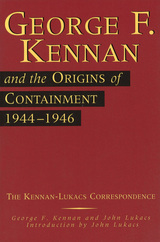
In 1945 the United States saw the Soviet Union as its principal ally. By 1947, it saw the Soviet Union as its principal opponent. How did this happen? Historian John Lukacs has provided an answer to this question through an exchange of letters with George F. Kennan. Their correspondence deals with the antecedents of containment between 1944 and 1946, during most of which time Kennan was at the American embassy in Moscow.
Kennan had strong opinions about America's appropriate role during and after World War II and is perhaps best known as the architect of America's containment policy. Much has been written about Kennan and containment, but relatively little is known about the events that made him compose and send the Long Telegram in 1946 that ultimately became the draft for foreign policy dealing with the Soviets in the following forty years.
These letters show Kennan's fear of the extent to which the United States misunderstood the Soviet regime. Especially in 1944, at the time of the Russians' betrayal of the Warsaw Uprising, it became evident that the Soviets were interested in establishing their rigid domination of Eastern and Central Europe and dividing the continent.
Kennan's letters to Lukacs are thorough and detailed, suggesting that the Truman administration was not in the least premature in opposing the Soviet Union. Indeed, both correspondents suggest that these decisions should have been made earlier. This series of letters will add greatly to our understanding of what preceded containment and the Cold War in 1947.

Border fixity—the proscription of foreign conquest and the annexation of homeland territory—has, since World War II, become a powerful norm in world politics. This development has been said to increase stability and peace in international relations. Yet, in a world in which it is unacceptable to challenge international borders by force, sociopolitically weak states remain a significant source of widespread conflict, war, and instability.
In this book, Boaz Atzili argues that the process of state building has long been influenced by external territorial pressures and competition, with the absence of border fixity contributing to the evolution of strong states—and its presence to the survival of weak ones. What results from this norm, he argues, are conditions that make internal conflict and the spillover of interstate war more likely. Using a comparison of historical and contemporary case studies, Atzili sheds light on the relationship between state weakness and conflict. His argument that under some circumstances an international norm that was established to preserve the peace may actually create conditions that are ripe for war is sure to generate debate and shed light on the dynamics of continuing conflict in the twenty-first century.
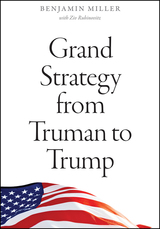
American foreign policy is the subject of extensive debate. Many look to domestic factors as the driving forces of bad policies. Benjamin Miller instead seeks to account for changes in US international strategy by developing a theory of grand strategy that captures the key security approaches available to US decision-makers in times of war and peace.
Grand Strategy from Truman to Trump makes a crucial contribution to our understanding of competing grand strategies that accounts for objectives and means of security policy. Miller puts forward a model that is widely applicable, based on empirical evidence from post-WWII to today, and shows that external factors—rather than internal concerns—are the most determinative.

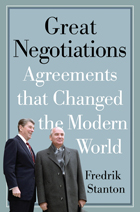
Lessons in Diplomacy from Colonial America to the Cold War
"In a time when negotiations, both great and small, continue to shape our world, this book provides an excellent opportunity to learn from the past and understand the present.”—Kofi Annan, Nobel Peace Prize Winner and former Secretary General of the United Nations
“A thought-provoking, informative book, highly recommended for all readers interested in international affairs.”—Library Journal
“For anyone with an interest in diplomacy and political history, Stanton's book is both entertaining and informative.” —Foreign Policy Watch
“Every professional concerned with dispute resolution and every student of negotiation has much to learn from Fredrik Stanton's lively stories of eight history-shaping negotiations.”—Robert H. Mnookin, Chair Program on Negotiation, Harvard Law School
“An excellent introduction into some of the great triumphs and failures of modern diplomacy.”—Seattle Post-Intelligencer
“An interesting, informative study well worth reading and pondering.” —American Diplomacy
“Stanton deftly illustrates that the power of haggling can easily rival that of any army or warhead.”—Roll Call
“Exhaustive research and careful thought have enabled Stanton to employ an extraordinary writing talent to produce a contribution to history and a source of enjoyable reading.”—New York Law Journal
“Stanton brings back to life both famous and some long forgotten personalities in the history of major American, European, and Asian negotiations. He persuasively makes his case for the importance of negotiators and negotiations both when wars can be kept from beginning and when wars end. He weaves in deft descriptions of the personal strengths and foibles of negotiators and homes in on the ability of the best to improvise when maneuvering on unfamiliar terrain.” —Ambassador Richard W. Murphy, Council on Foreign Relations
Words as much as weapons have shaped the course of history. Whether to avert, resolve, assist, or secure the outcome of a conflict, diplomacy in the modern age has had great triumphs and bitter failures, from the Cuban Missile Crisis in 1962, which narrowly spared humanity from a nuclear Armageddon, to the Treaty of Versailles after World War I, which created problems that still confront us today. Drawing on primary sources, transcripts, and interviews, Great Negotiations: Agreements that Changed the Modern World tells the stories of eight key episodes in modern diplomacy. From Benjamin Franklin securing crucial French support for the American revolution to Reagan and Gorbachev laying the groundwork to eliminate an entire class of nuclear weapons, Fredrik Stanton explains what each party brought to the negotiating table, the stakes, the obstacles to success, and how they were overcome.
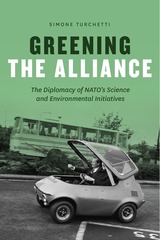
Drawing on previously unseen documents from NATO’s own archives, Simone Turchetti reveals how its investments were rooted in the alliance’s defense and surveillance needs, needs that led it to establish a program prioritizing environmental studies. A long-overlooked and effective diplomacy exercise, NATO’s “greening” at one point constituted the organization’s chief conduit for negotiating problematic relations between allies. But while Greening the Alliance explores this surprising coevolution of environmental monitoring and surveillance, tales of science advisers issuing instructions to bomb oil spills with napalm or Dr. Strangelove–like experts eager to divert the path of hurricanes with atomic weapons make it clear: the coexistence of these forces has not always been harmonious. Reflecting on this rich, complicated legacy in light of contemporary global challenges like climate change, Turchetti offers both an eye-opening history of international politics and environmental studies and a thoughtful assessment of NATO’s future.
READERS
Browse our collection.
PUBLISHERS
See BiblioVault's publisher services.
STUDENT SERVICES
Files for college accessibility offices.
RECENTLY PUBLISHED




UChicago Accessibility Resources
home | accessibility | search | about | contact us
BiblioVault ® 2001 - 2026
The University of Chicago Press