
 A SCHOLARLY BOOK REPOSITORY
11 start with G start with G

Winner of the 2018 Bronze Current Events Book Award from the Independent Publisher Book Awards
Generations ago, gambling in America was an illicit activity, dominated by gangsters like Benny Binion and Bugsy Siegel. Today, forty-eight out of fifty states permit some form of legal gambling, and America’s governors sit at the head of the gaming table. But have states become addicted to the revenue gambling can bring? And does the potential of increased revenue lead them to place risky bets on new casinos, lotteries, and online games?
In Gangsters to Governors, journalist David Clary investigates the pros and cons of the shift toward state-run gambling. Unearthing the sordid history of America’s gaming underground, he demonstrates the problems with prohibiting gambling while revealing how today’s governors, all competing for a piece of the action, promise their citizens payouts that are rarely delivered.
Clary introduces us to a rogue’s gallery of colorful characters, from John “Old Smoke” Morrissey, the Irish-born gangster who built Saratoga into a gambling haven in the nineteenth century, to Sheldon Adelson, the billionaire casino magnate who has furiously lobbied against online betting. By exploring the controversial histories of legal and illegal gambling in America, he offers a fresh perspective on current controversies, including bans on sports and online betting. Entertaining and thought-provoking, Gangsters to Governors considers the past, present, and future of our gambling nation.
Author's website (http://www.davidclaryauthor.com)
Moving away from state-centered and Marxist approaches to the study of the European monetary integration process, Karl Kaltenthaler offers a new analytical framework to assess the dynamics within and among the participating countries. Using official and unofficial documents as well as interviews with players ranging from presidents of the Bundesbank to functionaries in the trade unions, Kaltenthaler argues that the number of decision makers negotiating policy and their accountability to interest groups, political parties, government ministries, and Germany’s central bank have made Germany’s fluctuations in policy inevitable. Germany and the Politics of Europe’s Money examines twenty years of German policy through an analysis of four key episodes: the creation of the European Monetary System, the creation of the Franco-German Economic and Financial Council, the establishment of policy toward the European Monetary Union, and the institutional transformation of the EMS in the 1990s. It thus brings a new understanding to Germany’s dynamic policies and the political forces behind them.

This is an ambitious survey of the history and state of the world economy, covering the major upheavals of the capitalist system over the last 100 years.
Bill Dunn provides an original and enlightening explanation of the state of the world economy. He covers all the main aspects of global political economy explaining the theories behind production, trade, finance and relations between rich and poor countries. He also tackles the question of the origin of capitalism, a debate that always proves popular among students and academics. Dunn also includes a critique of alternative perspectives, showing that Marxism still provides the best analytical tools for understanding the global economy.
This comprehensive text is a must for students of politics and economics who are keen to understand how the economy reached its current stage and what the future is likely to bring.
Over the past century, Israel has been transformed from an agricultural colony, to a welfare-warfare state, to a globally integrated "market economy" characterised by great income disparities. What lies behind this transformation? In order to understand capitalist development, argue Bichler and Nitzan, we need to break the artificial separation between "economics" and "politics", and think of accumulation itself as "capitalisation of power". Applying this concept to Israel, they reveal the big picture that never makes it to the news. Diverse processes – such as regional conflicts and energy crises, ruling class formation and dominant ideology, militarism and dependency, inflation and recession, the politics of high-technology and the transnationalisation of ownership – are all woven into a single story. The result is a fascinating account of one of the world’s most volatile regions.

On the faulty intellectual origins of shareholder primacy—and how policy can win back what’s been lost.
In an era of shareholder primacy, share price is king. Businesses operate with short-term goals to deliver profits to shareholders, enjoying stability (and bonuses) in the process. While the public bemoans the doctrine for its insularity and wealth-consolidating effects, its influence over corporate governance persists. Good Company offers an exacting argument for why shareholder primacy was never the right model to follow for truly understanding how corporations operate.
Lenore Palladino shows that corporations draw power from public charters—agreements that allow corporations to enjoy all manner of operational benefits. In return, companies are meant to innovate for the betterment of the societies that support them. However, that debt—increasingly wielded for stock buybacks and shareholder bonuses—is not being repaid. Palladino theorizes a modern corporation that plays its intended role while delivering social and economic good in the process and offers tangible policy solutions to make this a reality. Good Company is both an expert introduction to the political economy of the firm—as it was, as it is, as it can be—and a calibrating examination of how public policy can shape companies, and societies, for the better.
The underappreciated but surprisingly successful implementation of the American Recovery and Reinvestment Act (ARRA) helped rescue the economy during the Great Recession and represented one of the most important achievements of the Obama presidency. It tested all levels of government with urgent time frames and extensive accountability requirements. While ARRA passed most tests with comparatively little mismanagement or fraud, negative public and media perceptions of the initiative deprived the president of political credit.
Drawing on more than two hundred interviews and nationwide field research, Governing under Stress examines a range of ARRA stimulus programs to analyze the fraught politics, complex implementation, and impact of the legislation. Essays from public administration scholars use ARRA to study how to implement large federal programs in our modern era of indirect, networked governance. Throughout, the contributors present potent insights into the most pressing challenges facing public policy and management, and they uncover important lessons about policy instruments and networks, the effects of transparency and accountability, and the successes and failures of different types of government intervention.
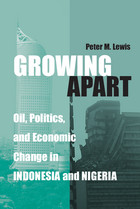
"Growing Apart is an important and distinguished contribution to the literature on the political economy of development. Indonesia and Nigeria have long presented one of the most natural opportunities for comparative study. Peter Lewis, one of America's best scholars of Nigeria, has produced the definitive treatment of their divergent development paths. In the process, he tells us much theoretically about when, why, and how political institutions shape economic growth."
—Larry Diamond, Senior Fellow, Hoover Institution
"Growing Apart is a careful and sophisticated analysis of the political factors that have shaped the economic fortunes of Indonesia and Nigeria. Both scholars and policymakers will benefit from this book's valuable insights."
—Michael L. Ross, Associate Professor of Political Science, Chair of International Development Studies, UCLA
"Lewis presents an extraordinarily well-documented comparative case study of two countries with a great deal in common, and yet with remarkably different postcolonial histories. His approach is a welcome departure from currently fashionable attempts to explain development using large, multi-country databases packed with often dubious measures of various aspects of 'governance.'"
—Ross H. McLeod, Editor, Bulletin of Indonesian Economic Studies
—Nicolas van de Walle, John S. Knight Professor of International Studies, Cornell University
Peter M. Lewis is Associate Professor and Director of the African Studies Program, Johns Hopkins University, School of Advanced International Studies.
READERS
Browse our collection.
PUBLISHERS
See BiblioVault's publisher services.
STUDENT SERVICES
Files for college accessibility offices.
RECENTLY PUBLISHED






UChicago Accessibility Resources
home | accessibility | search | about | contact us
BiblioVault ® 2001 - 2026
The University of Chicago Press