front cover of Gardening for Love
Gardening for Love
The Market Bulletins
Elizabeth A. Lawrence
Duke University Press, 1987
Elizabeth Lawrence occupies a secure place in the pantheon of twentieth-century gardening writers that includes Gertrude Jekyll and Vita Sackville-West of Great Britain and Katherine S. White of the United States. Her books, such as A Southern Garden (1942) and The Little Bulbs (1957), remain in print, continuing to win praise from criticis and to delight an ever-widening circle of readers. In Gardening for Love, Lawrence reveals another world of garden writing, the world of the rural women of the South with whom she corresponded extensively from the late 1950s into the mid-1970s in responce to their advertisements for herbs and ornamental perennials in several market bulletins (published by state departments of agriculture for the benefit of farmers).

It was Eudora Welty who awakened Elizabeth Lawrence's interest in this fascinating topic by putting her name on the mailing list of The Mississippi Market Bulletin, a twice-monthly collection of classified advertisements founded in 1928 and still published today. Lawrence soon discovered market bulletins from the Carolinas and other Southern states, as well as similar bulletins published privately in the North. She began ordering plants from the bulletins, and there ensued a lively exchange of letters wit the women who sold them.

Gardening for Love is Lawrence's exploration of this little-known side of American horticulture and her affectionate tribute to country people who shared her passion for plants. Drawing on the letters she received, sometimes a great many of them from the same persons over many years, she delves into traditional plant lore, herbal remedies, odd and often highly poetic vernacular plant names peculiar to particular regions of the South, and the herb collectors of the mountains of the Carolinas and Georgia. She focuses primarily on the Southeast and the Deep South, but her wide knowledge of both literature and botany gives Gardening for Love a dimension that transcends the category of regional writing.
[more]

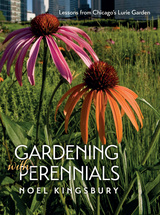
front cover of Gardening with Perennials
Gardening with Perennials
Lessons from Chicago's Lurie Garden
Noel Kingsbury
University of Chicago Press, 2014
For gardeners, inspiration can come from the most unexpected places. Perennial enthusiasts around the world might be surprised to find their muse in the middle of a bustling city. Lurie Garden, a nearly three-acre botanic garden in the center of Chicago’s lakefront in Millennium Park, is a veritable living lab of prairie perennials, with a rich array of plant life that both fascinates and educates as it grows, flowers, and dies back throughout the year. Thousands of visitors pass through each year, and many leave wondering how they might bring some of the magic of Lurie to their own home gardens.

With Gardening with Perennials horticulturalist and garden writer Noel Kingsbury brings a global perspective to the Lurie oasis through a wonderful introduction to the world of perennial gardening. He shows how perennials have much to offer home gardeners, from sustainability—perennials require less water than their annual counterparts—to continuity, as perennials’ longevity makes them a dependable staple.

Kingsbury also explains why Lurie is a perfect case study for gardeners of all locales. The plants represented in this urban oasis were chosen specifically for reliability and longevity. The majority will thrive on a wide range of soils and across a wide climatic range. These plants also can thrive with minimal irrigation, and without fertilizers or chemical control of pests and diseases. Including a special emphasis on plants that flourish in sun, and featuring many species native to the Midwest region, Gardening with Perennials will inspire gardeners around the world to try Chicago-style sustainable gardening.
[more]

front cover of Genus Cyclamen
Genus Cyclamen
In Science, Cultivation, Art and Culture
Edited by Brian Mathew
Royal Botanic Gardens, Kew, 2013
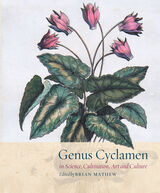
The Cyclamen is a literary and artistic darling, decorating ceramics, pottery, and jewelry, and found in botanical art references dating back to the first century. It is also a favorite of gardeners, growers, and botanists due to its extraordinary capacity for variation, in colors, shapes, fragrances, and flowering periods.

Genus Cyclamen is a celebration of this remarkable plant. Its science-based emphasis on botany and cultivation is complemented by sections on art and history, including twenty-five newly commissioned paintings and over seven hundred photographs. It provides a wealth of information, including taxonomic descriptions, flowering periods, distribution, and habitat, all based on the deep knowledge and practical experiences of the Cyclamen Society and other cyclamen experts. This book will find a wide audience of growers, gardeners, botanists, and enthusiasts, thanks to its all-encompassing coverage of the cyclamen and its informative, but accessible style.
[more]

front cover of The Genus Meconopsis
The Genus Meconopsis
Blue poppies and their relatives
Christopher Grey-Wilson
Royal Botanic Gardens, Kew, 2015
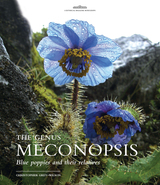
The Himalayan Blue Poppy is a bit of a perennial diva. Spotted in the wild, it turns heads and catches reverent attention, but it is also notoriously fickle, requiring careful cultivation and often refusing to flourish in most climates below 10,000 feet. Together with the other colorful species of the Meconopsis genus, they are some of the most distinctive and most sought-after members of the poppy family.
The Genus Meconopsis is the first major revision of the genus since 1934 and the only monograph on the genus in existence. This fully revised text incorporates the discovery of nearly thirty new species with decades of new scholarship. The book is extensively illustrated with striking color photographs and botanical paintings. Species descriptions that include habitat and variation within the genus, as well as detailed distribution maps, make this ideal for botanists, horticulturalists, and gardeners alike.
[more]

front cover of The Genus Tulipa
The Genus Tulipa
Tulips of the World
Diana Everett
Royal Botanic Gardens, Kew, 2013
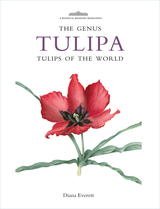
Beloved for their eye-popping colors that often mark the arrival of spring, tulips are a perennial favorite. The Genus Tulipa combines the latest scientific research with beautiful and useful illustrations, creating a visual delight as fascinating as the flowers themselves. Each species is fully illustrated with botanical paintings, color photographs of the plants in habitat, and distribution maps. In addition, the experts of the Royal Botanic Gardens, Kew, lend their prowess to chapters on everything from cultivation to classification. Checklists of tulip species and their world-wide synonyms, nursery and buying information, and a glossary with diagrams round out this comprehensive guide.
[more]

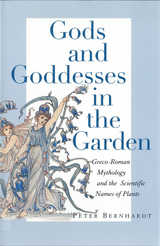
front cover of Gods and Goddesses in the Garden
Gods and Goddesses in the Garden
Greco-Roman Mythology and the Scientific Names of Plants
Bernhardt, Peter
Rutgers University Press, 2008
 Zeus, Medusa, Hercules, Aphrodite. Did you know that these and other dynamic deities, heroes, and monsters of Greek and Roman mythology live on in the names of trees and flowers? Some grow in your local woodlands or right in your own backyard garden.
 
In this delightful book, botanist Peter Bernhardt reveals the rich history and mythology that underlie the origins of many scientific plant names. Unlike other books about botanical taxonomy that take the form of heavy and intimidating lexicons, Bernhardt's account comes together in a series of interlocking stories. Each chapter opens with a short version of a classical myth, then links the tale to plant names, showing how each plant "resembles" its mythological counterpart with regard to its history, anatomy, life cycle, and conservation. You will learn, for example, that as our garden acanthus wears nasty spines along its leaf margins, it is named for the nymph who scratched the face of Apollo. The shape-shifting god, Proteus, gives his name to a whole family of shrubs and trees that produce colorful flowering branches in an astonishing number of sizes and shapes.
 
Amateur and professional gardeners, high school teachers and professors of biology, botanists and conservationists alike will appreciate this book's entertaining and informative entry to the otherwise daunting field of botanical names. Engaging, witty, and memorable, Gods and Goddesses in the Garden transcends the genre of natural history and makes taxonomy a topic equally at home in the classroom and at cocktail parties.
[more]

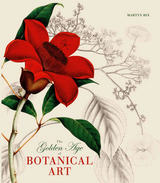
front cover of The Golden Age of Botanical Art
The Golden Age of Botanical Art
Martyn Rix
University of Chicago Press, 2012
The seventeenth century heralded a golden age of exploration, as intrepid travelers sailed around the world to gain firsthand knowledge of previously unknown continents. These explorers also collected the world’s most beautiful flora, and often their findings were recorded for posterity by talented professional artists. The Golden Age of Botanical Art tells the story of these exciting plant-hunting journeys and marries it with full-color reproductions of the stunning artwork they produced. Covering work through the nineteenth century, this lavishly illustrated book offers readers a look at 250 rare or unpublished images by some of the world’s most important botanical artists.
            Truly global in its scope, The Golden Age of Botanical Art features work by artists from Europe, China, and India, recording plants from places as disparate as Africa and South America. Martyn Rix has compiled the stories and art not only of well-known figures—such as Leonardo da Vinci and the artists of Empress Josephine Bonaparte—but also of those adventurous botanists and painters whose  names and work have been forgotten. A celebration of both extraordinarily beautiful plant life and the globe-trotting men and women who found and recorded it, The Golden Age of Botanical Art will enchant gardeners and art lovers alike.
 

[more]

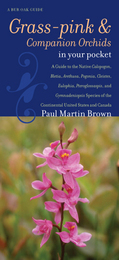
front cover of Grass-pinks and Companion Orchids in Your Pocket
Grass-pinks and Companion Orchids in Your Pocket
A Guide to the Native Calopogon, Bletia, Arethusa, Pogonia, Cleistes, Eulophia, Pteroglossaspis, and
Paul Martin Brown
University of Iowa Press, 2008
Native orchids are increasingly threatened by pressure from population growth and development but, nonetheless, still present a welcome surprise to observant hikers in every state and province. Compiled and illustrated by long-time orchid specialist Paul Martin Brown, these pocket guides to grass-pinks and their companions form part of a series that will cover all the wild orchids of the continental United States and Canada.
      Brown provides general distributional information, time of flowering, and habitat requirements for each species as well as a complete list of hybrids and the many different growth and color forms that can make identifying orchids so intriguing. For the grass-pinks and companions he includes information on 16 species, 2 additional varieties, and 7 hybrids.
      Grass-pinks, with their showy pink to white flowers, are some of the most conspicuous wild orchids encountered in the prairies, bogs, and open wetlands of eastern North America. Most of these species are easy to identify based upon their general appearance, range, and time of flowering. Answering three simple questions—when, where, and how does it grow?—and comparing the living plant with the striking photos in the backpack-friendly laminated guide should enable both professional and amateur naturalists to achieve the satisfaction of identifying a specific orchid.
[more]

front cover of The Guide to Oklahoma Wildflowers
The Guide to Oklahoma Wildflowers
Patricia Folley
University of Iowa Press, 2012
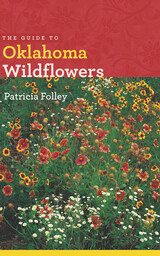
With its Rocky Mountain foothills, hardwood forests, many rivers and streams, low mountains, sand dunes, cypress swamps, and wide swaths of rangeland and pastureland, the Great Plains state of Oklahoma is one of only four with more than ten ecoregions. Tallgrass, mixed-grass, and shortgrass prairies are native to large areas; rainfall and temperature are quite variable; and elevations drop from 5,000 to 300 feet. This diversity ensures that Oklahoma is host to hundreds of species of wildflowers, yet no guidebook to these botanical riches has been available in recent years. Patricia Folley’s beautifully photographed and carefully compiled Guide to Oklahoma Wildflowers fills this gap.
 
Folley has photographed and described the two hundred wildflower species that are most commonly seen along roadsides and in parks throughout the state. She provides at least two photos for each plant, showing the entire plant as it occurs in the wild, outside of cultivation, along with a close-up of its flower. Each plant is keyed to a particular geographical location and a particular family, and an index to colors is a further aid to identification. If a species is native—such as big bluestem, the defining grass of Oklahoma’s tallgrass prairies—Folley presents this information in the text along with time of blooming, size and color of blooms, preferred habitat, and common and scientific names for all species.
 
Oklahoma contains vast plains, elevated rocky plateaus, and forested mountains. Botanizing one’s way across the Sooner State reveals celestial lilies in the east, prickly poppies in the west, Dutchman’s breeches in the northeast, large-flowered evening primrose in central and southwest areas, Indian pink in the southeast, walking-stick cholla in the Panhandle, and purple prairie clover statewide. Gardeners, teachers, tourists, and naturalists of all levels of expertise will enjoy this guide’s concise text and vibrant photos.
[more]

logo for Royal Botanic Gardens, Kew
Guide to the Flowers of Western China
Christopher Grey-Wilson and Phillip Cribb
Royal Botanic Gardens, Kew, 2023
A completely revised and updated second edition of the essential field guide and reference work.

Since the publication of the first edition of Guide to the Flowers of Western China in 2011, there have been great strides in knowledge of the flora of China through international collaboration. Many plants included in the first edition have been revisited in the wild, while areas hitherto inaccessible have opened up, if sometimes only temporarily. Great advances in systematic botany have occurred since the publication of the first edition, particularly with the widespread availability of rapid DNA analysis. The result of this has been an influx of new photographs and data, and the need for a second edition of Guide to the Flowers of Western China.
 
[more]

logo for Royal Botanic Gardens, Kew
Guide to the Flowers of Western China
Christopher Grey-Wilson and Phillip Cribb
Royal Botanic Gardens, Kew, 2011

Unrivaled in the temperate latitudes of the world, China’s rich flora comprises 30,000 species of plants, and nowhere is this floral richness more evident than in western China. With its lush forests, meandering rivers, and majestic mountains, the west of China has been a center of plant exploration for over two centuries, giving rise to many well-known species of trees, shrubs, perennials, and bulbs that populate our parks and botanical institutes, including rhododendron, orchids, peonies, and roses.

            
Guide to the Flowers of Western China describes and illustrates more than two thousand species, from the common to the endemic to the extremely rare. Plant families are arranged following the latest DNA-based classification, making this pictorial guide— the largest and most comprehensive on western China ever published—essential for gardeners and plant scientists.


Celebrating the wealth of western China’s vast flora, this magnificent volume will enable the horticulturally inclined traveler (or armchair traveler) to identify many of the plants encountered in the wild.

[more]


Send via email Share on Facebook Share on Twitter