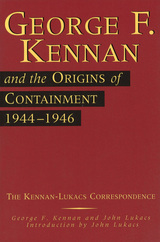
front cover of George F. Kennan and the Origins of Containment, 1944-1946
George F. Kennan and the Origins of Containment, 1944-1946
The Kennan-Lukacs Correspondence
George F. Kennan & Jonh Lukacs
University of Missouri Press, 1997

In 1945 the United States saw the Soviet Union as its principal ally. By 1947, it saw the Soviet Union as its principal opponent. How did this happen? Historian John Lukacs has provided an answer to this question through an exchange of letters with George F. Kennan. Their correspondence deals with the antecedents of containment between 1944 and 1946, during most of which time Kennan was at the American embassy in Moscow.

Kennan had strong opinions about America's appropriate role during and after World War II and is perhaps best known as the architect of America's containment policy. Much has been written about Kennan and containment, but relatively little is known about the events that made him compose and send the Long Telegram in 1946 that ultimately became the draft for foreign policy dealing with the Soviets in the following forty years.

These letters show Kennan's fear of the extent to which the United States misunderstood the Soviet regime. Especially in 1944, at the time of the Russians' betrayal of the Warsaw Uprising, it became evident that the Soviets were interested in establishing their rigid domination of Eastern and Central Europe and dividing the continent.

Kennan's letters to Lukacs are thorough and detailed, suggesting that the Truman administration was not in the least premature in opposing the Soviet Union. Indeed, both correspondents suggest that these decisions should have been made earlier. This series of letters will add greatly to our understanding of what preceded containment and the Cold War in 1947.
[more]

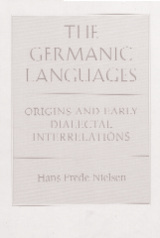
front cover of The Germanic Languages
The Germanic Languages
Origins and Early Dialectal Interrelations
Hans Frede Nielsen
University of Alabama Press, 1989
A revised and translated version of De germanske sprog. Baggrund og gruppe'ring (Odense University Press, 1979), which has been out of print for several years

The book is especially concerned with the grouping of the Germanic languages: with the research history of this much-debated question and with a discussion of the methods applied to past attempts and indeed applicable to future research in the field.
[more]

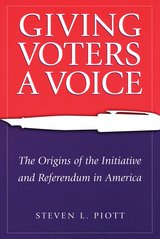
front cover of Giving Voters a Voice
Giving Voters a Voice
The Origins of the Initiative and Referendum in America
Steven L. Piott
University of Missouri Press, 2003
Giving Voters a Voice studies the origins of direct legislation, one of the most important political reforms enacted during the Progressive Era. Steven L. Piott begins with the source of the idea in the United States and proceeds to the earliest efforts aimed at generating a national movement to expand the parameters of popular democracy in the 1890s. He then broadens his examination to include the unique ways in which twenty-two states came to enact legislation allowing for the statewide initiative and referendum between 1898 and 1918. The book’s appendix offers the only comprehensive listing of all the ballot propositions and vote totals for the period.
Most historians of the Progressive Era have concluded that narrow self-interest prevented labor, farmers, and the middle class from working together to achieve important reforms. Giving Voters a Voice demonstrates that middle-class reformers, trade unionists, and farm organizers formed loose political coalitions and directed grass-roots campaigns to gain passage of initiative and referendum statutes because direct legislation offered the best means to correct political, economic, and social abuses. But there was more than just a shared sense of common interest that brought these seemingly oppositional groups together. What really made them willing to speak, lobby, and work together was quite simply the frustration felt by voters who sensed that they had become economically dependent and politically powerless.
Each state in which proponents conducted an active campaign to win adoption of direct legislation is studied in detail. The book analyzes the crucial roles played by individuals who led the movement to empower voters by enabling them to enact or veto legislation directly, and reveals the arguments, the stumbling blocks, and political compromises that are often slighted in generalized overviews. Each state possessed its own political dynamic. Giving Voters a Voice offers the reader a richness of detail and a completeness of coverage not found elsewhere.
[more]

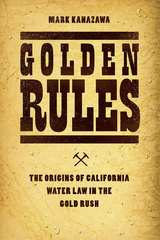
front cover of Golden Rules
Golden Rules
The Origins of California Water Law in the Gold Rush
Mark Kanazawa
University of Chicago Press, 2015
Fresh water has become scarce and will become even more so in the coming years, as continued population growth places ever greater demands on the supply of fresh water. At the same time, options for increasing that supply look to be ever more limited. No longer can we rely on technological solutions to meet growing demand. What we need is better management of the available water supply to ensure it goes further toward meeting basic human needs. But better management requires that we both understand the history underlying our current water regulation regime and think seriously about what changes to the law could be beneficial.

For Golden Rules, Mark Kanazawa draws on previously untapped historical sources to trace the emergence of the current framework for resolving water-rights issues to California in the 1850s, when Gold Rush miners flooded the newly formed state. The need to circumscribe water use on private property in support of broader societal objectives brought to light a number of fundamental issues about how water rights ought to be defined and enforced through a system of laws. Many of these issues reverberate in today’s contentious debates about the relative merits of government and market regulation. By understanding how these laws developed across California’s mining camps and common-law courts, we can also gain a better sense of the challenges associated with adopting new property-rights regimes in the twenty-first century.
[more]

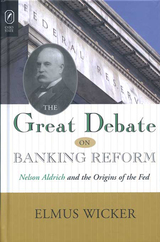
front cover of The GREAT DEBATE ON BANKING REFORM
The GREAT DEBATE ON BANKING REFORM
Nelson Aldrich and the Origins of the Fed
Elmus Wicker
The Ohio State University Press, 2005


Send via email Share on Facebook Share on Twitter