logo for University of Michigan Press
Game and Economic Theory
Selected Contributions in Honor of Robert J. Aumann
Sergiu Hart and Abraham Neyman, Editors
University of Michigan Press, 1995
Game and Economic Theory studies the interactions of decision makers whose decisions affect each other. The analysis is from a rational viewpoint: every participant would like to obtain the outcome that he prefers most. However, each one has to take into account that the others are doing the same--trying to get what they prefer most. At times this leads to fierce competition; at other times, to mutually beneficial cooperation; and in general, to an appropriate combination of these two extreme behaviors. Game theory, which may be viewed as a sort of "unified field" theory for the rational side of social science, develops the theoretical foundations for the analysis of such multi-person interactive situations, and then applies these to many disciplines: economics, political science, biology, psychology. computer science, statistics and law. Foremost among these is economic theory, where game theory is playing a central role.
This volume consists of twenty-two selected contributions to various areas of game and economic theory. These important and pathbreaking contributions are all by former students of Robert J. Aumann, to whom this volume is dedicated. The volume will no doubt shed light on the far-reaching pertinence of game theory and its application to economics, and also on the monumental impact of Aumann on this discipline.
Sergiu Hart is Alice Kusiel de Vorreuter Professor of Mathematical Economics and Director of the Center for Rationality and Interactive Decision Theory, The Hebrew University of Jerusalem. Abraham Neyman is Professor of Mathematics, The Hebrew University of Jerusalem, and Leading Professor of Economics and Mathematics, State University of New York at Stony Brook.
[more]

logo for Intellect Books
Gendered Transformations
Theory and Practices on Gender and Media
Edited by Tonny Krijnen, Claudia Alvares, and Sofie Van Bauwel
Intellect Books, 2011

Comprising the most current scholarship from leading experts in the fields of gender and media studies, Gendered Transformations offers readers a new foundation from which to reexamine traditional perspectives on gender. Organized into sections concerning representational politics, embodied performance, and social constructions of reality, these essays explore a wide variety of concerns from a similarly wide variety of perspectives, from essentialist to anti-essentialist. A thought-provoking contribution to a number of disparate fields, Gendered Transformations offers a rare interdisciplinary approach to gender that reflects the most recent developments in media theory and methodology.

[more]

logo for Intellect Books
Genre Matters
Essays in Theory and Criticism
Edited by Garin Dowd, Lesley Stevenson, and Jeremy Strong
Intellect Books, 2006
This collection of new essays addresses a topic of established and expanding critical interest throughout the humanities. It demonstrates that genre matters in a manner not constrained by disciplinary boundaries and includes new work on Genre Theory and applications of thinking about genre from Aristotle to Derrida and beyond. The essays focus on economies of expectation and competency, genre as media form, recent developments in television broadcast genres, translation and genericity, the role played by genre in film publicity, gender and genre, genre in fiction, and the problematics of classification. An introductory essay places the contributions in the context of a wide range of thinking about genre in the arts, media and humanities. The volume will be of interest to both undergraduates and postgraduates, especially those following courses on Genre Theory and Genre Criticism, and to academics working in a range of subject areas such as Cultural Studies, Film Studies, Media Studies and Literary Studies.
[more]

logo for Pluto Press
Global Politics of Regionalism
Theory and Practice
Edited by Mary Farrell, Bjorn Hettne, and Luk Van Langenhove
Pluto Press, 2005
This book explores the phenomenon of regionalism. In a seeming contradiction to globalization, there is a growing tendency for countries to enter into regional arrangements as a response to the pressures of operating in a global marketplace. But regionalism is also emerging as a phenomenon in its own right, serving distinct purposes and taking different forms in different areas. The contributors explore how these patterns impact on wider issues such as global governance, democracy and trade. 

The book reviews the major theoretical approaches to regional cooperation including perspectives from international relations, political economy, economics and sociology. It is divided into three main sections: theoretical approaches to regionalism; issues of regional cooperation (such as security, monetary issues, identity and integration); and an exploration of specific case studies including the Middle East, Africa, the Americas, China, Europe, Asia and the Pacific.

With an international range of contributors, including Bjorn Hettne, Louise Fawcett and Andrew Hurrell, this in-depth and multi-disciplinary guide will be of interest to students across the social sciences and to the wider policy community.
[more]

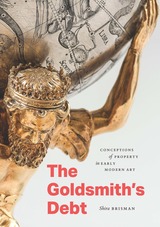
front cover of The Goldsmith's Debt
The Goldsmith's Debt
Conceptions of Property in Early Modern Art
Shira Brisman
University of Chicago Press, 2026
Reveals how art shaped the economy, social order, and legal claims during the rise of capitalism.
 
In the sixteenth century, German goldsmiths played a unique role in articulating property claims and social values. These artisans shaped precious metals into visible expressions of domination, subordination, and obligation. The objects they crafted played a major role in the practices of exchange and inheritance that were reconfiguring a tumultuous economic landscape. Cities commissioned goldsmiths to transform revenue into goblets that could be given as diplomatic gifts or reconverted into currency in times of war, and courts used serving implements as promises of credit.
 
With The Goldsmith’s Debt, art historian Shira Brisman offers the first book-length study of the Nuremberg goldsmith Christoph Jamnitzer (1563–1618), who created elaborate gilded silver drinking cups that he crafted into unexpected forms, with designs ranging from racialized heads to mining scenes. Considering how works of art can shape a social order, Brisman explores what Jamnitzer’s etchings and goblets reveal about how goldsmiths shared ideas and how their patrons used commissioned works to legitimize their claims over land and the rights of others. Drawing on a range of textual and material evidence—including commentaries on Roman and customary laws, wills and civic statutes, printed designs, and firsthand study of lidded cups in dozens of major European institutions—this unprecedented study places the goldsmith at the heart of the era’s arguments about how people and lands should be subjugated. Brisman reveals the insidious side of these objects that were often used to advance socially conservative agendas, and she presents radical proposals for addressing inequity in the world of ornament prints.
 
[more]

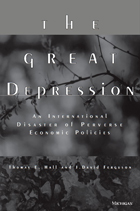
front cover of The Great Depression
The Great Depression
An International Disaster of Perverse Economic Policies
Thomas E. Hall and J. David Ferguson
University of Michigan Press, 1998
The Great Depression was the worst economic catastrophe in modern history. Not only did it cause massive worldwide unemployment, but it also led to the rise of Adolf Hitler in Germany, World War II in Europe, and the tragic deaths of tens of millions of people. This book describes the sequence of policy errors committed by powerful, well-meaning people in several countries, which, in combination with the gold standard in place at the time, caused the disaster. In addition, it details attempts to reduce unemployment in the United States by Franklin Roosevelt's New Deal, and in Germany by Hitler's National Socialist economic policies.
A comprehensive economic and historical explanation of the events pertaining to the Depression, this book begins by describing the economic setting in the major industrialized countries during the 1920s and the gold standard that linked theory economies together. It then discusses the triggering event that started the economic decline--the Federal Reserve's credit tightening in reaction to perceived overspeculation in the U.S. stock market. The policy bungling that transformed the recession into the Great Depression is detailed: Smoot Hawley, the Federal Reserve's disastrous adherence to the real bills doctrine, and Hoover's 1932 tax hike. This is followed by a detailed description of the New Deal's shortcomings in trying to end the Depression, along with a discussion of the National Socialist economic programs in Germany. Finally, the factors that ended the Depression are examined.
This book will appeal to economists, historians, and those interested in business conditions who would like to know more about the causes and consequences of the Great Depression. It will be particularly useful as a supplementary text in economic history courses.
Thomas E. Hall and J. David Ferguson are both Professors of Economics, Miami University.
[more]

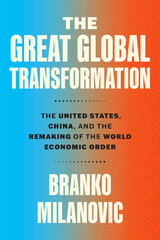
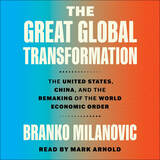
front cover of The Great Global Transformation
The Great Global Transformation
The United States, China, and the Remaking of the World Economic Order
Branko Milanovic
University of Chicago Press, 2026
From the essential chronicler of the world economy, a portrait of the Great Powers in transition.

The world’s two great economic powers are on opposite trajectories. In the United States, decades of neoliberal policies produced a small class of rich elites and gutted the middle class. In China, the same global forces have created a massive new upper class. The result is the greatest reshuffling of global incomes since the Industrial Revolution—a dramatic shakeup of each country’s political order. As the two powers retreat from one another, the implications for their futures, and for the world economy, are uncertain.

In The Great Global Transformation, acclaimed economist Branko Milanovic draws on original research to chart how these seismic shifts will shape the next century of the global economy. As both the US and China retreat into protectionism, Milanovic shows how a new and multipolar world order will follow—and how rising nationalism will have dramatically different effects on the two countries. And he shows us the fight ahead: as plutocracy returns, global war threatens, and a new system silently shapes our nations, driving populist discontent to the breaking point.

A worthy successor to Capitalism, Alone and his other landmark works, Milanovic’s new book announces the arrival of a new era he terms “national market liberalism,” in which liberalism survives in domestic economies, but not necessarily in the social arena. The Great Global Transformation is Milanovic’s indispensable account of the new twenty-first century now underway.
 
[more]

front cover of The Great Global Transformation
The Great Global Transformation
The United States, China, and the Remaking of the World Economic Order
Branko Milanovic
University of Chicago Press, 2026

From the essential chronicler of the world economy, a portrait of the Great Powers in transition.

The world’s two great economic powers are on opposite trajectories. In the United States, decades of neoliberal policies produced a small class of rich elites and gutted the middle class. In China, the same global forces have created a massive new upper class. The result is the greatest reshuffling of global incomes since the Industrial Revolution—a dramatic shakeup of each country’s political order. As the two powers retreat from one another, the implications for their futures, and for the world economy, are uncertain.

In The Great Global Transformation, acclaimed economist Branko Milanovic draws on original research to chart how these seismic shifts will shape the next century of the global economy. As both the US and China retreat into protectionism, Milanovic shows how a new and multipolar world order will follow—and how rising nationalism will have dramatically different effects on the two countries. And he shows us the fight ahead: as plutocracy returns, global war threatens, and a new system silently shapes our nations, driving populist discontent to the breaking point.

A worthy successor to Capitalism, Alone and his other landmark works, Milanovic’s new book announces the arrival of a new era he terms “national market liberalism,” in which liberalism survives in domestic economies, but not necessarily in the social arena. The Great Global Transformation is Milanovic’s indispensable account of the new twenty-first century now underway.
 

[more]

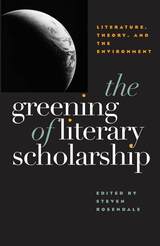
front cover of The Greening Of Literary Scholarship
The Greening Of Literary Scholarship
Literature, Theory, and he Environment
Steven Rosendale
University of Iowa Press, 2002
A collection of thirteen original essays by leaders in the emerging field of ecocriticism,The Greening of Literary Scholarship is devoted to exploring new and previously neglected literatures, theories, and methods in environmental-literary scholarship.

Each essay in this impressive collection challenges the notion that the study of environmental literature is separate from traditional concerns of criticism, and each applies ecocritical scholarship to literature not commonly explored in this context. New historicism, postcolonialism, deconstructionism, and feminist and Marxist theories are all utilized to evaluate and gain new insights into environmental literature; at the same time, Percy Bysshe Shelley, Upton Sinclair, Leslie Marmon Silko, and Susan Howe are studied from an ecocritical perspective.
At its core, The Greening of Literary Scholarship offers a practical demonstration of how articulating traditional and environmental modes of literary scholarship can enrich the interpretation of literary texts and, most important, revitalize the larger fields of environmental and literary scholarship.
[more]

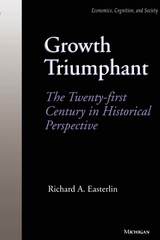
front cover of Growth Triumphant
Growth Triumphant
The Twenty-first Century in Historical Perspective
Richard A. Easterlin
University of Michigan Press, 1998
Taking a longer view than most literature on economic development, Richard A. Easterlin stresses the enormous contrast between the collective experience of the last half century in both developed and developing countries and what has gone before. An economic historian and demographer, the author writes in the tradition of the "new economic history," drawing on economic theory and quantitative evidence to interpret the historical experience of economic theory and population growth. He reaches beyond the usual disciplinary limits to draw, as appropriate, on sociology, political science, psychology, anthropology, and the history of science. The book will be of interest not only to social scientists but to all readers concerned with where we have been and where we are going.
". . . Easterlin is both an economic historian and a demographer, and it is the combination of these two disciplines and the fine balance between theory and experience that make this well-written, refreshingly optimistic book excellent reading." --Population and Development Review
"In this masterful synthesis, Richard Easterlin draws on the disciplines of economic history, demography, sociology, political science, psychology, and the history of science to present an integrated explation of the origins of modern economic growth and of the mortality revolution. . . . His book should be easily accessible to non-specialists and will give them a sense of why economic history can inform our understanding of the future." --Dora L. Costa, Massachusetts Institute of Technology, EH.Net and H-Net
"Growth Triumphant is, simply, a fascinating book. Easterlin has woven together a history of economic growth, economic development, human mortality and morbidity, the connections each has with the others, and the implications of this nexus of forces on the future. . . . This book deserves a wide audience." --Choice
"In what must surely be the most fair-minded, well-balanced, and scrupulously reasoned and researched book on the sensational subjects implied in its title--the Industrial Revolution, the mortality and fertility revolutions, and the prospects for future happiness for the human race--Professor Easterlin has set in place the capstone of his research career." --Journal of Economic History
Richard A. Easterlin is Professor of Economics, University of Southern California.
[more]


Send via email Share on Facebook Share on Twitter