
 A SCHOLARLY BOOK REPOSITORY
12 start with G start with G

From flight simulators and first-person shooters to MMPOG and innovative strategy games like 2008’s Spore, computer games owe their development to computer simulation and imaging produced by and for the military during the Cold War. To understand their place in contemporary culture, Patrick Crogan argues, we must first understand the military logics that created and continue to inform them. Gameplay Mode situates computer games and gaming within the contemporary technocultural moment, connecting them to developments in the conceptualization of pure war since the Second World War and the evolution of simulation as both a technological achievement and a sociopolitical tool.
Crogan begins by locating the origins of computer games in the development of cybernetic weapons systems in the 1940s, the U.S. Air Force’s attempt to use computer simulation to protect the country against nuclear attack, and the U.S. military’s development of the SIMNET simulated battlefield network in the late 1980s. He then examines specific game modes and genres in detail, from the creation of virtual space in fight simulation games and the co-option of narrative forms in gameplay to the continuities between online gaming sociality and real-world communities and the potential of experimental or artgame projects like September 12th: A Toy World and Painstation, to critique conventional computer games.
Drawing on critical theoretical perspectives on computer-based technoculture, Crogan reveals the profound extent to which today’s computer games—and the wider culture they increasingly influence—are informed by the technoscientific program they inherited from the military-industrial complex. But, Crogan concludes, games can play with, as well as play out, their underlying logic, offering the potential for computer gaming to anticipate a different, more peaceful and hopeful future.

According to security elites, revolutions in information, transport, and weapons technologies have shrunk the world, leaving the United States and its allies more vulnerable than ever to violent threats like terrorism or cyberwar. As a result, they practice responses driven by fear: theories of falling dominoes, hysteria in place of sober debate, and an embrace of preemptive war to tame a chaotic world.
Patrick Porter challenges these ideas. In The Global Village Myth, he disputes globalism's claims and the outcomes that so often waste blood and treasure in the pursuit of an unattainable "total" security. Porter reexamines the notion of the endangered global village by examining Al-Qaeda's global guerilla movement, military tensions in the Taiwan Strait, and drones and cyberwar, two technologies often used by globalists to support their views. His critique exposes the folly of disastrous wars and the loss of civil liberties resulting from the globalist enterprise. Showing that technology expands rather than shrinks strategic space, Porter offers an alternative outlook to lead policymakers toward more sensible responses—and a wiser, more sustainable grand strategy.
Contributors. Gwen Bergner, Maliha Chishti, Cheshmak Farhoumand-Sims, Nigel C. Gibson, Zubeda Jalalzai, David Jefferess, Altaf Ullah Khan, Kamran Rastegar, Rodney J. Steward, Imre Szeman
Americans have long considered their country to be good—a nation "under God" with a profound role to play in the world. Yet nothing tests that proposition like war. Raymond Haberski argues that since 1945 the common moral assumptions expressed in an American civil religion have become increasingly defined by the nation's experience with war.
God and War traces how three great postwar “trials”—the Cold War, the Vietnam War, and the War on Terror—have revealed the promise and perils of an American civil religion. Throughout the Cold War, Americans combined faith in God and faith in the nation to struggle against not only communism but their own internal demons. The Vietnam War tested whether America remained a nation "under God," inspiring, somewhat ironically, an awakening among a group of religious, intellectual and political leaders to save the nation's soul. With the tenth anniversary of 9/11 behind us and the subsequent wars in Iraq and Afghanistan winding down, Americans might now explore whether civil religion can exist apart from the power of war to affirm the value of the nation to its people and the world.
The evangelical embrace of conservatism is a familiar feature of the contemporary political landscape. What’s less well-known, however, is that the connection predates the Reagan revolution, going all the way back to the Depression and World War II. Evangelical businessmen at the time were quite active in opposing the New Deal—on both theological and economic grounds—and in doing so claimed a place alongside other conservatives in the public sphere. Like previous generations of devout laymen, they self-consciously merged their religious and business lives, financing and organizing evangelical causes with the kind of visionary pragmatism that they practiced in the boardroom.
In God’s Businessmen, Sarah Ruth Hammond explores not only these men’s personal trajectories but also those of the service clubs and other institutions that, like them, believed that businessmen were God’s instrument for the Christianization of the world. Hammond presents a capacious portrait of the relationship between the evangelical business community and the New Deal—and in doing so makes important contributions to American religious history, business history, and the history of the American state.
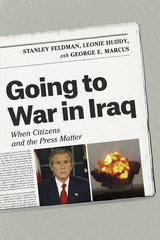
Drawing on the most comprehensive survey of public reactions to the war, Stanley Feldman, Leonie Huddy, and George E. Marcus revisit this critical period and come back with a very different story. Polling data from that critical period shows that the Bush administration’s carefully orchestrated campaign not only failed to raise Republican support for the war but, surprisingly, led Democrats and political independents to increasingly oppose the war at odds with most prominent Democratic leaders. More importantly, the research shows that what constitutes the news matters. People who read the newspaper were more likely to reject the claims coming out of Washington because they were exposed to the sort of high-quality investigative journalism still being written at traditional newspapers. That was not the case for those who got their news from television. Making a case for the crucial role of a press that lives up to the best norms and practices of print journalism, the book lays bare what is at stake for the functioning of democracy—especially in times of crisis—as newspapers increasingly become an endangered species.
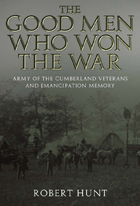
Robert Hunt examines how Union veterans of the Army of the Cumberland employed the extinction of slavery in the trans-Appalachian South in their memory of the Civil War. Hunt argues that rather than ignoring or belittling emancipation, it became central to veterans’ retrospective understanding of what the war, and their service in it, was all about. The Army of the Cumberland is particularly useful as a subject for this examination because it invaded the South deeply, encountering numerous ex-slaves as fugitives, refugees, laborers on military projects, and new recruits. At the same time, the Cumberlanders were mostly Illinoisans, Ohioans, Indianans, and, significantly, Kentucky Unionists, all from areas suspicious of abolition before the war.
Hunt argues that the collapse of slavery in the trans-Appalachian theater of the Civil War can be usefully understood by exploring the post-war memories of this group of Union veterans. He contends that rather than remembering the war as a crusade against the evils of slavery, the veterans of the Army of the Cumberland saw the end of slavery as a by-product of the necessary defeat of the planter aristocracy that had sundered the Union; a good and necessary outcome, but not necessarily an assertion of equality between the races.
Some of the most provocative discussions about the Civil War in current scholarship are concerned with how memory of the war was used by both the North and the South in Reconstruction, redeemer politics, the imposition of segregation, and the Spanish-American War. This work demonstrates that both the collapse of slavery and the economic and social post-War experience convinced these veterans that they had participated in the construction of the United States as a world power, built on the victory won against corrupt Southern plutocrats who had impeded the rightful development of the country.
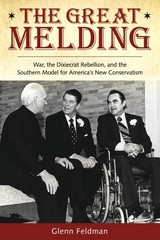
Audacious in its scope, subtle in its analysis, and persuasive in its arguments, The Great Melding is the second book in Glenn Feldman’s magisterial recounting of the South’s transformation from a Reconstruction-era citadel of Democratic Party inertia to a cauldron of GOP agitation. In this pioneering study, Feldman shows how the transitional years after World War II, the Dixiecrat episode, and the early 1950s formed a pivotal sequence of events that altered America’s political landscape in profound, fundamental, and unexpected ways.
Feldman’s landmark work The Irony of the Solid South dismantled the myth of the New Deal consensus, proving it to be only a fleeting alliance of fissiparous factions; The Great Melding further examines how the South broke away from that consensus. Exploring issues of race and white supremacy, Feldman documents and explains the roles of economics, religion, and emotive appeals to patriotism in southern voting patterns. His probing and original analysis includes a discussion of the limits of southern liberalism and a fresh examination of the Dixiecrat Revolt of 1948.
Feldman convincingly argues that the Dixiecrats—often dismissed as a transitory footnote in American politics—served as a template for the modern conservative movement. Now a predictable Republican stronghold, Alabama at the time was viewed by national political strategists as a battleground and bellwether. Masterfully synthesizing a vast range of sources, Feldman shows that Alabama was then one of the few states where voters made unpredictable choices between the competing ideologies of the Democrats, Republicans, and Dixiecrats.
Writing in his lively and provocative style, Feldman demonstrates that the events he recounts in Alabama between 1942 and Dwight Eisenhower’s 1952 election encapsulate a rare moment of fluidity in American politics, one in which the New Deal consensus shattered and the Democratic and Republican parties fought off a third-party revolt only to find themselves irrevocably altered by their success. The Great Melding will fascinate historians, political scientists, political strategists, and readers of political nonfiction.
READERS
Browse our collection.
PUBLISHERS
See BiblioVault's publisher services.
STUDENT SERVICES
Files for college accessibility offices.
RECENTLY PUBLISHED


UChicago Accessibility Resources
home | accessibility | search | about | contact us
BiblioVault ® 2001 - 2026
The University of Chicago Press