
 A SCHOLARLY BOOK REPOSITORY
132 start with H start with H
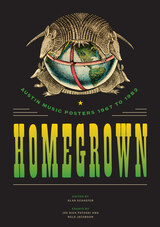
Before Austin became the “live music capital of the world” and attracted tens of thousands of music fans, it had a vibrant local music scene that spanned late sixties psychedelic and avant-garde rock to early eighties punk. Venues such as the Vulcan Gas Company and the Armadillo World Headquarters hosted both innovative local musicians and big-name touring acts. Poster artists not only advertised the performances—they visually defined the music and culture of Austin during this pivotal period. Their posters promoted an alternative lifestyle that permeated the city and reflected Austin’s transformation from a sleepy university town into a veritable oasis of underground artistic and cultural activity in the state of Texas.
This book presents a definitive survey of music poster art produced in Austin between 1967 and 1982. It vividly illustrates four distinct generations of posters—psychedelic art of the Vulcan Gas Company, early works from the Armadillo World Headquarters, an emerging variety of styles from the mid-1970s, and the radical visual aesthetic of punk—produced by such renowned artists as Gilbert Shelton, Jim Franklin, Kerry Awn, Micael Priest, Guy Juke, Ken Featherston, NOXX, and Danny Garrett. Setting the posters in context, Texas music and pop-culture authority Joe Nick Patoski details the history of music posters in Austin, and artist and poster art scholar Nels Jacobson explores the lives and techniques of the artists.
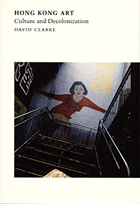
Clarke shows how a sense of local identity emerged in Hong Kong as the transition approached and found expression in the often politicized art produced. Given the recent international exposure of mainland Chinese contemporary art, this book considers the uniqueness of the art of China’s most cosmopolitan city. With a modern visual culture that was flourishing even when the People’s Republic was still closed to the outside world, Hong Kong has established itself as an exemplary site for both local and transnational elements to formulate into brilliant and groundbreaking art.
The author writes about individual artists and art works with a detail that will appeal to artists, curators, and art historians, as well as to postcolonial scholars, cultural studies scholars, and others.

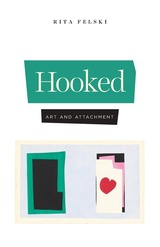
How does a novel entice or enlist us? How does a song surprise or seduce us? Why do we bristle when a friend belittles a book we love, or fall into a funk when a favored TV series comes to an end? What characterizes the aesthetic experiences of feeling captivated by works of art? In Hooked, Rita Felski challenges the ethos of critical aloofness that is a part of modern intellectuals’ self-image. The result is sure to be as widely read as Felski’s book, The Limits of Critique.
Wresting the language of affinity away from accusations of sticky sentiment and manipulative marketing, Felski argues that “being hooked” is as fundamental to the appreciation of high art as to the enjoyment of popular culture. Hooked zeroes in on three attachment devices that connect audiences to works of art: identification, attunement, and interpretation. Drawing on examples from literature, film, music, and painting—from Joni Mitchell to Matisse, from Thomas Bernhard to Thelma and Louise—Felski brings the language of attachment into the academy. Hooked returns us to the fundamentals of aesthetic experience, showing that the social meanings of artworks are generated not just by critics, but also by the responses of captivated audiences.
This is an auto-narrated audiobook edition of this book.
How does a novel entice or enlist us? How does a song surprise or seduce us? Why do we bristle when a friend belittles a book we love, or fall into a funk when a favored TV series comes to an end? What characterizes the aesthetic experiences of feeling captivated by works of art? In Hooked, Rita Felski challenges the ethos of critical aloofness that is a part of modern intellectuals’ self-image. The result is sure to be as widely read as Felski’s book, The Limits of Critique.
Wresting the language of affinity away from accusations of sticky sentiment and manipulative marketing, Felski argues that “being hooked” is as fundamental to the appreciation of high art as to the enjoyment of popular culture. Hooked zeroes in on three attachment devices that connect audiences to works of art: identification, attunement, and interpretation. Drawing on examples from literature, film, music, and painting—from Joni Mitchell to Matisse, from Thomas Bernhard to Thelma and Louise—Felski brings the language of attachment into the academy. Hooked returns us to the fundamentals of aesthetic experience, showing that the social meanings of artworks are generated not just by critics, but also by the responses of captivated audiences.
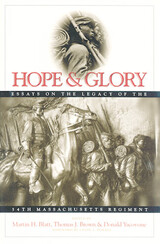
The monument by Augustus Saint-Gaudens to Robert Gould Shaw and the 54th Massachusetts Regiment, located on Boston Common, stands at a symbolic crossroads of American history. A reminder of the nation's ongoing struggle over race, it captures the Civil War's higher purpose—the end of slavery—and memorializes those black soldiers and white officers who made common cause in the service of freedom. The monument and the saga of the 54 th Massachusetts remain powerful touchstones, inspiring enduring meditations such as Robert Lowell's poem “For the Union Dead” and the popular film Glory.
This volume brings together the best scholarship on the history of the 54th, the formation of collective memory and identity, and the ways Americans have responded to the story of the regiment and the Saint-Gaudens monument. Contributors use the historical record and popular remembrance of the 54th as a lens for examining race and community in the United States. The essays range in time from the mid-nineteenth century to the present and encompass history, literature, art, music, and popular culture.
In addition to the editors and Colin Powell, who writes about the memory and example of the 54th in his own career, contributors include Stephen Belyea, David W. Blight, Thomas Cripps, Kathryn Greenthal, James Oliver Horton, Edwin S. Redkey, Marilyn Richardson, Kirk Savage, James Smethurst, Cathy Stanton, Helen Vendler, Denise Von Glahn, and Joan Waugh.
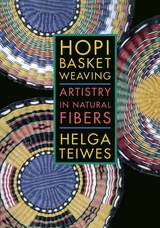
Rising dramatically from the desert floor, Arizona's windswept mesas have been home to the Hopis for hundreds of years. A people known for protecting their privacy, these Native Americans also have a long and less known tradition of weaving baskets and plaques. Generations of Hopi weavers have passed down knowledge of techniques and materials from the plant world around them, from mother to daughter, granddaughter, or niece.
This book is filled with photographs and detailed descriptions of their beautiful baskets—the one art, above all others, that creates the strongest social bonds in Hopi life. In these pages, weavers open their lives to the outside world as a means of sharing an art form especially demanding of time and talent. The reader learns how plant materials are gathered in canyons and creek bottoms, close to home and far away. The long, painstaking process of preparation and dying is followed step by step. Then, using techniques of coiled, plaited, or wicker basketry, the weaving begins.
Underlying the stories of baskets and their weavers is a rare glimpse of what is called "the Hopi Way," a life philosophy that has strengthened and sustained the Hopi people through centuries of change. Many other glimpses of the Hopi world are also shared by author and photographer Helga Teiwes, who was warmly invited into the homes of her collaborators. Their permission and the permission of the Cultural Preservation Office of the Hopi Tribe gave her access to people and information seldom available to outsiders.
Teiwes was also granted access to some of the ceremonial observances where baskets are preeminent. Woven in brilliant reds, greens, and yellows as well as black and white, Hopi weavings, then, not only are an arresting art form but also are highly symbolic of what is most important in Hopi life. In the women's basket dance, for example, woven plaques commemorate and honor the Earth and the perpetuation of life. Other plaques play a role in the complicated web of Hopi social obligation and reciprocity.
Living in a landscape of almost surreal form and color, Hopi weavers are carrying on one of the oldest arts traditions in the world. Their stories in Hopi Basket Weaving will appeal to collectors, artists and craftspeople, and anyone with an interest in Native American studies, especially Native American arts. For the traveler or general reader, the book is an invitation to enter a little-known world and to learn more about an art form steeped in meaning and stunning in its beauty.

The remarkable relationship between people and horses has been evoked in art from the beginning of the bond between them. In this beautifully illustrated book, Catherine Johns explores the horse in art from the ancient world to the modern era.
In early human history, horses were among the wild creatures hunted for meat; they were domesticated comparatively late, around 4000 B.C. As people developed from hunter-gatherers to farmers, the horse offered the potential for a revolution in power and transport—the ability to move farther and faster transformed society. Johns tells the story of the horse and highlights the key roles this animal has played in human warfare, travel, ceremony, hunting, racing, and in myth and symbolism.
The themes are presented in stunning four-color illustrations of British Museum objects that trace our perceptions of the horse through time and space, and convey the wide variety of images that have been created of this magnificent creature: in colossal and life-sized sculpture, in paintings, and in minuscule form on coins, gems, and jewelry; and from the world of ancient Greece and Rome to the arts of India, Africa, China, and Japan.
Horses appear in stone and metal, ceramic, wood, bone, ivory, and textiles. From the Horse of Selene and a gold model chariot from the Oxus treasure to Persian miniatures and prints by Duerer, Stubbs, and Hokusai, this book will inform, entertain, and delight horse lovers and all readers interested in this inspiring animal and its profound contribution to human culture.
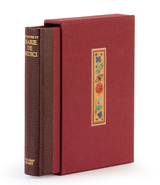
At the turn of the fifteenth century, private devotionals became a specialty of the renowned Ghent–Bruges illuminators. Wealthy patrons who commissioned work from these artists often spared no expense in the presentation of their personal prayer books, or “books of hours,” from detailed decoration to luxurious bindings and embroidery.
This manuscript owes its name to the French queen, Marie de Medici, widow of King Henri IV. The manuscript was painted by an artist known as the David Master, one of the renowned Flemish illuminators of the sixteenth century. Fine architectural interiors, gorgeous landscapes, and detailed city scenes form the subjects of three full-size illuminations and forty-two full-page miniatures. It is one of the finest examples of medieval illumination in a personal prayer book and the most copiously illustrated work of the David Master to survive.
Together with a scholarly introduction that gives an overview of Flemish illumination and examines each of the illustrations in detail, this full-color facsimile limited edition, bound in linen with a leather quarter binding and beautifully presented in a slipcase, faithfully reproduces all 176 leaves of the original manuscript.
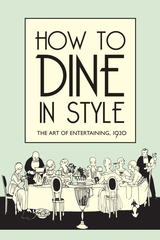
By turns a collection of practical advice and a catalog of eccentricities, The Whole Art of Dining, republished by the Bodleian Library as How to Dine in Style, contained everything the would-be socialite needed to know in order to elevate food to high art, from tricks for putting together a proper French menu or throwing a garden party to practical tips on serving wines in the correct order and at the right temperature. Throughout the book are stories of astonishing excess, such as the search for ever-more-elaborate themes and venues, and the more daring of the book’s devotees might have been tempted to emulate efforts like those of the intrepid hostess whose mountaineering-themed dinner party had guests rappel to the rooftop of her Chicago home or American millionaire George A. Kessler, whose infamous “Gondola Party” flooded— for the first and only time—the central courtyard of the Savoy.
A captivating glimpse into the golden age of fine dining, this book will be consumed with interest by discerning diners and fans of the Roaring Twenties—and it may even inspire readers to try their hand at throwing a stylish soiree of their own.

First published in 1971, How to Read Donald Duck shocked readers by revealing how capitalist ideology operates in our most beloved cartoons. Having survived bonfires, impounding and being dumped into the ocean by the Chilean army, this controversial book is once again back on our shelves.
Written and published during the blossoming of Salvador Allende's revolutionary socialism in Chile, the book examines how Disney products reflect capitalist ideology, and are active agents working in this ideology’s favor. Focusing on the hapless mice and ducks of Disney, curiously parentless, marginalized and always short of cash, Ariel Dorfman and Armand Mattelart expose how these characters established hegemonic ideas about capital, race, gender and the relationship between developed countries and the Third World.
A devastating indictment of a media giant, a document of twentieth-century political upheaval, and a reminder of the dark undercurrent of pop culture, How to Read Donald Duck is once again available, together with a new introduction by Ariel Dorfman in which he writes.
"It is that joy in liberation, that alegria, that spirit of resistance, that I wish to share with America, as the book that Pinochet’s soldiers could not liquidate or Disney’s lawyers stop from entering the United States finally finds its way to its new home, deep into the land that invented Donald Duck and Donald Trump. Is the same country that gave me such a warm welcome as a child, and perhaps may now equally greet with open arms this critique of oppression and it certainty that we don’t have to leave the world as it was when we first encountered it."
How should art be taught? What kind of knowledge should artists absorb? How might an ordinary person become a creature addicted to the creative process? In other words, how can a non-artist become an artist? Such programmatic questions articulated by acclaimed Polish artist Artur Żmijewski were at the heart of the workshop “How to Teach Art?” Żmijewski invited a group of graduate and doctoral students from three Zurich universities—the Swiss Federal Institute of Technology, the University of Zurich, and the Zurich University of the Arts—to collectively reflect on their artistic practices. Over the course of four months, the group met several times a week for hourlong sessions, following individual and collective exercises induced by Żmijewski himself.
This book retraces the workshop and its process by showing inconclusive, fragmentary results between theory and practice. How to Teach Art? presents drawings, videos, photographs, 16mm films, and accompanying reflections on the central premise, “How to teach art?”
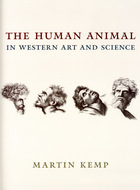
From the lazy, fiddling grasshopper to the sneaky Big Bad Wolf, children’s stories and fables enchant us with their portrayals of animals who act like people. But the comparisons run both ways, as metaphors, stories, and images—as well as scientific theories—throughout history remind us that humans often act like animals, and that the line separating them is not as clear as we’d like to pretend.
Here Martin Kemp explores a stunning range of images and ideas to demonstrate just how deeply these underappreciated links between humans and other fauna are embedded in our culture. Tracing those interconnections among art, science, and literature, Kemp leads us on a dazzling tour of Western thought, from Aristotelian physiognomy and its influence on phrenology to the Great Chain of Being and Darwinian evolution. We learn about the racist anthropology underlying a familiar Degas sculpture, see paintings of a remarkably simian Judas, and watch Mowgli, the man-child from Kipling’s The Jungle Book, exhibit the behaviors of the beasts who raised him. Like a kaleidoscope, Kemp uses these stories to refract, reconfigure, and echo the essential truth that the way we think about animals inevitably inflects how we think about people, and vice versa.
Loaded with vivid illustrations and drawing on sources from Hesiod to La Fontaine, Leonardo to P. T. Barnum, The Human Animal in Western Art and Science is a fascinating, eye-opening reminder of our deep affinities with our fellow members of the animal kingdom.
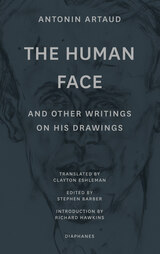
The many major exhibitions of Antonin Artaud’s drawings and drawn notebook pages in recent years—at New York’s Museum of Modern Art, Vienna’s Museum Moderner Kunst, and Paris’s Centre Georges Pompidou—have entirely transformed our perception of his work, reorienting it toward the artworks of his final years. This volume collects all three of Artaud’s major writings on his artworks. “The Human Face” (1947) was written as the catalog text for Artaud’s only gallery exhibition of his drawings during his lifetime, focusing on his approach to making portraits of his friends at the decrepit pavilion in the Paris suburbs where he spent the final year of his life. “Ten years that language is gone” (1947) examines the drawings Artaud made in his notebooks—his main creative medium at the end of his life—and their capacity to electrify his creativity when language failed him. “50 Drawings to assassinate magic” (1948), the residue of an abandoned book of Artaud’s drawings, approaches the act of drawing as part of the weaponry deployed by Artaud at the very end of his life to combat malevolent assaults and attempted acts of assassination. Together, these three extraordinary texts—pitched between writing and image—project Artaud’s ferocious engagement with the act of drawing.
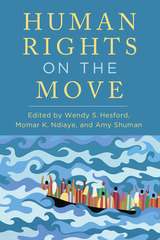
Contributing artists, activists, and scholars expose the fundamental paradox of human rights (namely that nation-states are violators and guarantors of rights) while also showing how people facing violence and persecution move with the hope of more livable and equitable futures. The assembled scholarly essays, interviews, and creative pieces demonstrate the importance of a more relational and contextual understanding of human rights—one that can destabilize current definitions and open space for new formulations.
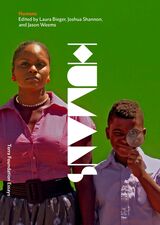
Humans are organisms, but “the human being” is a term referring to a complicated, self-contradictory, and historically evolving set of concepts and practices. Humans explores competing versions, constructs, and ideas of the human being that have figured prominently in the arts of the United States. These essays consider a range of artworks from the colonial period to the present, examining how they have reflected, shaped, and modeled ideas of the human in American culture and politics. The book addresses to what extent artworks have conferred more humanity on some human beings than others, how art has shaped ideas about the relationships between humans and other beings and things, and in what ways different artistic constructions of the human being evolved, clashed, and intermingled over the course of American history. Humans both tells the history of a concept foundational to US civilization and proposes new means for its urgently needed rethinking.
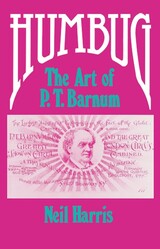

Reproducing some 150 images drawn from Furniss’s extensive graphic work, The Humours of Parliament: Harry Furniss’s View of Late-Victorian Political Culture, edited and with an introduction by Gareth Cordery and Joseph S. Meisel, presents Furniss’s unpublished lecture text for the first time. The extensive introduction places the show in its biographical, political, and performative contexts. Cordery and Meisel’s volume therefore both documents a pivotal moment in British political and social history and provides a rare case study of an important yet little studied nineteenth-century performance genre: the illustrated platform lecture.
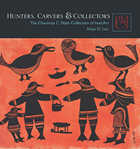
In the late 1950s, Chauncey C. Nash started collecting Inuit carvings just as the art of printmaking was being introduced in Kinngait (Cape Dorset), an Inuit community on Baffin Island in the Canadian territory of Nunavut. Nash donated some 300 prints and sculptures to Harvard’s Peabody Museum—one of the oldest collections of early modern Inuit art. The Peabody collection includes not only early Inuit sculpture but also many of the earliest prints on paper made by the women and men who helped propel Inuit art onto the world stage.
Author Maija M. Lutz draws from ethnology, archaeology, art history, and cultural studies to tell the story of a little-known collection that represents one of the most vibrant and experimental periods in the development of contemporary Inuit art. Lavishly illustrated, Hunters, Carvers, and Collectors presents numerous never-before-published gems, including carvings by the artists John Kavik, Johnniebo Ashevak, and Peter Qumalu POV Assappa. This latest contribution to the award-winning Peabody Museum Collections Series fills an important gap in the literature of Native American art.
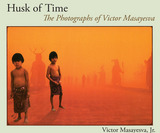
The notion of ecology not only figures centrally in current debates around climate change, but also traverses contemporary discourses in the arts, the humanities, and the social and techno sciences. In this present form, ecology refers to the multilayered and multidimensional nexus of living processes and technological and media practices—that is, to the complex relations of human and nonhuman agents. Hybrid Ecologies understands ecology as an ambivalent notion, whose very broadness simultaneously opens up new fields of action and raises provocative questions, not least concerning its genealogy. This interdisciplinary volume explores the political and social effects of rethinking community in ecological terms, with a particular emphasis on what the contemporary notion of ecology might mean for artistic and design practices. The result of the fifth annual program of the cx centre for interdisciplinary studies, which was conceived in cooperation with the Chair of Philosophy | Aesthetic Theory at the Academy of Fine Arts in Munich, Hybrid Ecologies is a timely and thought-provoking study of one of the most important themes of our time.
Hybrid Renaissance introduces the idea that the Renaissance in Italy, elsewhere in Europe, and in the world beyond Europe is an example of cultural hybridization.
The two key concepts used in this book are “hybridization” and “Renaissance”. Roughly speaking, hybridity refers to something new that emerges from the combination of diverse older elements. (The term “hybridization” is preferable to “hybridity” because it refers to a process rather than to a state, and also because it encourages the writer and the readers alike to think in terms of degree: where there is more or less, rather than presence versus absence.)
The book begins with a discussion of the concept of cultural hybridization and a cluster of other concepts related to it. Then comes a geography of cultural hybridization focusing on three locales: courts, major cities (whether ports or capitals) and frontiers. The following seven chapters describe the hybridity of the Renaissance in different fields: architecture, painting and sculpture, languages, literature, music, philosophy and law and finally religion. The essay concludes with a brief account of attempts to resist hybridization or to purify cultures or domains from what was already hybridized.
With Hyecho’s Journey, eminent scholar of Buddhism Donald S. Lopez Jr. re-creates Hyecho’s trek. Using the surviving fragments of Hyecho’s travel memoir, along with numerous other textual and visual sources, Lopez imagines the thriving Buddhist world the monk explored. Along the way, Lopez introduces key elements of Buddhism, including its basic doctrines, monastic institutions, works of art, and the many stories that have inspired Buddhist pilgrimage. Through the eyes of one remarkable Korean monk, we discover a vibrant tradition flourishing across a vast stretch of Asia. Hyecho’s Journey is simultaneously a rediscovery of a forgotten pilgrim, an accessible primer on Buddhist history and doctrine, and a gripping, beautifully illustrated account of travel in a world long lost.
From Oiticica’s late 1950s experiments with painting and color to his mid-1960s wearable Parangolés, Small traces a series of artistic procedures that foreground the activation of the spectator. Analyzing works, propositions, and a wealth of archival material, she shows how Oiticica’s practice recast—in a sense “folded”—Brazil’s utopian vision of progress as well as the legacy of European constructive art. Ultimately, the book argues that the effectiveness of Oiticica’s participatory works stems not from a renunciation of art, but rather from their ability to produce epistemological models that reimagine the traditional boundaries between art and life.
READERS
Browse our collection.
PUBLISHERS
See BiblioVault's publisher services.
STUDENT SERVICES
Files for college accessibility offices.
RECENTLY PUBLISHED




UChicago Accessibility Resources
home | accessibility | search | about | contact us
BiblioVault ® 2001 - 2026
The University of Chicago Press