
 A SCHOLARLY BOOK REPOSITORY
6 start with H start with H
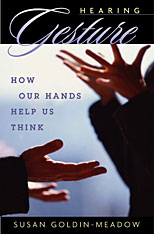
Many nonverbal behaviors—smiling, blushing, shrugging—reveal our emotions. One nonverbal behavior, gesturing, exposes our thoughts. This book explores how we move our hands when we talk, and what it means when we do so.
Susan Goldin-Meadow begins with an intriguing discovery: when explaining their answer to a task, children sometimes communicate different ideas with their hand gestures than with their spoken words. Moreover, children whose gestures do not match their speech are particularly likely to benefit from instruction in that task. Not only do gestures provide insight into the unspoken thoughts of children (one of Goldin-Meadow’s central claims), but gestures reveal a child’s readiness to learn, and even suggest which teaching strategies might be most beneficial.
In addition, Goldin-Meadow characterizes gesture when it fulfills the entire function of language (as in the case of Sign Languages of the Deaf), when it is reshaped to suit different cultures (American and Chinese), and even when it occurs in children who are blind from birth.
Focusing on what we can discover about speakers—adults and children alike—by watching their hands, this book discloses the active role that gesture plays in conversation and, more fundamentally, in thinking. In general, we are unaware of gesture, which occurs as an undercurrent alongside an acknowledged verbal exchange. In this book, Susan Goldin-Meadow makes clear why we must not ignore the background conversation.
For the first time in English, the introductory volume in a major French philosopher’s groundbreaking series of poetic transdisciplinary works
Michel Serres is recognized as one of the giants of postwar French philosophy of knowledge, along with Gilles Deleuze, Jacques Derrida, Michel Foucault, and Gilbert Simondon. His early five-volume series Hermes, which appeared in the 1960s and 1970s, was an intellectual supernova in its proposition that culture and science shared the same mythic and narrative structures. Hermes I: Communication marks the start of a major publishing endeavor to introduce this foundational series into English.
Building on the figure of the Greek god Hermes, who presides over the realms of communication and interpretation, Hermes I embarks on a reflection concerning the history of mathematics via Descartes and Leibniz and culminates by way of a Bachelardian logoanalytic reading of Homer, Dumas, Molière, Verne, and the story of Cinderella. We observe a singular poetic philosopher seeking to bridge the gap between the liberal arts and the sciences through a profound mathematical and poetic fable regarding information theory, history, and art, establishing a new way to think about the production of knowledge during the late twentieth century. In these pages, students and scholars of philosophy will discover an extraordinary project of thought as vital to critical reflection today as it was fifty years ago.

Unveiling the hidden connections in the network of knowledge
Hermes II: Interference is the second in a series of works by philosopher Michel Serres using Hermes, god of communication, as an archetypal symbolic figure for reflecting on philosophy and the arts and sciences. Serres delves into the concept of interreferentiality, proposing that every node—whether it be knowledge, objects, or people—exists within a network where it both receives and transmits information. He argues against the existence of a dominant center or pole within these networks, emphasizing that each node can temporarily serve as a focal point depending on context.
Serres presents unique insights into topics such as the nature of knowledge, the world of objects, intersubjectivity, the origins of geometry, the interplay of music and background noise, and empiricism. By identifying parallel structures across these areas, Serres unifies them into a comprehensive theoretical framework, revealing hidden connections and potential future influences. Additionally, this work includes a critique of Gaston Bachelard’s The Formation of the Scientific Mind and concludes with an analysis of communication in Hergé’s The Castafiore Emerald.
Hermes II is a unique blend of ancient and modern perspectives, combining rigorous analysis with an optimistic outlook and highlighting the interconnectedness of knowledge and its implications for fostering peaceful relations within the network of life.

"[Borgmann] has offered a stunningly clear definition of information in Holding On to Reality. . . . He leaves room for little argument, unless one wants to pose the now vogue objection: I guess it depends on what you mean by nothing."—Paul Bennett, Wired
"A superb anecdotal analysis of information for a hype-addled age."—New Scientist
"This insightful and poetic reflection on the changing nature of information is a wonderful antidote to much of the current hype about the 'information revolution.' Borgmann reminds us that whatever the reality of our time, we need 'a balance of signs and things' in our lives."—Margaret Wertheim, LA Weekly
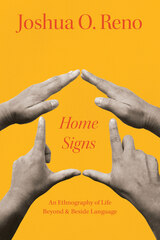
Home Signs grew out of the anthropologist Joshua Reno’s experience of caring for and trying to communicate with his teenage son, Charlie, who cannot speak. To manage interactions with others, Charlie uses what are known as “home signs,” gestures developed to meet his need for expression, ranging from the wiggle of a finger to a subtle sideways glance. Though he is nonverbal, he is far from silent: in fact, he is in constant communication with others.
In this intimate reflection on language, disability, and togetherness, the author invites us into his and Charlie’s shared world. Combining portraits of family life and interviews with other caregivers, Reno upends several assumptions, especially the idea that people who seem not to be able to speak for themselves need others to speak on their behalf. With its broad exploration of nonverbal communication in both human and nonhuman contexts, Home Signs challenges us to think harder about what it means to lead a “normal” life and to connect with another person.
READERS
Browse our collection.
PUBLISHERS
See BiblioVault's publisher services.
STUDENT SERVICES
Files for college accessibility offices.
RECENTLY PUBLISHED







UChicago Accessibility Resources
home | accessibility | search | about | contact us
BiblioVault ® 2001 - 2025
The University of Chicago Press