
 A SCHOLARLY BOOK REPOSITORY
4 start with H start with H

“Only someone shortsighted, or someone who values equality more than freedom, would deny that today’s citizens enjoy little or no freedom, particularly freedom of speech, and even less the ability to express openly or publicly the opinions that are not in conformity with what the majority considers acceptable at a given moment. It may sound paradoxical to contemporary ears, but a fight against totalitarianism must also mean a fight against the expansion of democracy.”
Janowski all at once brazen and out of bounds states what he calls the obvious and unthinkable truth: In the United States, we are already living in a totalitarian reality. The American citizen, the Homo Americanus, is an ideological being who is no longer good or bad, reasonable or irrational, proper or improper except when measured against the objectives of the dominating egalitarian mentality that American democracy has successfully incubated. American democracy has done what other despotic regimes have likewise achieved––namely, taken hold of the individual and forced him to renounce (or forget) his greatness, pursuit of virtue and his orientation toward history and Tradition.
Homo Americanus, Janowski argues, has no mind or soul and he cannot tolerate diversity and indeed he now censors himself. Democracy is not benign, and we should fear its principles come by and applied ad hoc. It is deeply troublesome that in the way democracy moves today it gives critics no real insight into any trajectory of reason behind its motion, which is erratic and unmappable. The Homo Americanus is an ideological entity whose thought and even morality are forbidden from universal abstraction.
Janowski mounts the offensive against what the American holds most sacred, and he does so in order to save him. After exposing the danger and the damage done, Janowski makes another startling proposal. It is a “diseased collective mind” that is the source of this ideology, the liberal anti-perspective that presses man into the image of the Homo Americanus, and its grip can only be broken through the recovery of instinct. Homo Americanus cannot be free again until he is himself again. That is, until the shadow that belongs only to him is restored, and he is thereby no longer alienated from others. Despite the condemnation Janowski seems to be levying on the citizen of the United States, he betrays a great hope and confidence that the means to shake ourselves awake from the bad dream are nevertheless in hand.
Janowski’s work is the next title in St. Augustine’s Press Dissident American Thought Today Series. It occupies a controversial overlapping terrain between the philosophical descriptions of liberalism as a tradition, psychology and the fundamentally influential critiques of democracy offered by Thucydides, Jefferson, Franklin, Tocqueville, Mill, Burke and more. More anecdotal than analytical, Janowski offers the contemporary proof that the reader is right to be scandalized by democracy and his or her own likeness of the Homo Americanus. Once upon a time it was the despicable Homo Sovieticus fruit of tyranny, but now we fear democratic society too might fall and all its citizens never be found again.
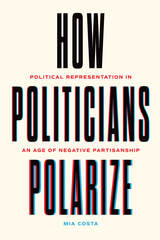
A fresh examination of political representation in an era of negative partisanship.
What does representation look like when politicians focus on "othering" the opposing party rather than the policy interests of their constituents? How do voters react to negative partisan rhetoric? And is policy responsiveness still the cornerstone of American representative democracy?
In How Politicians Polarize, Mia Costa draws on survey experiments, analysis of congressional newsletters and tweets, and data on fundraising and media coverage to examine how and why politicians rely so often on negative partisan attacks. Costa shows that most Americans do not like negative rhetoric, and politicians know this. Nonetheless, these kinds of attacks can reap powerful rewards from national media, donors, and party elites. Costa’s findings challenge the popular notion that Americans are motivated more by their partisan identities than by policy representation. Her research illuminates how the political ecosystem rewards negative representation and how this affects the quality of American democracy.
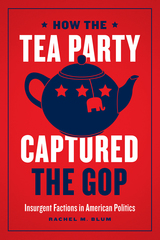
In How the Tea Party Captured the GOP, Rachel Marie Blum approaches the Tea Party from the angle of party politics, explaining the Tea Party’s insurgent strategies as those of a party faction. Blum offers a novel theory of factions as miniature parties within parties, discussing how fringe groups can use factions to increase their political influence in the US two-party system. In this richly researched book, the author uncovers how the electoral losses of 2008 sparked disgruntled Republicans to form the Tea Party faction, and the strategies the Tea Party used to wage a systematic takeover of the Republican Party. This book not only illuminates how the Tea Party achieved its influence, but also provides a framework for identifying other factional insurgencies.

Yilmaz’s primary case study is Danish immigration discourse, but his argument contextualizes his study in terms of questions of current concern across Europe, where right-wing groups that were long on the fringes of “legitimate” politics have managed to make significant gains with populations traditionally aligned with the Left. Specifically, Yilmaz argues that sociopolitical space has been transformed in the last three decades such that group classification has been destabilized to emphasize cultural rather than economic attributes.
According to this point-of-view, traditional European social and political splits are jettisoned for new “cultural” alliances pulling the political spectrum to the right, against the “corrosive” presence of Muslim immigrants, whose own social and political variety is flattened into an illusion of alien sameness.
READERS
Browse our collection.
PUBLISHERS
See BiblioVault's publisher services.
STUDENT SERVICES
Files for college accessibility offices.
RECENTLY PUBLISHED




UChicago Accessibility Resources
home | accessibility | search | about | contact us
BiblioVault ® 2001 - 2026
The University of Chicago Press