
 A SCHOLARLY BOOK REPOSITORY
11 start with H start with H
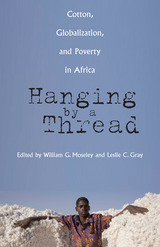
The textile industry was one of the first manufacturing activities to become organized globally, as mechanized production in Europe used cotton from the various colonies. Africa, the least developed of the world’s major regions, is now increasingly engaged in the production of this crop for the global market, and debates about the pros and cons of this trend have intensified.
Hanging by a Thread: Cotton, Globalization, and Poverty in Africa illuminates the connections between Africa and the global economy. The editors offer a compelling set of linked studies that detail one aspect of the globalization process in Africa, the cotton commodity chain.
From global policy debates, to impacts on the natural environment, to the economic and social implications of this process, Hanging by a Thread explores cotton production in the postcolonial period from different disciplinary perspectives and in a range of national contexts. This approach makes the globalization process palpable by detailing how changes at the macroeconomic level play out on the ground in the world’s poorest region. Hanging by a Thread offers new insights on the region in a global context and provides a critical perspective on current and future development policy for Africa.
Contributors: Thomas J. Bassett, Jim Bingen, Duncan Boughton, Brian M. Dowd, Marnus Gouse, Leslie C. Gray, Dolores Koenig, Scott M. Lacy, William G. Moseley, Colin Poulton, Bhavani Shankar, Corinne Siaens, Colin Thirtle, David Tschirley, and Quentin Wodon.
The celebrated economist Zvi Griliches’s entire career can be viewed as an attempt to advance the cause of accuracy in economic measurement. His interest in the causes and consequences of technical progress led to his pathbreaking work on price hedonics, now the principal analytical technique available to account for changes in product quality.
Hard-to-Measure Goods and Services, a collection of papers from an NBER conference held in Griliches’s honor, is a tribute to his many contributions to current economic thought. Here, leading scholars of economic measurement address issues in the areas of productivity, price hedonics, capital measurement, diffusion of new technologies, and output and price measurement in “hard-to-measure” sectors of the economy. Furthering Griliches’s vital work that changed the way economists think about the U.S. National Income and Product Accounts, this volume is essential for all those interested in the labor market, economic growth, production, and real output.

In this volume, some of the brightest minds in the field of economics present new empirical research that suggests that each side of the debate has something to offer the other. Free enterprise and well-developed financial systems are proven to produce growth in those countries that have them. But research also suggests that in some other capitalist countries, arrangements truly do concentrate corporate ownership in the hands of a few wealthy families.
A History of Corporate Governance around the World provides historical studies of the patterns of corporate governance in several countries-including the large industrial economies of Canada, France, Germany, Italy, Japan, the United Kingdom, and the United States; larger developing economies like China and India; and alternative models like those of the Netherlands and Sweden.
Leora Bilsky argues class action litigation and settlement offer a mode of accountability well suited to addressing the bureaucratic nature of business involvement in atrocities. Prior to these lawsuits, legal treatment of the Holocaust was dominated by criminal law and its individualistic assumptions, consistently failing to relate to the structural aspects of Nazi crimes. Engaging critically with contemporary debates about corporate responsibility for human rights violations and assumptions about “law,” she argues for the need to design processes that make multinational corporations accountable, and examines the implications for transitional justice, the relationship between law and history, and for community and representation in a post-national world. Her novel interpretation of the restitution lawsuits not only adds an important dimension to the study of Holocaust trials, but also makes an innovative contribution to broader and pressing contemporary legal and political debates. In an era when corporations are ever more powerful and international, Bilsky’s arguments will attract attention beyond those interested in the Holocaust and its long shadow.
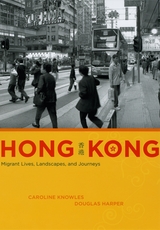
In 1997 the United Kingdom returned control of Hong Kong to China, ending the city’s status as one of the last remnants of the British Empire and initiating a new phase for it as both a modern city and a hub for global migrations. Hong Kong is a tour of the city’s postcolonial urban landscape, innovatively told through fieldwork and photography.
Caroline Knowles and Douglas Harper’s point of entry into Hong Kong is the unusual position of the British expatriates who chose to remain in the city after the transition. Now a relatively insignificant presence, British migrants in Hong Kong have become intimately connected with another small minority group there: immigrants from Southeast Asia. The lives, journeys, and stories of these two groups bring to life a place where the past continues to resonate for all its residents, even as the city hurtles forward into a future marked by transience and transition. By skillfully blending ethnographic and visual approaches, Hong Kong offers a fascinating guide to a city that is at once unique in its recent history and exemplary of our globalized present.

The only way to transform Haiti's dismal human rights legacy is through a bottom-up social movement, supported by local and international challenges to the status quo. That recipe for reform mirrors the strategy followed by Mario Joseph, Brian Concannon, and their clients and colleagues profiled in this book. Together, Joseph, Concannon, and their allies represent Haiti's best hope to escape the cycle of disaster, corruption, and violence that has characterized the country's two-hundred-year history. At the same time, their efforts are creating a template for a new and more effective human rights-focused strategy to turn around failed states and end global poverty.
An all-star cast of scholars and politicians from Europe and America propose and debate the creation of a new European parliament with substantial budgetary and legislative power to solve the crisis of governance in the Eurozone and promote social and fiscal justice and public investment.
The European Union is struggling. The rise of Euroskeptic parties in member states, economic distress in the south, the migrant crisis, and Brexit top the news. But deeper structural problems may be a greater long-term peril. Not least is the economic management of the Eurozone, the nineteen countries that use the Euro. How can this be accomplished in a way generally acceptable to members, given a political system whose structures are routinely decried for a lack of democratic accountability? How can the EU promote fiscal and social justice while initiating the long-term public investments that Europe needs to overcome stagnation? These are the problems a distinguished group of European and American scholars set out to solve in this short but valuable book.
Among many longstanding grievances is the charge that Eurozone policies serve large and wealthy countries at the expense of poorer nations. It is also unclear who decides economic policy, how the interests of diverse member states are balanced, and to whom the decision-makers are accountable. The four lead authors—Stéphanie Hennette, Thomas Piketty, Guillaume Sacriste, and Antoine Vauchez—describe these and other problems, and respond with a draft treaty establishing a parliament for economic policy, its members drawn from national parliaments. We then hear from invited critics, who express support, objections, or alternative ideas.
How to Democratize Europe offers a chance to observe how major thinkers view some of the Continent’s most pressing issues and attempt to connect democratic reform with concrete changes in economic and social policies.

Human Rights after Hitler reveals thousands of forgotten US and Allied war crimes prosecutions against Hitler and other Axis war criminals based on a popular movement for justice that stretched from Poland to the Pacific. These cases provide a great foundation for twenty-first-century human rights and accompany the achievements of the Nuremberg trials and postwar conventions. They include indictments of perpetrators of the Holocaust made while the death camps were still operating, which confounds the conventional wisdom that there was no official Allied response to the Holocaust at the time. This history also brings long overdue credit to the United Nations War Crimes Commission (UNWCC), which operated during and after World War II.
From the 1940s until a recent lobbying effort by Plesch and colleagues, the UNWCC’s files were kept out of public view in the UN archives under pressure from the US government. The book answers why the commission and its files were closed and reveals that the lost precedents set by these cases have enormous practical utility for prosecuting war crimes today. They cover US and Allied prosecutions of torture, including “water treatment,” wartime sexual assault, and crimes by foot soldiers who were “just following orders.” Plesch’s book will fascinate anyone with an interest in the history of the Second World War as well as provide ground-breaking revelations for historians and human rights practitioners alike.
READERS
Browse our collection.
PUBLISHERS
See BiblioVault's publisher services.
STUDENT SERVICES
Files for college accessibility offices.
RECENTLY PUBLISHED


UChicago Accessibility Resources
home | accessibility | search | about | contact us
BiblioVault ® 2001 - 2025
The University of Chicago Press