
 A SCHOLARLY BOOK REPOSITORY
17 start with H start with H
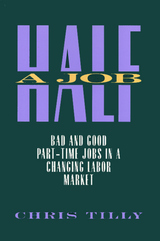
Over 20 million people are working part-time in the United States, more than six million of them involuntarily. Both Time and Fortune magazines have run recent cover stories about this constrained faction of the workforce, who tend to earn on average 40 percent less than full-time workers. Addressing this disturbing trend, Chris Tilly presents a current, in-depth analysis of how U.S. businesses use part-time employment, and why they are using it more and more.
Worker demand for part-time jobs peaked more than twenty years ago, but employers' desires for cheap labor and schedule flexibility have continued to drive the long-term growth of part-time jobs. Tilly argues that this growth is a reaction to the expanding trade and service industries, which, by their nature, depend on part-time workers. Examining the nature and purposes of the different types of part-time employment, he explores the roots of part-time jobs in the organization of work, and the inadequacies of existing public policies on part-time employment.
Using not only statistical analysis but over eighty interviews with employers in the retail and insurance industries, Tilly suggests new approaches to providing flexibility without insecurity.
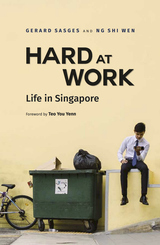
Through first-person narratives based on detailed interviews, vividly augmented with color photographs, Hard at Work reminds us of the everyday labor that continually goes on around us, and that every job can reveal something interesting if we just look closely enough. It shows us too the ways inequalities of status and income are felt and internalized in this highly globalized society.
A career-spanning collection of writings by the legendary labor historian
One of American labor history's most prominent scholars, Melvyn Dubofsky curated an accessible style and historical reach that have long marked his work as required reading for students and scholars.
This collection juxtaposes Dubofsky's early writings with scholarship from the 1990s. Selections include work on western working-class radicalism, U.S. labor history in transnational and comparative settings, and the impact of technological change on American worker’s movements. Throughout, the writings provide an invaluable eyewitness perspective on the academic and political climate of the 1960s and 1970s while tracing the development of labor history as a discipline.
An exploration of important themes in labor history, Hard Work combines essential scholarship with the story of how past and present interact in the work of historians.
- Winner of a Silver Medal from the Independent Publisher Book Awards
- Won Honorable Mention for 2023 ILHA Book of the Year (International Labor History Association)
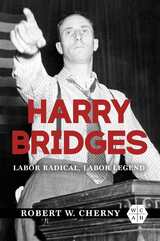
The iconic leader of one of America’s most powerful unions, Harry Bridges put an indelible stamp on the twentieth century labor movement. Robert Cherny’s monumental biography tells the life story of the figure who built the International Longshore and Warehouse Union (ILWU) into a labor powerhouse that still represents almost 30,000 workers.
An Australian immigrant, Bridges worked the Pacific Coast docks. His militant unionism placed him at the center of the 1934 West Coast Waterfront Strike and spurred him to expand his organizing activities to warehouse laborers and Hawaiian sugar and pineapple workers. Cherny examines the overall effectiveness of Bridges as a union leader and the decisions and traits that made him effective. Cherny also details the price paid by Bridges as the US government repeatedly prosecuted him for his left-wing politics.
Drawing on personal interviews with Bridges and years of exhaustive research, Harry Bridges places an extraordinary individual and the ILWU within the epic history of twentieth-century labor radicalism.
Helping Out addresses the centrality of children's labor participation in such family enterprises. Discussing the case of Chinese families running take-out food shops in Britain, Miri Song examines the ways in which children contribute their labor and the context in which children come to understand and believe in "helping out" as part of a "family work contract." Song explores the implications of these children's labor participation for family relationships, cultural identity, and the future of the Chinese community in Britain. While doing so, she argues that the practical importance and the broader meanings of children's work must be understood in the context of immigrant families' experiences of migration and ethnic minority status in Western, white-majority societies.
Author and journalist Lynn Waltz reveals how these aggressive tactics went unchecked for years until Sherri Buffkin, a higher-up manager at Smithfield, blew the lid off the company’s corrupt practices. Through meticulous reporting, in-depth interviews with key players, and a mind for labor and environmental histories, Waltz weaves a fascinating tale of the nearly two-decade struggle that eventually brought justice to the workers and accountability to the food giant, pitting the world’s largest slaughterhouse against the world’s largest meatpacking union.
Following in a long tradition of books that expose the horrors of the meatpacking industry—from Upton Sinclair’s The Jungle to Eric Schlosser’s Fast Food Nation—Hog Wild uncovers rampant corporate environmental hooliganism, labor exploitation, and union-busting by one of the nation’s largest meat producers. Waltz’s eye-opening examination sheds new light on the challenges workers face not just in meatpacking, but everywhere workers have lost their power to collectively bargain with powerful corporations.
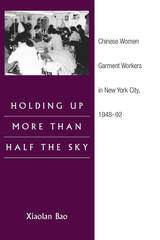
In 1982, 20,000 Chinese-American garment workers—most of them women—went on strike in New York City. Every Chinese garment industry employer in the city soon signed a union contract. The successful action reflected the ways women's changing positions within their families and within the workplace galvanized them to stand up for themselves.
Xiaolan Bao's now-classic study penetrates to the heart of Chinese American society to explain how this militancy and organized protest, seemingly so at odds with traditional Chinese female behavior, came about. Drawing on more than one hundred interviews, Bao blends the poignant personal stories of Chinese immigrant workers with the interwoven history of the garment industry and the city's Chinese community. Bao shows how the high rate of married women employed outside the home profoundly transformed family culture and with it the image and empowerment of Chinese American women. At the same time, she offers a complex and subtle discussion of the interplay of ethnic and class factors within New York's garment industry.
Passionately told and prodigiously documented, Holding Up More Than Half the Sky examines the journey of a community's women through an era of change in the home, on the shop floor, and walking the picket line.
This book is a timely contribution to the field of scholarship that focuses on Catholic Social Thought and is ideally suited for graduate studies and the reader interested in more serious questions in Christian theology.
Giulio Maspero, "The Bible and the Fathers of the Church on Work"
Patricia Ranft, "Work Theology in the High Middle Ages"
Angela Franks, "John Paul II's Metaphysics of Labor"
Deborah Savage, "Confronting a Technocratic Future: Women's Work and the Church's Social Vision"
Martin Schlag, "Contemplation at Work: A Theological Conversation Between John Paul II and Josemaría Escrivá"
Richard Turnbull, "Laborem Exercens: A Protestant Appreciation"
Michael Naughton, "Good Work: Insights from the Subjective Dimension of Work"
Christopher Michaelson, "Subjects and Objects in Meaningful Work"
Javier Ignacio Pinto Garay and Alvaro Pezoa Bissieres, "The Worker and the Transistor: The Dignity of Work and Business Ethics in Global Corporate Practices"
Gonzalo Flores-Castro Lingán, "The Real Work: Making the Encyclical Laborem Exercens Operational"
Geoffrey C. Friesen, "Laborem Exercens and the Subjective Dimension of Work in Economics and Finance"

With Housekeeping by Design, David Brody introduces us to those people—the housekeepers whose labor keeps the rooms clean and the guests happy. Through unprecedented access to staff at several hotels, Brody shows us just how much work goes on behind the scenes—and how much management goes out of its way to make sure that labor stays hidden. We see the incredible amount of hard physical work that is involved in cleaning and preparing a room, how spaces, furniture, and other objects are designed to facilitate a smooth flow of hidden labor, and, crucially, how that design could be improved for workers and management alike if front-line staff were involved in the design process. After reading this fascinating exposé of the ways hotels work—or don’t for housekeepers—one thing is certain: checking in will never be the same again.
As most American labor organizations struggle for survival and relevance in the twenty-first century, teachers unions appear to be an exception. Despite being all but nonexistent until the 1960s, these unions are maintaining members, assets—and political influence. As the COVID-19 epidemic has illustrated, today’s teachers unions are something greater than mere labor organizations: they are primary influencers of American education policy. How Policies Make Interest Groups examines the rise of these unions to their current place of influence in American politics.
Michael Hartney details how state and local governments adopted a new system of labor relations that subsidized—and in turn, strengthened—the power of teachers unions as interest groups in American politics. In doing so, governments created a force in American politics: an entrenched, subsidized machine for membership recruitment, political fundraising, and electoral mobilization efforts that have informed elections and policymaking ever since. Backed by original quantitative research from across the American educational landscape, Hartney shows how American education policymaking and labor relations have combined to create some of the very voter blocs to which it currently answers. How Policies Make Interest Groups is trenchant, essential reading for anyone seeking to understand why some voices in American politics mean more than others.

The Babylonian poem Atra-hasis is a forgotten masterpiece of political thought. Written in Akkadian in what is now southern Iraq during the early second millennium BCE, Atra-hasis gives us a glimpse of how ancient poets understood the society growing around them. This radical history of the world told from the perspective of the mother goddess conveys the complexity and contradictions that lie at the heart of the human experience. Atra-hasis tells how humanity was created as part of a bargain to resolve the world’s first labor strike, in which the lower gods rebelled against the excessive work imposed on them by the higher gods. It depicts humans as workers endowed with defiant intelligence. They multiply and become too loud, so the gods decide to quiet them with a cataclysmic flood.
Looking to Atra-hasis, Sophus Helle reveals an ancient story with reflections on power and history that invite comparison to topics of contemporary relevance, including labor, inequality, climate change, artificial intelligence, threats to democracy, disability, care work, sexual consent, and more. Helle considers Atra-hasis as a foundational document of “pasthumanism,” a term he uses to describe the study of how cultural conceptions of humanity have changed across centuries. He argues that ancient and non-Western texts remind us that cultural assumptions we now take for granted are neither natural nor necessary.
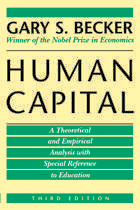
This expanded edition includes four new chapters, covering recent ideas about human capital, fertility and economic growth, the division of labor, economic considerations within the family, and inequality in earnings.
"Critics have charged that Mr. Becker's style of thinking reduces humans to economic entities. Nothing could be further from the truth. Mr. Becker gives people credit for having the power to reason and seek out their own best destiny."—Wall Street Journal
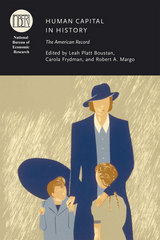
Human Capital in History brings together contributions from leading researchers in economic history, labor economics, the economics of education, and related fields. Building on Claudia Goldin’s landmark research on the labor history of the United States, the authors consider the roles of education and technology in contributing to American economic growth and well-being, the experience of women in the workforce, and how trends in marriage and family affected broader economic outcomes. The volume provides important new insights on the forces that affect the accumulation of human capital.
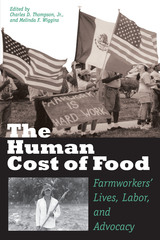
Finding fresh fruits and vegetables is as easy as going to the grocery store for most Americans—which makes it all too easy to forget that our food is cultivated, harvested, and packaged by farmworkers who labor for less pay, fewer benefits, and under more dangerous conditions than workers in almost any other sector of the U.S. economy. Seeking to end the public's ignorance and improve workers' living and working conditions, this book addresses the major factors that affect farmworkers' lives while offering practical strategies for action on farmworker issues.
The contributors to this book are all farmworker advocates—student and community activists and farmworkers themselves. Focusing on workers in the Southeast United States, a previously understudied region, they cover a range of issues, from labor organizing, to the rise of agribusiness, to current health, educational, and legal challenges faced by farmworkers. The authors blend coverage of each issue with practical suggestions for working with farmworkers and other advocates to achieve justice in our food system both regionally and nationally.
READERS
Browse our collection.
PUBLISHERS
See BiblioVault's publisher services.
STUDENT SERVICES
Files for college accessibility offices.
RECENTLY PUBLISHED






UChicago Accessibility Resources
home | accessibility | search | about | contact us
BiblioVault ® 2001 - 2026
The University of Chicago Press