
 A SCHOLARLY BOOK REPOSITORY
6 start with H start with H
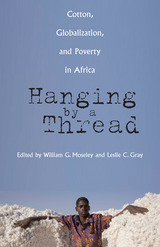
The textile industry was one of the first manufacturing activities to become organized globally, as mechanized production in Europe used cotton from the various colonies. Africa, the least developed of the world’s major regions, is now increasingly engaged in the production of this crop for the global market, and debates about the pros and cons of this trend have intensified.
Hanging by a Thread: Cotton, Globalization, and Poverty in Africa illuminates the connections between Africa and the global economy. The editors offer a compelling set of linked studies that detail one aspect of the globalization process in Africa, the cotton commodity chain.
From global policy debates, to impacts on the natural environment, to the economic and social implications of this process, Hanging by a Thread explores cotton production in the postcolonial period from different disciplinary perspectives and in a range of national contexts. This approach makes the globalization process palpable by detailing how changes at the macroeconomic level play out on the ground in the world’s poorest region. Hanging by a Thread offers new insights on the region in a global context and provides a critical perspective on current and future development policy for Africa.
Contributors: Thomas J. Bassett, Jim Bingen, Duncan Boughton, Brian M. Dowd, Marnus Gouse, Leslie C. Gray, Dolores Koenig, Scott M. Lacy, William G. Moseley, Colin Poulton, Bhavani Shankar, Corinne Siaens, Colin Thirtle, David Tschirley, and Quentin Wodon.

Nestled against the Cascade Mountains, former lumber town Bend, Oregon, entices residents who long to live in a wonderland of sagebrush and forests. But like so many other communities across the West, Bend has too few homes for everyone clambering for access. In High Desert, Higher Costs, Jonathan Bach takes a closer look at the housing crisis in this mid-sized city that is both the population center for rural Central Oregon and a major recreation area. Bach uses Bend as a lens into the growing housing crisis in the region, where residents and tourists alike prize access to outdoor recreation, and housing issues have been brewing for decades.
Like other cities in Montana, Idaho, and Colorado, Bend serves as a gateway to popular natural areas while also experiencing a limited amount of new housing, increasing populations, amenity migrants in the age of remote work, depressed or stagnating wages, and a widening gulf between homeowners and renters. High Desert, Higher Costs introduces us to regular people—from the former political candidate evicted during COVID-19 to the nonprofit worker hoping to build apartments for the houseless—who struggle to call Bend home. Bach explores the causes of these issues and the political, legal, economic, and cultural factors influencing them, and also offers potential solutions for current and future residents to build their lives now, and in the years to come, in Bend and throughout the American West.

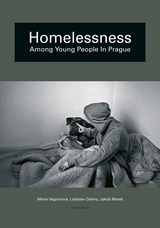
Young homeless people describe a life in which they lose their privacy, the possibility to satisfy their basic needs, and, often, their self-respect in order to survive. The latter half of the book considers what happens when these young people return to society and how they navigate difficulties as they attempt to leave their past behind. Often, the struggle is not solely one of coping with the stigma of their experience; rather, they must face the legacies that linger long after their lives have turned a corner: drug addiction, criminal records, and accumulated debt.
Based on interviews with homeless people in Prague, Homelessness as an Alternative Existence of Young People paints an authentic picture of this social group and documents the often unseen social consequences of the transformation to capitalism from communism.
Humans are social animals and, in general, don’t thrive in isolated environments. Homeless people, many of whom suffer from serious mental illnesses, often live socially isolated on the streets or in shelters. Homelessness, Housing, and Mental Illness describes a carefully designed large-scale study to assess how well these people do when attempts are made to reduce their social isolation and integrate them into the community.
Should homeless mentally ill people be provided with the type of housing they want or with what clinicians think they need? Is residential staff necessary? Are roommates advantageous? How is community integration affected by substance abuse, psychiatric diagnoses, and cognitive functioning? Homelessness, Housing, and Mental Illness answers these questions and reexamines the assumptions behind housing policies that support the preference of most homeless mentally ill people to live alone in independent apartments. The analysis shows that living alone reduces housing retention as well as cognitive functioning, while group homes improve these critical outcomes. Throughout the book, Russell Schutt explores the meaning and value of community for our most fragile citizens.
READERS
Browse our collection.
PUBLISHERS
See BiblioVault's publisher services.
STUDENT SERVICES
Files for college accessibility offices.
RECENTLY PUBLISHED






UChicago Accessibility Resources
home | accessibility | search | about | contact us
BiblioVault ® 2001 - 2026
The University of Chicago Press