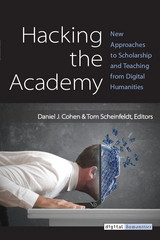
front cover of Hacking the Academy
Hacking the Academy
New Approaches to Scholarship and Teaching from Digital Humanities
Daniel J. Cohen and Tom Scheinfeldt, Editors
University of Michigan Press, 2013

On May 21, 2010, Daniel J. Cohen and Tom Scheinfeldt posted the following provocative questions online:

“Can an algorithm edit a journal? Can a library exist without books? Can students build and manage their own learning management platforms? Can a conference be held without a program? Can Twitter replace a scholarly society?”

As recently as the mid-2000s, questions like these would have been unthinkable. But today serious scholars are asking whether the institutions of the academy as they have existed for decades, even centuries, aren’t becoming obsolete. Every aspect of scholarly infrastructure is being questioned, and even more importantly, being hacked. Sympathetic scholars of traditionally disparate disciplines are canceling their association memberships and building their own networks on Facebook and Twitter. Journals are being compiled automatically from self-published blog posts. Newly minted PhDs are forgoing the tenure track for alternative academic careers that blur the lines between research, teaching, and service. Graduate students are looking beyond the categories of the traditional CV and building expansive professional identities and popular followings through social media. Educational technologists are “punking” established technology vendors by rolling out their own open source infrastructure.

Here, in Hacking the Academy, Daniel J. Cohen and Tom Scheinfeldt have gathered a sampling of the answers to their initial questions from scores of engaged academics who care deeply about higher education. These are the responses from a wide array of scholars, presenting their thoughts and approaches with a vibrant intensity, as they explore and contribute to ongoing efforts to rebuild scholarly infrastructure for a new millennium.
[more]

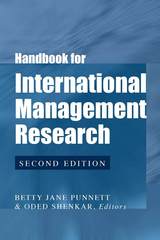
front cover of Handbook for International Management Research
Handbook for International Management Research
Betty Jane Punnett and Oded Shenkar, Editors
University of Michigan Press, 2004
Success in business today requires an understanding of the nature of globalization and its impact on managers. Now in a fully revised second edition, The Handbook for International Management Research provides a complete and up-to-date assessment of the field of international management. Part 1 provides a useful context and overview for the book. Part 2, "Designing Effective Research," will help readers develop effective, rigorous, and theory-based research designs for international management research, including qualitative research and experimental methods. Part 3, "Topical Issues in International Management Research," explores areas such as cross-cultural management, international alliances, human resources, and negotiations research. The conclusion to the volume considers where and how the field should progress.
 
Intended primarily for those doing research in the field of international management, this book should also interest scholars and students of public institutions, sociology, and industrial psychology. Managers will find the book's comprehensive overview of international management to be invaluable. Its global perspective will appeal to readers around the world.
[more]

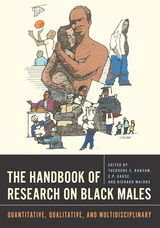
front cover of The Handbook of Research on Black Males
The Handbook of Research on Black Males
Quantitative, Qualitative, and Multidisciplinary
Theodore S. Ransaw
Michigan State University Press, 2018
Drawing from the work of top researchers in various fields, The Handbook of Research on Black Males explores the nuanced and multifaceted phenomena known as the black male. Simultaneously hyper-visible and invisible, black males around the globe are being investigated now more than ever before; however, many of the well-meaning responses regarding media attention paid to black males are not well informed by research. Additionally, not all black males are the same, and each of them have varying strengths and challenges, making one-size-fits-all perspectives unproductive. This text, which acts as a comprehensive tool that can serve as a resource to articulate and argue for policy change, suggest educational improvements, and advocate judicial reform, fills a large void. The contributors, from multidisciplinary backgrounds, focus on history, research trends, health, education, criminal and social justice, hip-hop, and programs and initiatives. This volume has the potential to influence the field of research on black males as well as improve lives for a population that is often the most celebrated in the media and simultaneously the least socially valued.
 
[more]

front cover of The Handbook of Research Synthesis
The Handbook of Research Synthesis
Harris Cooper
Russell Sage Foundation, 1994
"The Handbook is a comprehensive treatment of literature synthesis and provides practical advice for anyone deep in the throes of, just teetering on the brink of, or attempting to decipher a meta-analysis. Given the expanding application and importance of literature synthesis, understanding both its strengths and weaknesses is essential for its practitioners and consumers. This volume is a good beginning for those who wish to gain that understanding." —Chance "Meta-analysis, as the statistical analysis of a large collection of results from individual studies is called, has now achieved a status of respectability in medicine. This respectability, when combined with the slight hint of mystique that sometimes surrounds meta-analysis, ensures that results of studies that use it are treated with the respect they deserve….The Handbook of Research Synthesis is one of the most important publications in this subject both as a definitive reference book and a practical manual."—British Medical Journal The Handbook of Research Synthesis is the definitive reference and how-to manual for behavioral and medical scientists applying the craft of research synthesis. It draws upon twenty years of ground-breaking advances that have transformed the practice of synthesizing research literature from an art into a scientific process in its own right. Editors Harris Cooper and Larry V. Hedges have brought together leading authorities to guide the reader through every stage of the research synthesis process—problem formulation, literature search and evaluation, statistical integration, and report preparation. The Handbook of Research Synthesis incorporates in a single volume state-of-the-art techniques from all quantitative synthesis traditions, including Bayesian inference and the meta-analytic approaches. Distilling a vast technical literature and many informal sources, the Handbook provides a portfolio of the most effective solutions to problems of quantitative data integration. The Handbook of Research Synthesis also provides a rich treatment of the non-statistical aspects of research synthesis. Topics include searching the literature, managing reference databases and registries, and developing coding schemes. Those engaged in research synthesis will also find useful advice on how tables, graphs, and narration can be deployed to provide the most meaningful communication of the results of research synthesis. The Handbook of Research Synthesis is an illuminating compilation of practical instruction, theory, and problem solving. It provides an accumulation of knowledge about the craft of reviewing a scientific literature that can be found in no other single source. The Handbook offers the reader thorough instruction in the skills necessary to conduct powerful research syntheses meeting the highest standards of objectivity, systematicity, and rigor demanded of scientific enquiry. This definitive work will represent the state of the art in research synthesis for years to come.
[more]

front cover of The Handbook of Research Synthesis and Meta-Analysis
The Handbook of Research Synthesis and Meta-Analysis
Harris Cooper
Russell Sage Foundation, 2019
Research synthesis is the practice of systematically distilling and integrating data from many studies in order to draw more reliable conclusions about a given research issue. When the first edition of The Handbook of Research Synthesis and Meta-Analysis was published in 1994, it quickly became the definitive reference for conducting meta-analyses in both the social and behavioral sciences. In the third edition, editors Harris Cooper, Larry Hedges, and Jeff Valentine present updated versions of classic chapters and add new sections that evaluate cutting-edge developments in the field.
 
The Handbook of Research Synthesis and Meta-Analysis draws upon groundbreaking advances that have transformed research synthesis from a narrative craft into an important scientific process in its own right. The editors and leading scholars guide the reader through every stage of the research synthesis process—problem formulation, literature search and evaluation, statistical integration, and report preparation. The Handbook incorporates state-of-the-art techniques from all quantitative synthesis traditions and distills a vast literature to explain the most effective solutions to the problems of quantitative data integration. Among the statistical issues addressed are the synthesis of non-independent data sets, fixed and random effects methods, the performance of sensitivity analyses and model assessments, the development of machine-based abstract screening, the increased use of meta-regression and the problems of missing data. The Handbook also addresses the non-statistical aspects of research synthesis, including searching the literature and developing schemes for gathering information from study reports. Those engaged in research synthesis will find useful advice on how tables, graphs, and narration can foster communication of the results of research syntheses.
 
The third edition of the Handbook provides comprehensive instruction in the skills necessary to conduct research syntheses and represents the premier text on research synthesis.


Praise for the first edition: "The Handbook is a comprehensive treatment of literature synthesis and provides practical advice for anyone deep in the throes of, just teetering on the brink of, or attempting to decipher a meta-analysis. Given the expanding application and importance of literature synthesis, understanding both its strengths and weaknesses is essential for its practitioners and consumers. This volume is a good beginning for those who wish to gain that understanding." —Chance "Meta-analysis, as the statistical analysis of a large collection of results from individual studies is called, has now achieved a status of respectability in medicine. This respectability, when combined with the slight hint of mystique that sometimes surrounds meta-analysis, ensures that results of studies that use it are treated with the respect they deserve….The Handbook of Research Synthesis is one of the most important publications in this subject both as a definitive reference book and a practical manual."—British Medical Journal When the first edition of The Handbook of Research Synthesis was published in 1994, it quickly became the definitive reference for researchers conducting meta-analyses of existing research in both the social and biological sciences. In this fully revised second edition, editors Harris Cooper, Larry Hedges, and Jeff Valentine present updated versions of the Handbook's classic chapters, as well as entirely new sections reporting on the most recent, cutting-edge developments in the field. Research synthesis is the practice of systematically distilling and integrating data from a variety of sources in order to draw more reliable conclusions about a given question or topic. The Handbook of Research Synthesis and Meta-Analysis draws upon years of groundbreaking advances that have transformed research synthesis from a narrative craft into an important scientific process in its own right. Cooper, Hedges, and Valentine have assembled leading authorities in the field to guide the reader through every stage of the research synthesis process—problem formulation, literature search and evaluation, statistical integration, and report preparation. The Handbook of Research Synthesis and Meta-Analysis incorporates state-of-the-art techniques from all quantitative synthesis traditions. Distilling a vast technical literature and many informal sources, the Handbook provides a portfolio of the most effective solutions to the problems of quantitative data integration. Among the statistical issues addressed by the authors are the synthesis of non-independent data sets, fixed and random effects methods, the performance of sensitivity analyses and model assessments, and the problem of missing data. The Handbook of Research Synthesis and Meta-Analysis also provides a rich treatment of the non-statistical aspects of research synthesis. Topics include searching the literature, and developing schemes for gathering information from study reports. Those engaged in research synthesis will also find useful advice on how tables, graphs, and narration can be used to provide the most meaningful communication of the results of research synthesis. In addition, the editors address the potentials and limitations of research synthesis, and its future directions. The past decade has been a period of enormous growth in the field of research synthesis. The second edition Handbook thoroughly revises original chapters to assure that the volume remains the most authoritative source of information for researchers undertaking meta-analysis today. In response to the increasing use of research synthesis in the formation of public policy, the second edition includes a new chapter on both the strengths and limitations of research synthesis in policy debates
[more]

front cover of The Handbook of Research Synthesis and Meta-Analysis
The Handbook of Research Synthesis and Meta-Analysis
Harris Cooper
Russell Sage Foundation, 2009
Praise for the first edition: "The Handbook is a comprehensive treatment of literature synthesis and provides practical advice for anyone deep in the throes of, just teetering on the brink of, or attempting to decipher a meta-analysis. Given the expanding application and importance of literature synthesis, understanding both its strengths and weaknesses is essential for its practitioners and consumers. This volume is a good beginning for those who wish to gain that understanding." —Chance "Meta-analysis, as the statistical analysis of a large collection of results from individual studies is called, has now achieved a status of respectability in medicine. This respectability, when combined with the slight hint of mystique that sometimes surrounds meta-analysis, ensures that results of studies that use it are treated with the respect they deserve….The Handbook of Research Synthesis is one of the most important publications in this subject both as a definitive reference book and a practical manual."—British Medical Journal When the first edition of The Handbook of Research Synthesis was published in 1994, it quickly became the definitive reference for researchers conducting meta-analyses of existing research in both the social and biological sciences. In this fully revised second edition, editors Harris Cooper, Larry Hedges, and Jeff Valentine present updated versions of the Handbook's classic chapters, as well as entirely new sections reporting on the most recent, cutting-edge developments in the field. Research synthesis is the practice of systematically distilling and integrating data from a variety of sources in order to draw more reliable conclusions about a given question or topic. The Handbook of Research Synthesis and Meta-Analysis draws upon years of groundbreaking advances that have transformed research synthesis from a narrative craft into an important scientific process in its own right. Cooper, Hedges, and Valentine have assembled leading authorities in the field to guide the reader through every stage of the research synthesis process—problem formulation, literature search and evaluation, statistical integration, and report preparation. The Handbook of Research Synthesis and Meta-Analysis incorporates state-of-the-art techniques from all quantitative synthesis traditions. Distilling a vast technical literature and many informal sources, the Handbook provides a portfolio of the most effective solutions to the problems of quantitative data integration. Among the statistical issues addressed by the authors are the synthesis of non-independent data sets, fixed and random effects methods, the performance of sensitivity analyses and model assessments, and the problem of missing data. The Handbook of Research Synthesis and Meta-Analysis also provides a rich treatment of the non-statistical aspects of research synthesis. Topics include searching the literature, and developing schemes for gathering information from study reports. Those engaged in research synthesis will also find useful advice on how tables, graphs, and narration can be used to provide the most meaningful communication of the results of research synthesis. In addition, the editors address the potentials and limitations of research synthesis, and its future directions. The past decade has been a period of enormous growth in the field of research synthesis. The second edition Handbook thoroughly revises original chapters to assure that the volume remains the most authoritative source of information for researchers undertaking meta-analysis today. In response to the increasing use of research synthesis in the formation of public policy, the second edition includes a new chapter on both the strengths and limitations of research synthesis in policy debates

[more]

front cover of Haunting Biology
Haunting Biology
Science and Indigeneity in Australia
Emma Kowal
Duke University Press, 2023
In Haunting Biology Emma Kowal recounts the troubled history of Western biological studies of Indigenous Australians and asks how we now might see contemporary genomics, especially that conducted by Aboriginal and Torres Strait Islander scientists. Kowal illustrates how the material persistence of samples over decades and centuries folds together the fates of different scientific methodologies. Blood, bones, hair, comparative anatomy, human biology, physiology, and anthropological genetics all haunt each other across time and space, together with the many racial theories they produced and sustained. The stories Kowal tells feature a variety of ghostly presences: a dead anatomist, a fetishized piece of hair hidden away in a war trunk, and an elusive white Indigenous person. By linking this history to contemporary genomics and twenty-first-century Indigeneity, Kowal outlines the fraught complexities, perils, and potentials of studying Indigenous biological difference in the twenty-first century.
[more]

front cover of Here or There
Here or There
Research on Interpreting via Video Link
Jemina Napier
Gallaudet University Press, 2018
The field of sign language interpreting is undergoing an exponential increase in the delivery of services through remote and video technologies. The nature of these technologies challenges established notions of interpreting as a situated, communicative event and of the interpreter as a participant. As a result, new perspectives and research are necessary for interpreters to thrive in this environment. This volume fills that gap and features interdisciplinary explorations of remote interpreting from spoken and signed language interpreting scholars who examine various issues from linguistic, sociological, physiological, and environmental perspectives.

       Here or There presents cutting edge, empirical research that informs the professional practice of remote interpreting, whether it be video relay service, video conference, or video remote interpreting. The research is augmented by the perspectives of stakeholders and deaf consumers on the quality of the interpreted work. Among the topics covered are professional attitudes and motivations, interpreting in specific contexts, and adaptation strategies. The contributors also address potential implications for relying on remote interpreting, discuss remote interpreter education, and offer recommendations for service providers.
[more]

front cover of Heredity under the Microscope
Heredity under the Microscope
Chromosomes and the Study of the Human Genome
Soraya de Chadarevian
University of Chicago Press, 2020
By focusing on chromosomes, Heredity under the Microscope offers a new history of postwar human genetics. Today chromosomes are understood as macromolecular assemblies and are analyzed with a variety of molecular techniques. Yet for much of the twentieth century, researchers studied chromosomes by looking through a microscope. Unlike any other technique, chromosome analysis offered a direct glimpse of the complete human genome, opening up seemingly endless possibilities for observation and intervention. Critics, however, countered that visual evidence was not enough and pointed to the need to understand the molecular mechanisms.
 
Telling this history in full for the first time, Soraya de Chadarevian argues that the often bewildering variety of observations made under the microscope were central to the study of human genetics. Making space for microscope-based practices alongside molecular approaches, de Chadarevian analyzes the close connections between genetics and an array of scientific, medical, ethical, legal, and policy concerns in the atomic age. By exploring the visual evidence provided by chromosome research in the context of postwar biology and medicine, Heredity under the Microscope sheds new light on the cultural history of the human genome.

[more]

front cover of Homeward
Homeward
Life in the Year After Prison
Bruce Western
Russell Sage Foundation, 2018
In the era of mass incarceration, over 600,000 people are released from federal or state prison each year, with many returning to chaotic living environments rife with violence. In these circumstances, how do former prisoners navigate reentering society? In Homeward, sociologist Bruce Western examines the tumultuous first year after release from prison. Drawing from in-depth interviews with over one hundred individuals, he describes the lives of the formerly incarcerated and demonstrates how poverty, racial inequality, and failures of social support trap many in a cycle of vulnerability despite their efforts to rejoin society.
 
Western and his research team conducted comprehensive interviews with men and women released from the Massachusetts state prison system who returned to neighborhoods around Boston. Western finds that for most, leaving prison is associated with acute material hardship. In the first year after prison, most respondents could not afford their own housing and relied on family support and government programs, with half living in deep poverty. Many struggled with chronic pain, mental illnesses, or addiction—the most important predictor of recidivism. Most respondents were also unemployed.  Some older white men found union jobs in the construction industry through their social networks, but many others, particularly those who were black or Latino, were unable to obtain full-time work due to few social connections to good jobs, discrimination, and lack of credentials. Violence was common in their lives, and often preceded their incarceration. In contrast to the stereotype of tough criminals preying upon helpless citizens, Western shows that many former prisoners were themselves subject to lifetimes of violence and abuse and encountered more violence after leaving prison, blurring the line between victims and perpetrators.
 
Western concludes that boosting the social integration of former prisoners is key to both ameliorating deep disadvantage and strengthening public safety. He advocates policies that increase assistance to those in their first year after prison, including guaranteed housing and health care, drug treatment, and transitional employment. By foregrounding the stories of people struggling against the odds to exit the criminal justice system, Homeward shows how overhauling the process of prisoner reentry and rethinking the foundations of justice policy could address the harms of mass incarceration.
 
[more]

front cover of How to Make Art at the End of the World
How to Make Art at the End of the World
A Manifesto for Research-Creation
Natalie Loveless
Duke University Press, 2019
In recent years, the rise of research-creation—a scholarly activity that considers art practices as research methods in their own right—has emerged from the organic convergences of the arts and interdisciplinary humanities, and it has been fostered by universities wishing to enhance their public profiles. In How to Make Art at the End of the World Natalie Loveless draws on diverse perspectives—from feminist science studies to psychoanalytic theory, as well as her own experience advising undergraduate and graduate students—to argue for research-creation as both a means to produce innovative scholarship and a way to transform pedagogy and research within the contemporary neoliberal university. Championing experimental, artistically driven methods of teaching, researching, and publication, research-creation works to render daily life in the academy more pedagogically, politically, and affectively sustainable, as well as more responsive to issues of social and ecological justice.
[more]

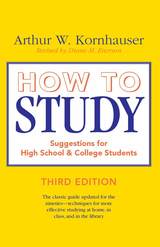
front cover of How to Study
How to Study
Suggestions for High-School and College Students
Arthur W. Kornhauser
University of Chicago Press, 1993
A complete guide for successful studying, How to Study is concise, practical, time-tested, and free of gimmicks. Designed originally for freshmen at the University of Chicago, this smart book has helped generations of students throughout the country improve their skills in learning quickly and effectively. It offers a no-nonsense plan of action filled with techniques, strategies, exercises, and advice for:

*Mastering rather than just memorizing material

*Learning the secrets of mental preparation before tackling difficult assignments or exams

*Strengthening skills for better reading, note taking, and listening

*Improving use of time in the classroom, the library, and at home

It offers a wealth of advice, from the commonsensical ("Never begin study immediately after eating" and "Check every tendency to daydream") to the more psychological ("Use your knowledge by thinking, talking, and writing about the things you are learning").

Thoroughly revised and updated, this powerful little book can help any motivated and capable student work smarter, not just harder, from high school through college.

When he wrote How to Study Arthur W. Kornhauser (1896-1990) was associate professor of business psychology at the University of Chicago.
[more]

front cover of Human Embryos, Human Beings
Human Embryos, Human Beings
A Scientific and Philosophical Approach
Samuel B. Condic
Catholic University of America Press, 2018
The overall purpose of Human Embryos, Human Beings is to establish the ontological status of the human embryo, in light of the most recent biological evidence. The thesis of the book is that sound philosophical reasoning and the available scientific evidence support the claim that a human being is present from the moment of fertilization onward (the “immediate hominization” view) and does not support the contrary claim that a human being appears only after a time following fertilization (the “delayed hominization” view). Included in the scope of this argument is an examination of several long-standing philosophical arguments claiming that immediate hominization is false; a detailed examination of several arguments claiming that though immediate hominization is possible, both evidence and argument best support the delayed hominization view or some alternate view; and an examination of several cases where natural defect or scientific manipulation make determining the ontological status of the embryo more difficult. The book also includes a presentation of hylomorphism, as this is the philosophical viewpoint employed by the authors to analyze the question. Human Embryos, Human Beings is based on the premise that philosophical and scientific approaches are not in conflict, with the most comprehensive understanding of human embryos being achieved by application of a rigorous hylomorphic philosophy to the best available scientific data. Often, one finds either a thorough and well-reasoned philosophical account or a detailed scientific account. This book makes a welcome addition to the field by integrating both of these needed elements into a single text.
[more]

front cover of Hypothesis and Evidence in Psychoanalysis
Hypothesis and Evidence in Psychoanalysis
Marshall Edelson
University of Chicago Press, 1984
A scholar, psychologist, physician, and experienced psychoanalyst, Marshall Edelson is uniquely qualified to respond to questions about the scientific status of psychoanalysis. He has written this book both for psychoanalysts and for philosophers of science, intending to bridge gaps in communication between them. It is also a book for anyone interested in the nature of psychoanalytic knowledge.
[more]


Send via email Share on Facebook Share on Twitter