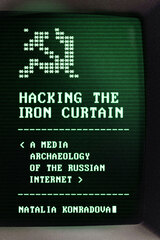
front cover of Hacking the Iron Curtain
Hacking the Iron Curtain
A Media Archaeology of the Russian Internet
Natalia Konradova
University of Wisconsin Press, 2026
For decades before the internet existed, scientists, technologists, novelists, and enthusiasts of all descriptions dreamed of instantaneous, worldwide communication systems. What forms such systems might take and what technologies could be used to accomplish this goal were open questions—questions asked by people around the world, including in the Cold War–era superpowers of the United States and the Soviet Union. 

Media archaeologist Natalia Konradova examines the history of the internet in Russia and its predecessor state, cutting through layers of technological history and dusting off conceptual artifacts of the past. Inspired by the fundamental question of how Soviets imagined future technologies, she investigates experiments with telepathy alongside the (then equally improbable) dream of a global, digitally connected computer network. Since the story of the Russian internet is inextricably wound up with Soviet society and the history of the Cold War, Hacking the Iron Curtain is as much a cultural and political history as it is a technological one—a history that illustrates how collective dreams can challenge geopolitical ambitions and inspire world-changing technologies.
[more]

front cover of A History of Modern Russia
A History of Modern Russia
From Nicholas II to Vladimir Putin, Revised Edition
Robert Service
Harvard University Press, 2003
Russia had an extraordinary twentieth century, undergoing upheaval and transformation. Updating his acclaimed History of Twentieth-Century Russia through 2002, Robert Service provides a panoramic perspective on a country whose Soviet past encompassed revolution, civil war, mass terror, and two world wars. He shows how seven decades of communist rule, which penetrated every aspect of Soviet life, continue to influence Russia today. This new edition also discusses continuing economic and social difficulties at the beginning of the twenty-first century, the military campaign in Chechnya, and Russia's reduced role on the world stage.
[more]

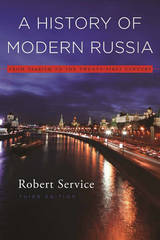
front cover of A History of Modern Russia
A History of Modern Russia
From Tsarism to the Twenty-First Century, Third Edition
Robert Service
Harvard University Press, 2009
Russia had an extraordinary twentieth century, undergoing upheaval and transformation. Updating his acclaimed History of Modern Russia, Robert Service provides a panoramic perspective on a country whose Soviet past encompassed revolution, civil war, mass terror, and two world wars. He shows how seven decades of communist rule, which penetrated every aspect of Soviet life, continue to influence Russia today. This new edition takes the story from 2002 through the entire presidency of Vladimir Putin to the election of his successor, Dmitri Medvedev.
[more]

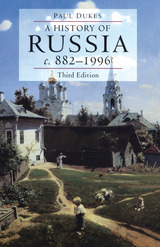
front cover of A History of Russia
A History of Russia
Medieval, Modern, Contemporary, c.882-1996
Paul Dukes
Duke University Press, 1998
Is today’s Russia capable of democracy, the free market, and a pluralist ideology? In this new edition of A History of Russia, Paul Dukes investigates these questions, taking into full account the extraordinary changes that have occurred since the arrival of first Mikhail Gorbachev and then Boris Yeltsin. Substantially expanded and rewritten, this new edition sets these events within the context of over 1100 years of Russian history. Dukes reviews the successive phases in Russian history from medieval Kiev and Muscovy to the current post-Soviet Union, with distinctive sections on political, economic, and cultural aspects of each period.
With its breadth of scope and conciseness of presentation, this third edition of A History of Russia will be invaluable to students of European and Russian history, and also to students of Russian language, literature, and social science.

[more]

logo for Harvard University Press
A History of Twentieth-Century Russia
Robert Service
Harvard University Press, 1998

Russia has had an extraordinary history in the twentieth century. As the first Communist society, the USSR was both an admired model and an object of fear and hatred to the rest of the world.

How are we to make sense of this history? A History of Twentieth-Century Russia treats the years from 1917 to 1991 as a single period and analyzes the peculiar mixture of political, economic, and social ingredients that made up the Soviet formula. Under a succession of leaders from Lenin to Gorbachev, various methods were used to conserve and strengthen this compound. At times the emphasis was upon shaking up the ingredients, at others upon stabilization. All this occurred against a background of dictatorship, civil war, forcible industrialization, terror, world war, and the postwar arms race. Communist ideas and practices never fully pervaded the society of the USSR. Yet an impact was made and, as this book expertly documents, Russia since 1991 has encountered difficulties in completely eradicating the legacy of Communism.

A History of Twentieth-Century Russia is the first work to use the mass of material that has become available in the documentary collections, memoirs, and archives over the past decade. It is an extraordinarily lucid, masterful account of the most complex and turbulent period in Russia's long history.
[more]

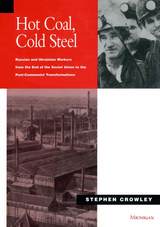
front cover of Hot Coal, Cold Steel
Hot Coal, Cold Steel
Russian and Ukrainian Workers from the End of the Soviet Union to the Post-Communist Transformations
Stephen Crowley
University of Michigan Press, 1997
Well after the disintegration of the Communist Party and the Soviet state--and through several years of economic collapse--industrial workers in almost every sector of the former Soviet Union have remained quiescent and the same ineffective and unpopular trade unions still hold a virtual monopoly on worker's representation. Why? While many argue that labor is a central variable in the development of economic and political systems, little is known about workers in the states of the former Soviet Union since the fall of Communism. In a comparative study of two groups of industrial workers--the coal miners and steelworkers--at the end of the Soviet era, Stephen Crowley sheds light on where these workers have been and where they are going.
Coal miners in the final years of the Soviet Union effectively organized and led strikes which supported the end of Communism, even though their heavy subsidies would be threatened by capitalism. Steel workers, in contrast, did not effectively organize and strike. This pattern has continued under the new governments, with the coal miners effectively organized and seeking protection from the worst consequences of marketization, while the steel workers remain weakly organized despite deteriorating economic conditions.
Based on extensive on-site research including interviews with miners and steelworkers, labor leaders and plant managers, Crowley develops a detailed picture of the conditions under which workers organize. His findings have application beyond the conditions of post-Communist Russia and Ukraine to other societies undergoing fundamental change.
This book will be of interest to sociologists and political scientists interested in the role of labor in transitional societies, the patterns of organization of labor, as well as area specialists.
Stephen Crowley is Associate Professor of Political Science, Oberlin College.
[more]

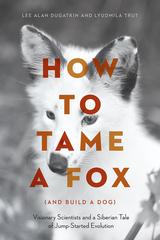
front cover of How to Tame a Fox (and Build a Dog)
How to Tame a Fox (and Build a Dog)
Visionary Scientists and a Siberian Tale of Jump-Started Evolution
Lee Alan Dugatkin and Lyudmila Trut
University of Chicago Press, 2017
Tucked away in Siberia, there are furry, four-legged creatures with wagging tails and floppy ears that are as docile and friendly as any lapdog. But, despite appearances, these are not dogs—they are foxes. They are the result of the most astonishing experiment in breeding ever undertaken—imagine speeding up thousands of years of evolution into a few decades. In 1959, biologists Dmitri Belyaev and Lyudmila Trut set out to do just that, by starting with a few dozen silver foxes from fox farms in the USSR and attempting to recreate the evolution of wolves into dogs in real time in order to witness the process of domestication. This is the extraordinary, untold story of this remarkable undertaking.

Most accounts of the natural evolution of wolves place it over a span of about 15,000 years, but within a decade, Belyaev and Trut’s fox breeding experiments had resulted in puppy-like foxes with floppy ears, piebald spots, and curly tails. Along with these physical changes came genetic and behavioral changes, as well. The foxes were bred using selection criteria for tameness, and with each generation, they became increasingly interested in human companionship. Trut has been there the whole time, and has been the lead scientist on this work since Belyaev’s death in 1985, and with Lee Dugatkin, biologist and science writer, she tells the story of the adventure, science, politics, and love behind it all.  In How to Tame a Fox, Dugatkin and Trut take us inside this path-breaking experiment in the midst of the brutal winters of Siberia to reveal how scientific history is made and continues to be made today.

To date, fifty-six generations of foxes have been domesticated, and we continue to learn significant lessons from them about the genetic and behavioral evolution of domesticated animals. How to Tame a Fox offers an incredible tale of scientists at work, while also celebrating the deep attachments that have brought humans and animals together throughout time.
[more]


Send via email Share on Facebook Share on Twitter