
 A SCHOLARLY BOOK REPOSITORY
4 start with H start with H
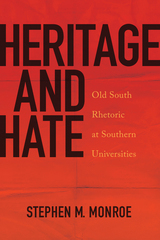
The US South is a rhetorical landscape that pulsates with division, a place where words and symbols rooted in a deeply problematic past litter the ground and contaminate the soil. Stephen M. Monroe’s provocative study focuses on predominantly white southern universities where Old South rhetoric still reverberates, where rebel flags cast a shadow over attempts at racial harmony, school cheers to reinforce racial barriers, and student yearbooks to create and protect
an oppressive culture of exclusion. Across the region, in college towns like Oxford, Mississippi; Athens, Georgia; and Tuscaloosa, Alabama—communities remain locked in a difficult, recursive, and inherently rhetorical struggle that wrestles with this troubling legacy.
Words, images, and symbols are not merely passive artifacts of southern history, Monroe argues, but formative agents that influence human behavior and shape historical events. Drawing on research from many disciplines, including rhetoric, southern studies, history, sociology, and African American studies, Monroe develops the concept of confederate rhetoric: the collection of Old South words and symbols that have been and remain central to the identity conflicts of the South. He charts examples of such rhetoric at work in southern universities from Reconstruction to the present day.
Tracing the long life and legacy of Old South words and symbols at southern universities, this book provides close and nuanced analysis of the rhetorical conflicts that have resulted at places like the University of Mississippi and the University of Missouri. Some conflicts erupted during the civil rights movement, when the first African American students sought admission to all-white southern universities and colleges, and others are brewing now, as African
Americans (and their progressive white peers) begin to cement genuine agency and voice in these communities. Tensions have been, and remain, high.
Ultimately, Monroe offers hope and optimism, contending that if words and symbols can be used to damage and divide, then words and symbols can also be used to heal and unify. Racist rhetoric can be replaced by antiracist rhetoric. The old South can become new. While resisting naïve or facile arguments, Heritage and Hate ultimately finds the promise of progress within the tremendous power of language.


What is distinctive, Derek Bok asks, about the American system of higher education, and how well does it perform? In particular, just how good is the education our universities offer? Are they doing all they can to educate their students, or do teaching and learning get lost in the pressure for ever more prestigious research and publication? Bok concludes that the competition characteristic of American higher education—competition for the best students, the most advanced scholarship, the most successful scientific research, the best facilities—has helped to produce venturesome, adaptable, and varied universities. But because the process of learning itself is imperfectly understood, it is difficult to achieve sustained progress in the quality of education or even to determine which educational innovations actually enhance learning.
Despite these problems, the last fifteen years have produced many promising developments, such as experimental curricula, computer-assisted learning, much-expanded offerings for nontraditional students, clinical legal education, schools of public policy to prepare students for public service careers, and many more. Such initiatives need a more secure and central place within the regular curriculum. In addition to the traditional focus on program and curriculum, Bok stresses the need to pay greater attention to improving the effectiveness of teaching and learning. He calls for a number of steps, including a sustained program of research directed toward evaluating educational programs and methods of teaching. Only through careful experimentation and evaluation of its own efforts, through many small improvements and occasional inspired advances, can each university move toward the goal of giving its students the best possible preparation for life in an increasingly complex world.
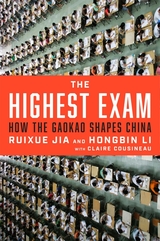
An Economist Best Book of the Year
Combining personal narratives with decades of research, a vivid account of how the gaokao—China’s high-stakes college admissions test—shapes that society and influences education debates in the United States.
Each year, more than ten million students across China pin their hopes on the gaokao, the nationwide college entrance exam. Unlike in the United States, where standardized tests are just one factor, in China college admission is determined entirely by gaokao performance. It is no wonder the test has become a national obsession.
Drawing on extensive surveys, historical research, and economic analysis, and informed by Ruixue Jia and Hongbin Li’s own experiences of the gaokao gauntlet, The Highest Exam reveals how China’s education system functions as a centralized tournament. It explains why preparation for the gaokao begins even before first grade—and why, given its importance for upward mobility, Chinese families are behaving rationally when they devote immense quantities of money and effort to acing the test. It shows how the exam system serves the needs of the Chinese Communist Party and drives much of the country’s economic growth. And it examines the gaokao’s far-reaching effects on China’s society, as the exam’s promise of meritocracy encourages citizens to focus on individual ability at the expense of considering socioeconomic inequalities.
What’s more, as the book makes clear, the gaokao is now also shaping debates around education in the United States. As Chinese-American families bring the expectations of the highest exam with them, their calls for objective, transparent metrics in the education system increasingly clash with the more holistic measures of achievement used by American schools and universities.
READERS
Browse our collection.
PUBLISHERS
See BiblioVault's publisher services.
STUDENT SERVICES
Files for college accessibility offices.
RECENTLY PUBLISHED



UChicago Accessibility Resources
home | accessibility | search | about | contact us
BiblioVault ® 2001 - 2025
The University of Chicago Press