
 A SCHOLARLY BOOK REPOSITORY
8 start with I start with I

The Best Narrative & Biography Books of 2024, Selected by Porchlight
When a progressive college professor runs for the Pennsylvania House of Representatives in a deeply conservative rural district, he loses. That’s no surprise. But the story of how Ferrence loses and, more importantly, how American political narratives refuse to recognize the existence and value of nonconservative rural Americans offers insight into the political morass of our nation.
In essays focused on showing goats at the county fair, planting native grasses in the front lawn, the political power of poetry, and getting wiped out in an election, Ferrence offers a counter-narrative to stereotypes of monolithic rural American voters and emphasizes the way stories told about rural America are a source for the bitter divide between Red America and Blue America.
Winner of the National Communication Association’s 2023 Hochmuth-Nichols Award
" . . . An important contribution to studies of the American conservative movement and, more generally, Populist discourse. Recommended." —CHOICE
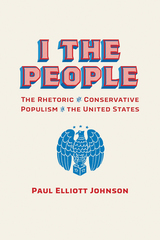
I The People: The Rhetoric of Conservative Populism in the United States examines a variety of texts—ranging from speeches and campaign advertisements to news reports and political pamphlets—to outline the populist character of conservatism in the United States. Paul Elliott Johnson focuses on key inflection points in the development of populist conservatism, including its manifestation in the racially charged presidential election of 1964, its consolidation at the height of Ronald Reagan’s reelection campaign in 1984, and its character in successive moments that saw its fortunes wax and wane, including 1994, the Obama era, and the rise of Donald J. Trump. theorizing conservative populism as a rhetorical form, Johnson advances scholarship about populism away from a binary ideological framework while offering a useful lens for contextualizing scholarship on American conservatism. I The People emphasizes that the populist roots of conservative hegemony exercise a powerful constraining force on conservative intellectuals, whose power to shape and control the movement to which they belong is circumscribed by the form of its public-facing appeals.
The study also reframes scholarly understandings of the conservative tradition’s seeming multiplicity, especially the tendency to suggest an abiding conservative unease regarding capitalism, showing how racist hostility underwrote a compromise with an increasingly economized understanding of humanity. Johnson also contests the narrative that conservatives learned to practice identity politics from social progressives. From the beginning, conservatism’s public vernacular was a white and masculine identity politics reliant on a rhetoric of victimhood, whether critiquing the liberal Cold War consensus or President Barack Obama.
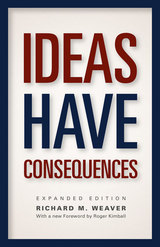
In its pages, Richard M. Weaver argues that the decline of Western civilization resulted from the rising acceptance of relativism over absolute reality. In spite of increased knowledge, this retreat from the realist intellectual tradition has weakened the Western capacity to reason, with catastrophic consequences for social order and individual rights. But Weaver also offers a realistic remedy. These difficulties are the product not of necessity, but of intelligent choice. And, today, as decades ago, the remedy lies in the renewed acceptance of absolute reality and the recognition that ideas—like actions—have consequences.
This expanded edition of the classic work contains a foreword by New Criterion editor Roger Kimball that offers insight into the rich intellectual and historical contexts of Weaver and his work and an afterword by Ted J. Smith III that relates the remarkable story of the book’s writing and publication.

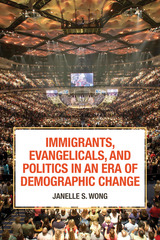
Asian Americans and Latinos currently constitute 13 percent of evangelicals, and their churches are among the largest, fastest growing organizations in their communities. While evangelical identity is associated with conservative politics, Wong draws from national surveys and interviews to show that non-white evangelicals express political attitudes that are significantly less conservative than those of their white counterparts. Black, Asian American, and Latino evangelicals are much more likely to support policies such as expanded immigration rights, increased taxation of the wealthy, and government interventions to slow climate change. As Wong argues, non-white evangelicals’ experiences as members of racial or ethnic minority groups often lead them to adopt more progressive political views compared to their white counterparts.
However, despite their growth in numbers, non-white evangelicals—particularly Asian Americans and Latinos—are concentrated outside of swing states, have lower levels of political participation than white evangelicals, and are less likely to be targeted by political campaigns. As a result, white evangelicals dominate the evangelical policy agenda and are overrepresented at the polls. Also, many white evangelicals have adopted even more conservative political views in response to rapid demographic change, perceiving, for example, that discrimination against Christians now rivals discrimination against racial and ethnic minorities.
Wong demonstrates that immigrant evangelicals are neither “natural” Republicans nor “natural” Democrats. By examining the changing demographics of the evangelical movement, Immigrants, Evangelicals, and Politics in an Era of Demographic Change sheds light on an understudied constituency that has yet to find its political home.

An Imperial Path to Modernity examines the role of liberal intellectuals in reshaping transnational ideas and internationalist aspirations into national values and imperial ambitions in early twentieth-century Japan. Perceiving the relationship between liberalism and the international world order, a cohort of Japanese thinkers conformed to liberal ideas and institutions to direct Japan’s transformation into a liberal empire in Asia. To sustain and rationalize the imperial enterprise, these Japanese liberals sought to make the domestic political stage less hostile to liberalism. Facilitating the creation of print-mediated public opinion, liberal intellectuals attempted to enlist the new middle class as a social ally in circulating liberal ideas and practices within Japan and throughout the empire.
In tracing the interconnections between liberalism and the imperial project, Jung-Sun N. Han focuses on the ideas and activities of Yoshino Sakuzo (1878–1933), who was and is remembered as a champion of prewar Japanese liberalism and Taisho democracy. Drawing insights from intellectual history, cultural studies, and international relations, this study argues that prewar Japanese liberalism grew out of the efforts of intellectuals such as Yoshino who worked to devise a transnational institution to govern the Japanese empire.
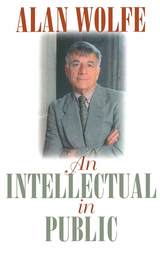
". . . proof that the spirit of the free-ranging public intellectual is still very much alive."
-Newsday
"Alan Wolfe is one of liberalism's last and most loyal sons. His mind is naturally decent and diversified; large enough and fair enough to contain both conviction and doubt. His profound respect for real people does not interfere with his profound respect for real thought. The criticism that he practices is, I fear, a dying art, but it is also one of the glories of American democracy."
-Leon Wieseltier, New Republic
"Alan Wolfe is one of America's indispensable essayists. On a broad range of topics-race, religion, politics, the marketplace, the university, and more-he combines a scholar's erudition with a historian's feel for the past and a journalist's keen attunement to the shifting patterns of the current scene. Above all he is a true writer, graceful but fearless, who ponders the deep questions so often ignored in the clamor of our ongoing civic conversation. Anyone who wonders what the term 'public intellectual' really means will find the answer-in fact many answers-in this scintillating collection."
-Sam Tanenhaus, Vanity Fair
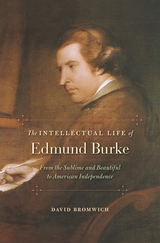
David Bromwich’s portrait of statesman Edmund Burke (1730–1797) is the first biography to attend to the complexity of Burke’s thought as it emerges in both the major writings and private correspondence. The public and private writings cannot be easily dissociated, nor should they be. For Burke—a thinker, writer, and politician—the principles of politics were merely those of morality enlarged. Bromwich reads Burke’s career as an imperfect attempt to organize an honorable life in the dense medium he knew politics to be.
This intellectual biography examines the first three decades of Burke’s professional life. His protest against the cruelties of English society and his criticism of all unchecked power laid the groundwork for his later attacks on abuses of government in India, Ireland, and France. Bromwich allows us to see the youthful skeptic, wary of a social contract based on “nature”; the theorist of love and fear in relation to “the sublime and beautiful”; the advocate of civil liberty, even in the face of civil disorder; the architect of economic reform; and the agitator for peace with America. However multiple and various Burke’s campaigns, a single-mindedness of commitment always drove him.
Burke is commonly seen as the father of modern conservatism. Bromwich reveals the matter to be far more subtle and interesting. Burke was a defender of the rights of disfranchised minorities and an opponent of militarism. His politics diverge from those of any modern party, but all parties would be wiser for acquaintance with his writing and thoughts.
READERS
Browse our collection.
PUBLISHERS
See BiblioVault's publisher services.
STUDENT SERVICES
Files for college accessibility offices.
RECENTLY PUBLISHED


UChicago Accessibility Resources
home | accessibility | search | about | contact us
BiblioVault ® 2001 - 2026
The University of Chicago Press