
 A SCHOLARLY BOOK REPOSITORY
4 start with I start with I
"North Korea is not just a security or human rights problem (although it is those things) but a real society. This book gets us closer to understanding North Korea beyond the usual headlines, and does so in a richly detailed, well-researched, and theoretically contextualized way."
---Charles K. Armstrong, Director, Center for Korean Research, Columbia University
"One of this book's strengths is how it deals at the same time with historical, geographical, political, artistic, and cultural materials. Film and theatre are not the only arts Kim studies---she also offers an excellent analysis of paintings, fashion, and what she calls 'everyday performance.' Her analysis is brilliant, her insights amazing, and her discoveries and conclusions always illuminating."
---Patrice Pavis, University of Kent, Canterbury
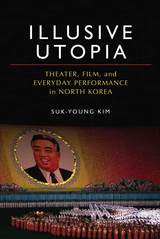
No nation stages massive parades and collective performances on the scale of North Korea. Even amid a series of intense political/economic crises and international conflicts, the financially troubled country continues to invest massive amounts of resources to sponsor unflinching displays of patriotism, glorifying its leaders and revolutionary history through state rituals that can involve hundreds of thousands of performers. Author Suk-Young Kim explores how sixty years of state-sponsored propaganda performances---including public spectacles, theater, film, and other visual media such as posters---shape everyday practice such as education, the mobilization of labor, the gendering of social interactions, the organization of national space, tourism, and transnational human rights. Equal parts fascinating and disturbing, Illusive Utopia shows how the country's visual culture and performing arts set the course for the illusionary formation of a distinctive national identity and state legitimacy, illuminating deep-rooted cultural explanations as to why socialism has survived in North Korea despite the fall of the Berlin Wall, the collapse of the Soviet Union, and China's continuing march toward economic prosperity. With over fifty striking color illustrations, Illusive Utopia captures the spectacular illusion within a country where the arts are not only a means of entertainment but also a forceful institution used to regulate, educate, and mobilize the population.
Suk-Young Kim is Associate Professor in the Department of Theater and Dance at the University of California, Santa Barbara, and coauthor with Kim Yong of Long Road Home: A Testimony of a North Korean Camp Survivor.
In the early 1990s, South Korea was showcased as a country that had combined extraordinary economic growth with a narrowing of income distribution, achieving remarkably low rates of unemployment and poverty. In the years following the financial crisis of 1997–1998, however, these rates ballooned to pre-crisis levels, giving rise to the perception that the gap between the rich and the poor in Korea had once again widened.
Income Inequality in Korea explores the relationship between economic growth and social developments in Korea over the last three decades. Analyzing the forces behind the equalizing trends in the 1980s and early 1990s, and the deterioration evident in the post-crisis years, Chong-Bum An and Barry Bosworth investigate the macroeconomic conditions, gains in educational attainment, demographic changes and conditions in labor markets, and social welfare policies that have contributed to the evolution of income inequality over time.
The authors also raise fundamental questions about whether the pre-crisis pattern of combining strong economic growth with improving equality can be restored, as well as how government policies might be designed to promote that objective. The book concludes with a discussion of some proposals for improving the efficacy of redistributive policies in Korea.
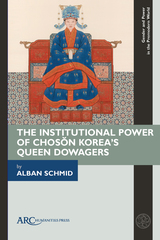
Power in the Chosŏn dynasty of Korea (1392–1910) was shared amongst various political actors, often including female heads of royal households, namely queen dowagers. Following a diachronic approach, several case studies are examined to illustrate the extent and limits of the queen dowagers’ authority. Evidence shows that queen dowagers grew more confident and more influential over the course of the dynasty, especially as more precedents concerning their exercise of power were added to the dynasty’s Veritable Records. While queen dowagers usually refrained from getting involved in day-to-day politics, some had the power to order the dethronement of not one, but two Korean kings and, by the nineteenth century, often ruled themselves during extensive periods of regency.
READERS
Browse our collection.
PUBLISHERS
See BiblioVault's publisher services.
STUDENT SERVICES
Files for college accessibility offices.
RECENTLY PUBLISHED



UChicago Accessibility Resources
home | accessibility | search | about | contact us
BiblioVault ® 2001 - 2026
The University of Chicago Press