
 A SCHOLARLY BOOK REPOSITORY
15 start with I start with I
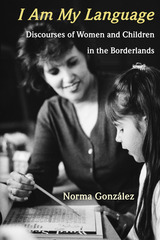
“I am my language,” says the poet Gloria Anzaldúa, because language is at the heart of who we are. But what happens when a person has more than one language? Is there an overlay of language on identity, and do we shift identities as we shift languages? More important, what identities do children construct for themselves when they use different languages in particular ways?
In this book, Norma González uses language as a window on the multiple levels of identity construction in children—as well as on the complexities of life in the borderlands—to explore language practices and discourse patterns of Mexican-origin mothers and the language socialization of their children. She shows how the unique discourses that result from the interplay of two cultures shape perceptions of self and community, and how they influence the ways in which children learn and families engage with their children’s schools.
González demonstrates that the physical presence of the border profoundly affects the practices and ideologies of Mexican-origin women and children. She then argues that language and cultural background should be used as a basis for building academic competencies, and she demonstrates why the evocative/emotive dimension of language should play a major part in studies of discourse, language socialization, and language ideology.
Drawing on women’s own narratives of their experiences as both mothers and borderland residents, I Am My Language is firmly rooted in the words of common people in their everyday lives. It combines personal odyssey with cutting-edge ethnographic research, allowing us to hear voices that have been muted in the academic and public policy discussions of “what it means to be Latina/o” and showing us new ways to connect language to complex issues of education, political economy, and social identity.
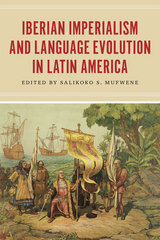
The essays approach language development through an ecological lens, exploring the effects of politics, economics, cultural contact, and natural resources on the indigenization of Spanish and Portuguese in a variety of local settings. They show how languages adapt to new environments, peoples, and practices, and the ramifications of this for the spread of colonial languages, the loss or survival of indigenous ones, and the way hybrid vernaculars get situated in larger political and cultural forces. The result is a sophisticated look at language as a natural phenomenon, one that meets a host of influences with remarkable plasticity.


In nine linked essays, Riley deftly unravels the rhetoric of life’s absurdities and urgencies, its comforts and embarrassments, to insist on the forcible affect of language itself. She teases out the emotional complexities of such quotidian matters as what she ironically terms the right to be lonely in the face of the imperative to be social or the guilt associated with feeling as if you’re lying when you aren’t. Impersonal Passion reinvents questions from linguistics, the philosophy of language, and cultural theory in an illuminating new idiom: the compelling emotion of the language of the everyday.
Informed by recent developments in literary criticism and social theory, In the Nature of Things addresses the presumption that nature exists independent of culture and, in particular, of language. The theoretical approaches of the contributors represent both modernist and postmodernist positions, including feminist theory, critical theory, Marxism, science fiction, theology, and botany. They demonstrate how the concept of nature is invoked and constituted in a wide range of cultural projects—from the Bible to science fiction movies, from hunting to green consumerism. Ultimately, it weeks to link the work of theorists concerned with nature and the environment to nontheorists who share similar concerns.
Contributors include R. McGreggor Cawley, Romand Coles, William E. Connolly, Jan E. Dizard, Valerie Hartouni, Cheri Lucas Jennings, Bruce H. Jennings, Timothy W. Luke, Shane Phelan, John Rodman, Michael J. Shapiro, and Wade Sikorski.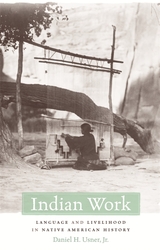
Representations of Indian economic life have played an integral role in discourses about poverty, social policy, and cultural difference but have received surprisingly little attention. Daniel Usner dismantles ideological characterizations of Indian livelihood to reveal the intricacy of economic adaptations in American Indian history.
Officials, reformers, anthropologists, and artists produced images that exacerbated Indians’ economic uncertainty and vulnerability. From Jeffersonian agrarianism to Jazz Age primitivism, European American ideologies not only obscured Indian struggles for survival but also operated as obstacles to their success. Diversification and itinerancy became economic strategies for many Indians, but were generally maligned in the early United States. Indians repeatedly found themselves working in spaces that reinforced misrepresentation and exploitation. Taking advantage of narrow economic opportunities often meant risking cultural integrity and personal dignity: while sales of baskets made by Louisiana Indian women contributed to their identity and community, it encouraged white perceptions of passivity and dependence. When non-Indian consumption of Indian culture emerged in the early twentieth century, even this friendlier market posed challenges to Indian labor and enterprise. The consequences of this dilemma persist today.
Usner reveals that Indian engagement with commerce has consistently defied the narrow choices that observers insisted upon seeing.
Over the past twenty-five years, Bruno Latour has developed a research protocol different from the actor-network theory with which his name is now associated—a research protocol that follows the different types of connectors that provide specific truth conditions. These are the connectors that prompt a climate scientist challenged by a captain of industry to appeal to the institution of science, with its army of researchers and mountains of data, rather than to “capital-S Science” as a higher authority. Such modes of extension—or modes of existence, Latour argues here—account for the many differences between law, science, politics, and other domains of knowledge.
“Magnificent…An Inquiry into Modes of Existence shows that [Latour] has lost none of his astonishing fertility as a thinker, or his skill and wit as a writer…Latour’s main message—that rationality is ‘woven from more than one thread’—is intended not just for the academic seminar, but for the public square—and the public square today is global as never before.”
—Jonathan Rée, Times Literary Supplement
“Latour’s work makes the world—sorry, worlds—interesting again.”
—Stephen Muecke, Los Angeles Review of Books


Taking as his point of departure Norbert Weiner’s statement that information is basic to understanding materialism in our era, Ronald Schleifer shows how discoveries of modern physics have altered conceptions of matter and energy and the ways in which both information theory and the study of literature can enrich these conceptions. Expanding the reductive notion of “the material” as simply matter and energy, he formulates a new, more inclusive idea of materialism.
Schleifer’s project attempts to bridge the divisions between the humanities and the sciences and to create a nonreductive materialism for the information age. He presents a materialistic account of human bodily experience by delving into language and literature that powerfully represents our faces, voices, hands, and pain. For example, he examines the material resources of poetic “literariness” as it is revealed in the condition of Tourette’s syndrome. Schleifer also investigates gestures of the hand in the formation of sociality, and he studies pain as both a physiological and phenomenological experience.
This ambitious work explores physiological analyses, evolutionary explanations, and semiotic descriptions of materialism to reveal how aspects of physical existence discover meaning in experience.

A closely annotated translation of Merleau-Ponty’s lecture notes on literary language
Investigations into the Literary Use of Language presents an annotated translation of Maurice Merleau-Ponty’s lecture notes from one of the two courses that he gave during his inaugural year teaching at the Collège de France. In his notes from the concurrent course, The Sensible World and the World of Expression, Merleau-Ponty contends that our embodied perceptual engagement with the sensible world already involves the same spontaneity that underlies cultural expression. Approaching it from the other side, he revisits here the analysis of language that he had undertaken in the unfinished manuscript The Prose of the World.
Focusing on the work of Paul Valéry (1871–1945) and Stendhal (Marie-Henri Beyle, 1783–1842), Merleau-Ponty explores how the spontaneity of literary language sheds light on the relation between lived experience and language more broadly, and how cultural expression remains grounded in embodied perceptual experience in a way that is homologous yet irreducible to it. Specifically, Merleau-Ponty shows how Stendhal had already overcome Valéry’s skepticism concerning literary sincerity by effectively incorporating what the latter called the linguistic “implex”—in effect, language as institution—and thus achieving a “total style” of improvisational spontaneity in which the “conquering function” characteristic of the literary use of language gives shape to an immanent model of political engagement.
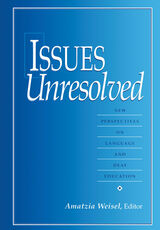
Part 1, Communication: Signed and Spoken Languages, addresses matters that range from considering critical periods for language acquisition, researched by Susan D. Fischer, to assessing the impact of immigration policies on the ethnic composition of Australia’s deaf community, intriguing work by Jan Branson and Don Miller.
Part 2, Communication: Accessibility to Speech, continues the debate with works on the perception of speech by deaf and hard of hearing children, contributed by Arthur Boothroyd, and automatic speech recognition and its applications, delineated by Harry Levitt.
Educational issues are brought to the forefront in Part 3 in such engrossing studies as Lea Lurie and Alex Kozulin’s discourse on the application of an instrumental-enrichment cognitive intervention program with deaf immigrant children from Ethiopia. Stephen Powers offers another perspective in this section with his retrospective evaluation of a distance education training course for teachers of the deaf.
Part 4, Psychological and Social Adjustment reviews progress in this area, with Anne de Klerk’s exposition on the Rotterdam Deaf Awareness Program, and Corinne J. Lewkowitz and Lynn S. Liben’s research on the development of deaf and hearing children’s sex-role attitudes and self-endorsements. These and the many other contributions by renowned international scholars in the field make Issues Unresolved a compelling new standard for all involved in deaf education.
READERS
Browse our collection.
PUBLISHERS
See BiblioVault's publisher services.
STUDENT SERVICES
Files for college accessibility offices.
RECENTLY PUBLISHED






UChicago Accessibility Resources
home | accessibility | search | about | contact us
BiblioVault ® 2001 - 2025
The University of Chicago Press