
 A SCHOLARLY BOOK REPOSITORY
5 start with I start with I
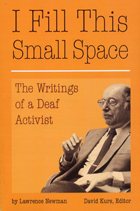
Lawrence Newman became deaf at the age of five in 1930, and saw his father fight back tears knowing that his son would never hear again. The next time he saw his father cry was in 1978, when Newman received an honorary doctorate from Gallaudet University, his alma mater. Newman was recognized for his achievements as a life-long advocate for deaf education, including receiving California’s Teacher of the Year award in 1968. Perhaps his greatest influence, however, stemmed from his many articles and columns that appeared in various publications, the best of which are featured in I Fill This Small Space: The Writings of a Deaf Activist.
Editor David Kurs has organized Newman’s writings around his passions — deaf education, communication and language, miscellaneous columns and poems on Deaf life, and humorous insights on his activism. His articles excel both as seamless arguments supporting his positions and as windows on the historical conflicts that he fought: against the Least Restrictive Environment in favor of residential deaf schools; for sign language, Total Communication, and bilingual education; and as a deaf teacher addressing parents of deaf children. A gifted writer in all genres, Newman amuses with ease (“On Mini and Midi-Skirts”), and moves readers with his heartfelt verse (“Girl with a Whirligig”). Newman ranges wide in his ability, but he always maintains his focus on equal tights for deaf people, as he demonstrates in his title poem “I Fill This Small Space:”
I fill this small space, this time
Who is to say yours is better
Than mine or mine yours
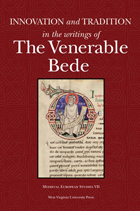
Works prior to this book focused on Bede as not only a European, but also as an English scholar, historian, scientist, or a biographer of saints, and have used a traditional approach towards his explanation of the Bible. Bede's interpretation of his work, its continuous progress, and the reasons behind his hurried appointment to an authority almost as high as the Church Fathers are all topics examined within the text. Essays are by Roger Ray, Faith Wallis, Calvin B. Kendall, George Hardin Brown, Scott DeGregorio, Arthur G. Holder, Lawrence T. Martin, Walter Goffart, and Joyce Hill.
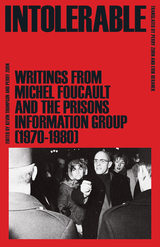
A groundbreaking collection of writings by Michel Foucault and the Prisons Information Group documenting their efforts to expose France’s inhumane treatment of prisoners
Founded by Michel Foucault and others in 1970–71, the Prisons Information Group (GIP) circulated information about the inhumane conditions within the French prison system. Intolerable makes available for the first time in English a fully annotated compilation of materials produced by the GIP during its brief but influential existence, including an exclusive new interview with GIP member Hélène Cixous and writings by Gilles Deleuze and Jean Genet.
These archival documents—public announcements, manifestos, reports, pamphlets, interventions, press conference statements, interviews, and round table discussions—trace the GIP’s establishment in post-1968 political turmoil, the new models of social activism it pioneered, the prison revolts it supported across France, and the retrospective assessments that followed its denouement. At the same time, Intolerable offers a rich, concrete exploration of Foucault’s concept of resistance, providing a new understanding of the arc of his intellectual development and the genesis of his most influential book, Discipline and Punish.
Presenting the account of France’s most vibrant prison resistance movement in its own words and on its own terms, this significant and relevant collection also connects the approach and activities of the GIP to radical prison resistance movements today.

Uri Avnery is one of the best-known peace activists in Israel and founder of the Gush Shalom peace movement. He has been involved in, and written about, all major events in Israel's history since its creation in 1948, and was the first Israeli to meet Yasser Arafat. This is a carefully selected collection of his articles from the last 10 years. Additionally, he has written a rigorous introduction that shows how peace can be achieved.
Avnery offers a unique perspective on the Middle-East conflict, drawing on his enormous experience of advocating Palestinian rights from within the system as a member of parliament and from outside as a peace activist. Written with passion and wit, his articles reveal and analyse the 'facts on the ground', always pointing out opportunities for reconciliation between the two sides and exposing those who exacerbate the conflict.
This book is a must-read for everyone who wants peace in the Middle East.

“It changed my life.” That’s what Betty Friedan heard over and over from women throughout the United States after the publication of her radical best-seller, The Feminine Mystique, sparked the beginning of contemporary feminism. The first stirring and uncertain years of the women’s movement helped many women put a name to the sense of invisibility, powerlessness, and depression that Friedan famously called “the problem that has no name.”
First published in 1976, “It Changed My Life” is a compellingly readable collection of reports from the front, back in the days less than a generation ago when women were routinely shut out of the professions and higher education, underpaid, condescended to, and harassed without consequences to the harassers. The book describes the political campaigns for equal pay and job opportunities, for the outlawing of sex discrimination, for the Equal Rights Amendment, and for legalized abortion, the creation of National Organization for Women, the National Abortion Rights Action League, and the National Women’s Political Caucus, and analyzes the antifeminist backlashes. Encounters with Simone de Beauvoir and Indira Gandhi are juxtaposed with moving and vivid personal struggles of many ordinary women. Among those women was Friedan herself, who frankly recorded her astonishment, gratification, and anger as the movement she helped create grew beyond all her hopes, and then raced beyond her control into a sexual politics she found disturbing.
A classic of modern feminism, “It Changed My Life” brings back years of struggle for those who were there, and recreates the past for the readers of today who were not yet born during these struggles for the opportunities and respect to which women can now feel entitled. In changing women’s lives, the women’s movement has changed everything.
READERS
Browse our collection.
PUBLISHERS
See BiblioVault's publisher services.
STUDENT SERVICES
Files for college accessibility offices.
RECENTLY PUBLISHED



UChicago Accessibility Resources
home | accessibility | search | about | contact us
BiblioVault ® 2001 - 2026
The University of Chicago Press