front cover of I Guess This Is Activism?
I Guess This Is Activism?
Youth, Political Education, and Free-Market Common Sense
Kevin L. Clay
University of Minnesota Press, 2026

How neoliberal capitalism and pedagogical deideologization constrain the radical possibilities of youth activism

In I Guess This Is Activism? Kevin L. Clay presents an eye-opening account of his experience with Youth Participatory Action Research (YPAR) as an Upward Bound educator. Grounded in Paulo Freire’s tradition of critical pedagogy, YPAR has been championed by community-based educators and scholars in the United States as an approach for supporting critical consciousness development and social change with working-class Black and Latino youth. Clay, however, questions whether YPAR can effectively prepare youths to subvert the systems reproducing their material conditions under neoliberal capitalism. Exposing the political and pedagogical limits of YPAR’s progressive education model, he reveals how omnipresent neoliberalism undermines youths’ radical potential when political education is not prioritized in youth activism.

I Guess This Is Activism? engages Black radical thinkers, including Ella Baker and Fred Hampton, to reveal the faulty assumptions implicit in YPAR’s program. Looking deeply into how he and his students navigated questions of community problems and social change at the twilight of the Obama presidency, Clay demonstrates how, in the absence of political education on the structures of race, class, and capitalism, youth activism is always eclipsed by the common sense of the free market.

As working-class Black and Latino youth inherit a society deeply shaped by neoliberal dogma, I Guess This Is Activism? delivers a much-needed reexamination of YPAR and visions for the future of youth activist education.

Retail e-book files for this title are screen-reader friendly with images accompanied by short alt text and/or extended descriptions.

[more]

front cover of If We Dream Too Long
If We Dream Too Long
Poh Seng Goh
National University of Singapore Press, 2020
Published in 1972 and widely regarded as the first Singapore novel, If We Dream Too Long explores the dilemmas and challenges faced by its hero, Kwang Meng, as he navigates the difficult transitional period between youthful aspirations and the external demands of society and family. Shy and sensitive, he feels detached from mainstream life and is unable to identify with the values that animate his friends. Kwang Meng takes refuge in dreams of exotic faraway places, and imagines merging himself with the sea, which he loves. Yet amid this uncertainty, the reader feels that all is not lost, that the young dreamer will eventually find his way. Kwang Meng’s experiences reflect Goh Poh Seng’s fascination with the question of self amid the dreariness and aimlessness of an increasingly urbanized and materialistic Asian society. The book also provides a fascinating portrait of Singapore as it was in the 1960s, a landscape and society that have since undergone many changes but remain faintly visible in modern Singapore. This new edition restores the author’s original typographic design and has an updated introduction by Koh Tai Ann.
[more]

front cover of In Defense of Youth
In Defense of Youth
A Study of the Role of Counsel in American Juvenile Courts
William Vaughn Stapleton
Russell Sage Foundation, 1972
In recent years the decisions of the United States Supreme Court in the area of juvenile law and the growing public awareness of the delinquency problem have brought about drastic changes in American juvenile courts. This book represents a major research effort to determine the effect of defense counsel's performance on the conduct and outcome of delinquency cases. After a brief historical analysis of the factors leading to changes in juvenile law, the authors explore in detail the impact of the lawyer's presence and performance on the outcomes of cases in two juvenile courts. The analysis further explores the various factors influencing a lawyer's defense posture and develops the thesis that the effectiveness of counsel is determined largely by the structure of the delinquency hearing and the willingness and ability of court personnel and procedures to adapt to the introduction of an adversarial role of defense counsel. What makes this study unique is the large-scale effort to combine legal analysis and sociological methodology to the study of an action-oriented program. The use of the classical experimental design, the selection of control and experimental groups by random assignment, and the extent to which the use of this methodology increases the validity of the results, will be of interest to both lawyers and social scientists. The book is a major contribution to the growing literature in the field of the sociology of law.
[more]

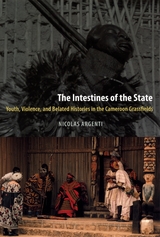
front cover of The Intestines of the State
The Intestines of the State
Youth, Violence, and Belated Histories in the Cameroon Grassfields
Nicolas Argenti
University of Chicago Press, 2007
The young people of the Cameroon Grassfields have been subject to a long history of violence and political marginalization. For centuries the main victims of the slave trade, they became prime targets for forced labor campaigns under a series of colonial rulers. Today’s youth remain at the bottom of the fiercely hierarchical and polarized societies of the Grassfields, and it is their response to centuries of exploitation that Nicolas Argenti takes up in this absorbing and original book.

Beginning his study with a political analysis of youth in the Grassfields from the eighteenth century to the present, Argenti pays special attention to the repeated violent revolts staged by young victims of political oppression. He then combines this history with extensive ethnographic fieldwork in the Oku chiefdom, discovering that the specter of past violence lives on in the masked dance performances that have earned intense devotion from today’s youth. Argenti contends that by evoking the imagery of past cataclysmic events, these masquerades allow young Oku men and women to address the inequities they face in their relations with elders and state authorities today.
[more]


Send via email Share on Facebook Share on Twitter