logo for University of Chicago Press Journals
JR vol 98 num 3
The University of Chicago Press
University of Chicago Press Journals, 2018

logo for University of Chicago Press Journals
JR vol 99 num 3
The University of Chicago Press
University of Chicago Press Journals, 2019

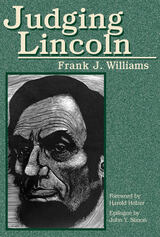
front cover of Judging Lincoln
Judging Lincoln
Frank J. Williams. Foreword by Harold Holzer. Epilogue by John Y. Simon
Southern Illinois University Press, 2007
Judging Lincoln collects nine of the most insightful essays on the topic of the sixteenth president written by Frank J. Williams, chief justice of the Rhode Island Supreme Court and one of the nation’s leading authorities on Abraham Lincoln. For Judge Williams, Lincoln remains the central figure of the American experience—past, present, and future.
Williams begins with a survey of the interest in—and influence of—Lincoln both at home and abroad and then moves into an analysis of Lincoln’s personal character with respect to his ability to foster relationships of equality among his intimates.
Williams then addresses Lincoln’s leadership abilities during the span of his career, with particular emphasis on the Civil War. Next, he compares the qualities of Abraham Lincoln, Franklin Delano Roosevelt, and Winston Churchill. The final essay, cowritten with Mark E. Neely Jr., concerns collecting Lincoln artifacts as a means of preserving and fostering the Lincoln legacy.
[more]

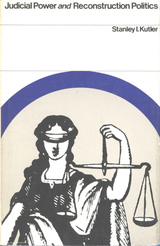
front cover of Judicial Power and Reconstruction Politics
Judicial Power and Reconstruction Politics
Stanley I. Kutler
University of Chicago Press, 1968
A study of the Supreme Court in the wake of the Dred Scott decision.

This book investigates the political and public standing of the Supreme Court following the Dred Scott decision. Arguing against interpretations by previous historians, Kutler asserts instead that the "Chase Court" was neither enfeebled by the decision itself, nor by congressional Republicans during reconstruction. Instead, Kutler suggests that during reconstruction, the Court was characterized by forcefulness and judicious restraint rather than timidity and cowardice, holding a creative and determining role rather than abdicating its rightful powers. This volume assembles a series of essays by Kutler arguing for this characterization. Provocative and persuasive at turns, this collection of essays provides a bold and innovative reinterpretation of the Supreme Court after the Civil War.
[more]

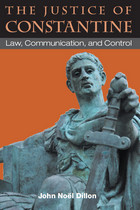
front cover of The Justice of Constantine
The Justice of Constantine
Law, Communication, and Control
John Noël Dillon
University of Michigan Press, 2012

As the first Christian emperor of Rome, Constantine the Great has long interested those studying the establishment of Christianity. But Constantine is also notable for his ability to control a sprawling empire and effect major changes. The Justice of Constantineexamines Constantine's judicial and administrative legislation and his efforts to maintain control over the imperial bureaucracy, to guarantee the working of Roman justice, and to keep the will of his subjects throughout the Roman Empire.

John Dillon first analyzes the record of Constantine's legislation and its relationship to prior legislation. His initial chapters also serve as an introduction to Roman law and administration in later antiquity. Dillon then considers Constantine's public edicts and internal communications about access to law, trials and procedure, corruption, and punishment for administrative abuses. How imperial officials relied on correspondence with Constantine to resolve legal questions is also considered. A study of Constantine's expedited appellate system, to ensure provincial justice, concludes the book.

Constantine's constitutions reveal much about the Theodosian Code and the laws included in it. Constantine consistently seeks direct sources of reliable information in order to enforce his will. In official correspondence, meanwhile, Constantine strives to maintain control over his officials through punishment; trusted agents; and the cultivation of accountability, rivalry, and suspicion among them.


[more]


Send via email Share on Facebook Share on Twitter