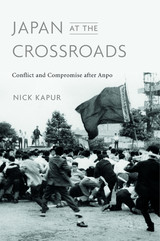
front cover of Japan at the Crossroads
Japan at the Crossroads
Conflict and Compromise after Anpo
Nick Kapur
Harvard University Press, 2018

In spring of 1960, Japan’s government passed Anpo, a revision of the postwar treaty that allows the United States to maintain a military presence in Japan. This move triggered the largest popular backlash in the nation’s modern history. These protests, Nick Kapur argues in Japan at the Crossroads, changed the evolution of Japan’s politics and culture, along with its global role.

The yearlong protests of 1960 reached a climax in June, when thousands of activists stormed Japan’s National Legislature, precipitating a battle with police and yakuza thugs. Hundreds were injured and a young woman was killed. With the nation’s cohesion at stake, the Japanese government acted quickly to quell tensions and limit the recurrence of violent demonstrations. A visit by President Eisenhower was canceled and the Japanese prime minister resigned. But the rupture had long-lasting consequences that went far beyond politics and diplomacy. Kapur traces the currents of reaction and revolution that propelled Japanese democracy, labor relations, social movements, the arts, and literature in complex, often contradictory directions. His analysis helps resolve Japan’s essential paradox as a nation that is both innovative and regressive, flexible and resistant, wildly imaginative yet simultaneously wedded to tradition.

As Kapur makes clear, the rest of the world cannot understand contemporary Japan and the distinct impression it has made on global politics, economics, and culture without appreciating the critical role of the “revolutionless” revolution of 1960—turbulent events that released long-buried liberal tensions while bolstering Japan’s conservative status quo.


[more]

front cover of Jewish Autonomy in Conflict with Christians in Northern Ethiopia
Jewish Autonomy in Conflict with Christians in Northern Ethiopia
The Gideonite Dynasty and the Solomonic Kingdom
Bar Kribus
Arc Humanities Press, 2025

Medieval and early modern Jews usually lived as a minority under non-Jewish rule, but there are a few known cases of independent or autonomous Jewish polities. One of the most intriguing is the autonomous Betä Ǝsraʾel (Ethiopian Jews) in the Sǝmen Mountains of Ethiopia.

Betä Ǝsraʾel oral tradition refers to this polity as the “Kingdom of the Gideonites.” From the fifteenth to the seventeenth century, the Betä Ǝsraʾel of the Sǝmen and its surroundings were involved in a series of wars against the Christian Solomonic kingdom, until finally being subdued in the late 1620s.

Based, in part, on the archaeological survey of Betä Ǝsra’el monastic sites, this book examines not only textual and oral accounts, but also the historical geography of the Betä Ǝsraʾel polity and its strongholds. It also discusses the commemoration of these wars in later times and their impact on the development of religious sites.

[more]

logo for Intellect Books
A Journey of Art and Conflict
Weaving Indra's Net
David Oddie
Intellect Books, 2015
A Journey of Art and Conflict is a deeply personal exploration of David Oddie’s attempts to uncover the potential of the arts as a resource for reconciliation in the wake of conflict and for the creative transformation of conflict itself. It began when Oddie, seeing the fractured world around him, asked himself what he could do to help; that question set him off on travels around the world, including to Palestine, Kosovo, South Africa, India, Northern Ireland, Brazil, and other places. In each location, he met with local people who had suffered from conflict and worked with them to forge artistic networks that have the potential to transform their situation.
[more]


Send via email Share on Facebook Share on Twitter