
 A SCHOLARLY BOOK REPOSITORY
4 start with J start with J
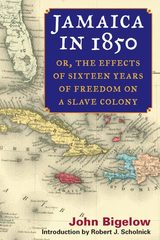
A reporter's firsthand portrait of formerly enslaved Jamaicans in the years after emancipation
John Bigelow’s Jamaica in 1850 provided an important document in the antislavery movement in the United States and Great Britain. Jamaica’s economy had collapsed after the 1838 emancipation. American supporters of enslavement used the Jamaican example to argue that abolition at home would unleash economic and social chaos. Bigelow’s vivid eyewitness reporting undermined that widely held view by proving Jamaica’s problems originated in the incompetence of absentee white planters and an obsolete colonial system. As Bigelow showed, many once-enslaved Jamaicans had in fact become successful small-scale landowners in the twelve years after emancipation while the large plantations languished.
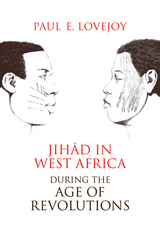
In Jihād in West Africa during the Age of Revolutions, a preeminent historian of Africa argues that scholars of the Americas and the Atlantic world have not given Africa its due consideration as part of either the Atlantic world or the age of revolutions. The book examines the jihād movement in the context of the age of revolutions—commonly associated with the American and French revolutions and the erosion of European imperialist powers—and shows how West Africa, too, experienced a period of profound political change in the late eighteenth through the mid-nineteenth centuries. Paul E. Lovejoy argues that West Africa was a vital actor in the Atlantic world and has wrongly been excluded from analyses of the period.
Among its chief contributions, the book reconceptualizes slavery. Lovejoy shows that during the decades in question, slavery expanded extensively not only in the southern United States, Cuba, and Brazil but also in the jihād states of West Africa. In particular, this expansion occurred in the Muslim states of the Sokoto Caliphate, Fuuta Jalon, and Fuuta Toro. At the same time, he offers new information on the role antislavery activity in West Africa played in the Atlantic slave trade and the African diaspora.
Finally, Jihād in West Africa during the Age of Revolutions provides unprecedented context for the political and cultural role of Islam in Africa—and of the concept of jihād in particular—from the eighteenth century into the present. Understanding that there is a long tradition of jihād in West Africa, Lovejoy argues, helps correct the current distortion in understanding the contemporary jihād movement in the Middle East, Afghanistan, Pakistan, and Africa.


This edition is introduced by John Brown scholar William S. King, who provides the background to the writing of the biography which took place during a turbulent time of race relations and competing visions from Booker T. Washington and Du Bois for the future of Black Americans. “Du Bois,” King reminds us, “remains one of the best writers on this phase of American history, which is still at our core.”
READERS
Browse our collection.
PUBLISHERS
See BiblioVault's publisher services.
STUDENT SERVICES
Files for college accessibility offices.
RECENTLY PUBLISHED




UChicago Accessibility Resources
home | accessibility | search | about | contact us
BiblioVault ® 2001 - 2026
The University of Chicago Press