front cover of Jewish Budapest
Jewish Budapest
Monuments, Rites, History
Géza Komoróczy
Central European University Press, 1999
As a painting by Chagall unfolds layer upon layer when viewed carefully, so does the city in Jewish Budapest. Neither a guidebook or a history in the traditional sense, this book is about the Jewish face of Budapest from medieval times to the present. To get the broadest possible perspective, this book is not only about the Hungarian capital as a Jewish city but, as befits a cosmopolitan metropolis, delves into its myriad elements. There was and is, as Jewish Budapest strikingly reveals, a Roman and a Greek – Catholic Budapest, a Lutheran and a Calvinist Budapest, a German, a Serbian and a Gypsy Budapest. All these are brought into play as backdrop to the main narrative about the history of Jews in Buda, Obuda, and Pest. Past and present Jewish life as an organic part of the life of the Hungarian capital Budapest – be it memory or living reality. Richly illustrated with wonderfully evocative literary line drawings and photos, the book includes a lavish, full-colour section of artwork that enhances the text. Here is a book at once personal and universal. It is about everyday Jewish life, the humor, the pathos, the human condition, which is the same or very similar anywhere in the Diaspora. Every image and incident, every happening is filtered through the strong sensibilities of the key citizens of the city throughout the past few centuries. Remarkable citizens personified by the likes of Theodor Herzl and Joseph Pulitzer. The city is itself the central character of this book. The authors write only about those parts where there is a story to tell. They talk about places where history is still visible, where it can be located, where its traces still exist, where it can be tasted, savoured, and where it surrounds us as part of life in Budapest today. Jewish Budapest amasses huge amounts of lore about the city, its monuments and relics, its language and scholarship, its cultural heart, and its intellectual core. Jewish Budapest proceeds according to the chronological sequence of the birth of the Jewish quarters in the city, focusing on patterns of settlement and occupation, and demography, and unfolds finally into a vision of the future of Jewish life in this remarkably vibrant, venerable city. The book includes a section of detailed comments on the illustrations with an explanation of the abbreviations throughout as well as a bibliography, an index of personal names, an index of cities and towns, and an index of Budapest street addresses.
[more]

front cover of Jewish Cuisine in Hungary
Jewish Cuisine in Hungary
A Cultural History with 83 Authentic Recipes
András Koerner
Central European University Press, 2020

Winner of the 2019 National Jewish Book Award in the category of Food Writing & Cookbooks.

The author refuses to accept that the world of pre-Shoah Hungarian Jewry and its cuisine should disappear almost without a trace and feels compelled to reconstruct its culinary culture. His book―with a preface by Barbara Kirshenblatt-Gimblett―presents eating habits not as isolated acts, divorced from their social and religious contexts, but as an organic part of a way of life.

According to Kirshenblatt-Gimblett: “While cookbooks abound, there is no other study that can compare with this book. It is simply the most comprehensive account of a Jewish food culture to date.” Indeed, no comparable study exists about the Jewish cuisine of any country, or―for that matter―about Hungarian cuisine. It describes the extraordinary diversity that characterized the world of Hungarian Jews, in which what could or could not be eaten was determined not only by absolute rules, but also by dietary traditions of particular religious movements or particular communities. 

Ten chapters cover the culinary culture and eating habits of Hungarian Jewry up to the 1940s, ranging from kashrut (the system of keeping the kitchen kosher) through the history of cookbooks, the food traditions of weekdays and holidays, the diversity of households, and descriptions of food and hospitality industries to the history of some typical dishes. Although this book is primarily a cultural history and not a cookbook, it includes 83 recipes, as well as nearly 200 fascinating pictures of daily life and documents.i
[more]

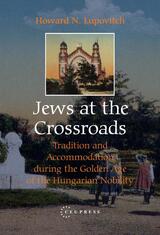
front cover of Jews at the Crossroads
Jews at the Crossroads
Tradition and Accomodation during the Golden Age of the Hungarian Nobility
Howard N. Lupovitch
Central European University Press, 2007
Examines the social and political history of the Jews of Miskolc-the third largest Jewish community in Hungary-and presents the wider transformation of Jewish identity during the eighteenth and nineteenth centuries. It explores the emergence of a moderate, accommodating form of traditional Judaism that combined elements of tradition and innovation, thereby creating an alternative to Orthodox and Neolog Judaism. This form of traditional Judaism reconciled the demands of religious tradition with the expectations of Magyarization and citizenship, thus allowing traditional Jews to be patriotic Magyars. By focusing on Hungary, this book seeks to correct a trend in modern Jewish historiography that views Habsburg Jewish History as an extension of German Jewish History, most notably with regard to emancipation and enlightenment. Rather than trying to fit Hungarian Jewry into a conventional Germano-centric taxonomy, this work places Hungarian Jews in the distinct contexts of the Habsburg Monarchy and the Danube Basin, positing a more seamless nexus between the eighteenth and nineteenth century. This nexus was rooted in a series of political experiments by Habsburg sovereigns and Hungarian noblemen that culminated in civic equality, and in the gradual expansion of traditional Judaism to meet the challenges of the age.
[more]


Send via email Share on Facebook Share on Twitter