
 A SCHOLARLY BOOK REPOSITORY
10 start with J start with J
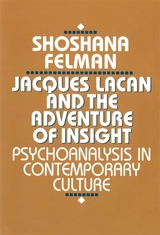
Jacques Lacan, one of the most influential and controversial French thinkers of the twentieth century, was a practicing and teaching psychoanalyst in Paris, but his revolutionary seminars on Freud reached out far beyond professional circles: they were enthusiastically attended by writers, artists, scientists, philosophers, and intellectuals from many disciplines.
Shoshana Felman elucidates the power and originality of Lacan’s work. She brilliantly analyzes Lacan’s investigation of psychoanalysis not as dogma but as an ongoing self-critical process of discovery. By focusing on Lacan’s singular way of making Freud’s thought new again—and of thus enabling us to participate in the very moment of intellectual struggle and insight—Felman shows how this moment of illumination has become crucial to contemporary thinking and has redefined insight as such. This book is a groundbreaking statement not only on Lacan but on psychoanalysis in general.
Felman argues that, contrary to popular opinion, Lacan’s preoccupation is with psychoanalytic practice rather than with theory for its own sake. His true clinical originality consists not in the incidental innovations that separate his theory from other psychoanalytic schools, but in the insight he gives us into the structural foundations of what is common to the practice of all schools: the transference action and the psychoanalytic dialogue. In chapters on Poe’s tale “The Purloined Letter”; Sophocles’s Oedipus plays, a case report by Melanie Klein, and Freud’s writings, Felman demonstrates Lacan’s rediscovery of these texts as renewed and renewable intellectual adventures and as parables of the psychoanalytic encounter. The book explores these questions: How and why does psychoanalytic practice work? What accounts for clinical success? What did Freud learn from the literary Oedipus, and how does Freud text take us beyond Oedipus? How does psychoanalysis inform, and radically displace, our conception of what learning is and of what reading is?
This book will be an intellectual event not only for clinicians and literary critics, but also for the broader audience of readers interested in contemporary thought.
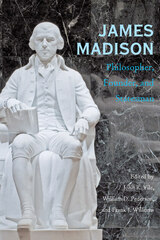
James Madison: Philosopher, Founder, and Statesman presents fresh scholarship on the nation’s fourth president, who is often called both the father of the U.S. Constitution and the father of the Bill of Rights. These essays by historians and political scientists from the United States and abroad focus on six distinct aspects of Madison’s life and work: his personality and development as a statesman; his work at the Constitutional Convention of 1787 and contributions to larger constitutional design; his advocacy for the adoption of the Bill of Rights; his controversial role as a party leader; his presidency; and his life after leaving office.
James Madison continues to be regarded as one of America’s great political theorists, a man who devoted his life to, and who found fulfillment in, public service. His philosophical contributions remain vital to any understanding of the modern American polity. This book will be of great interest to political scientists and theorists, as well as to historians of early American history and politics.
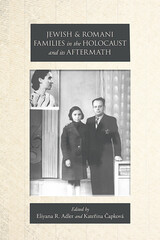
In this work, scholars from the United States, Israel, and across Europe bring a variety of backgrounds and disciplines to their study of the Holocaust and its aftermath from the family perspective. Drawing on research from Belarus to Great Britain, and examining both Jewish and Romani families, they demonstrate the importance of recognizing how people continued to function within family units—broadly defined—throughout the war and afterward.
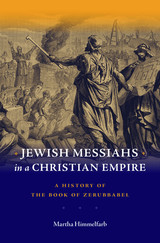
The seventh-century CE Hebrew work Sefer Zerubbabel (Book of Zerubbabel), composed during the period of conflict between Persia and the Byzantine Empire for control over Palestine, is the first full-fledged messianic narrative in Jewish literature. Martha Himmelfarb offers a comprehensive analysis of this rich but understudied text, illuminating its distinctive literary features and the complex milieu from which it arose.
Sefer Zerubbabel presents itself as an angelic revelation of the end of times to Zerubbabel, a biblical leader of the sixth century BCE, and relates a tale of two messiahs who, as Himmelfarb shows, play a major role in later Jewish narratives. The first messiah, a descendant of Joseph, dies in battle at the hands of Armilos, the son of Satan who embodies the Byzantine Empire. He is followed by a messiah descended from David modeled on the suffering servant of Isaiah, who brings him back to life and triumphs over Armilos. The mother of the Davidic messiah also figures in the work as a warrior.
Himmelfarb places Sefer Zerubbabel in the dual context of earlier Jewish eschatology and Byzantine Christianity. The role of the messiah’s mother, for example, reflects the Byzantine notion of the Virgin Mary as the protector of Constantinople. On the other hand, Sefer Zerubbabel shares traditions about the messiahs with rabbinic literature. But while the rabbis are ambivalent about these traditions, Sefer Zerubbabel embraces them with enthusiasm.
For many, the Middle Ages in general evokes a sense of the sinister and brings to mind a world of fear, superstition, and religious fanaticism. For Jews it was a period marked by persecutions, pogroms, and expulsions. Yet at the same time, the Middle Ages was also a time of lively cultural exchange and heightened creativity for Jews. In The Jewish Middle Ages, contributors explore the ways in which the stories of biblical women, including, Eve, Sarah, Hagar, Rebekah, Zipporah, Ruth, Esther, and Judith, make their way into the rich tapestry of medieval Jewish literature, mystical texts, and art, particularly in works emanating from Ashkenazic circles. Contributors include Carol Bakhos, Judith R. Baskin, Elisheva Baumgarten, Dagmar Börner-Klein, Constanza Cordoni, Rachel Elior, Meret Gutmann-Grün, Robert A. Harris, Yuval Katz-Wilfing, Sheila Tuller Keiter, Katrin Kogman-Appel, Gerhard Langer, Aurora Salvatierra Ossorio, and Felicia Waldman. These essays give us a glimpse into the role women played and the authority they assumed in medieval Jewish culture beyond the rabbinic centers of Palestine and Babylonia.
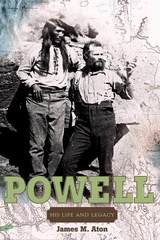
“John Wesley Powell: explorer, writer, geologist, anthropologist, land planner, bureaucrat. Which one do we focus on?” This is the question author James M. Aton poses at the beginning of his biography of Powell, though he soon decides that it is impossible to ignore any facet of Powell’s life. Powell was a polymath, one whose “divergent interests resemble one of those braided streambeds in his beloved canyon country, branching out in many directions, but ultimately beginning and ending in the same stream."
Aton beautifully tells the multidimensional stories of Powell’s childhood, his military and teaching careers, his famous and exciting explorations of the Colorado River, and the battles he waged from his influential positions within the Smithsonian’s Bureau of Ethnology and the United States Geological Survey. This new edition of John Wesley Powell: His Life and Legacy, first printed as an issue of the Boise State University Western Writers Series, includes the original biography, but also features Aton’s new interpretations of Powell’s writings on exploration, land-planning, anthropology, and irrigation, and incorporates the author’s distinguished faculty lecture on Powell and cash-register dams in the Colorado River Basin.
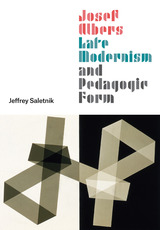
An extraordinary teacher whose influence continues today, Josef Albers helped shape the Bauhaus school in Germany and established the art and design programs at Black Mountain College in North Carolina and Yale University. His books about color theory have informed generations, and his artworks are included in the canon of high-modernist non-representational art. The pedagogy Albers developed was a dynamic approach to teaching that transcended the modernist agendas and cultivated a material way of thinking among his students.
With this book, Jeffrey Saletnik explores the origins of Albers’s teaching practices and their significance in conveying attitudes about form, material, and sensory understanding to artists Eva Hesse and Richard Serra. He demonstrates how pedagogy is a framework that establishes the possibility for artistic discourse and how the methods through which artists learn are manifested in their individual practices. Tracing through lines from Albers’s training in German educational traditions to his influence on American postwar art, Josef Albers, Late Modernism, and Pedagogic Form positions Albers’s pedagogy as central to the life of modernism.
READERS
Browse our collection.
PUBLISHERS
See BiblioVault's publisher services.
STUDENT SERVICES
Files for college accessibility offices.
RECENTLY PUBLISHED


UChicago Accessibility Resources
home | accessibility | search | about | contact us
BiblioVault ® 2001 - 2025
The University of Chicago Press