front cover of Kalmykia in Russia's Past and Present National Policies and Administrative System
Kalmykia in Russia's Past and Present National Policies and Administrative System
Konstantin N. Maksimov
Central European University Press, 2008
Kalmykia is a constituent of the Russian Federation that shaped and has been developing within Russia for several centuries. Kalmykia was incorporated into the Russian state in the early second half of the 17 th century, it was officially recognized by the Russian authorities and constituted as an ethno-political entity in the form of feudal khanate with the status of a virtually autonomous unit. The Kalmyk Khanate's status as a largely self-ruling area within the Russian Empire gradually transformed into the status of a regular administrative territory under the Astrakhan governor. It received the status of a Republic from Stalin.Maksimov examines issues of interrelations between the Kalmyk people and Russia before and after the Kalmyks' accession to the Russian state. Analyzes the Soviet national policy and to the destiny of Kalmykia under the communist regime. The legal status of this republic and its development under the new Russian federalism are discussed in great details.
[more]

front cover of Keeping the World’s Environment under Review
Keeping the World’s Environment under Review
An Intellectual History of the Global Environment Outlook
Jan Bakkes
Central European University Press, 2022

How do we take stock of the state and direction of the world’s environment, and what can we learn from the experience? Among the myriad detailed narratives about the condition of the planet, the Global Environment Outlook (GEO) reports—issued by the United Nations Environment Programme—stand out as the most ambitious. For nearly three decades the GEO project has not only delivered iconic global assessment reports, but through its multitude of contributors has inspired hundreds of similar processes worldwide from the regional to the local level.

This book provides an inside account of the evolution of the GEO project from its earliest days. Building on meticulous research, including interviews with former heads of the United Nations Environment Programme, diplomats, leading contributing scientists, and senior leaders of collaborating organizations, the story is told from the perspective of five GEO veterans who all played a pivotal role in shaping the periodic assessments. The GEO’s history provides striking insights and will save valuable time to those who commission, design and conduct, as well as critique and improve, assessments of environmental development in the next decade.

[more]

front cover of Key Concepts of Romanian History
Key Concepts of Romanian History
Alternative Approaches to Socio-Political Languages
Victor Neumann
Central European University Press, 2013
The theoretical analyses and interpretations contained in the studies of this volume focus on key-concepts such as: politics, politician, democracy, Europe, liberalism, constitution, property, progress, kinship, nation, national character and specificity, homeland, patriotism, education, totalitarianism, democracy, democratic, democratization, transition. The essays unveil specific aspects belonging to Romania's past and present. They also offer alternative perspectives on the Romanian culture through the relationship between the elite and society, and novel reflections on the delayed and unfinished modernization processes within the society and the state. The editors articulate the results coming from various sciences, such as history, linguistics, sociology, political sciences, and philosophy with the aim that the past and present profiles of Romania are better understood.
[more]

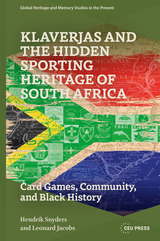
front cover of Klaverjas and the Hidden Sporting Heritage of South Africa
Klaverjas and the Hidden Sporting Heritage of South Africa
Card Games, Community, and Black History
Hendrik Snyders
Central European University Press, 2026
As a collective, klaverjas players form a distinct community of practice with a unique organisational discourse, language, and set of socialisation practices. Given its prevalence within South Africa’s Black communities, klawerjas, as it is locally known, is perceived as both the traditional game of the communities in question and a marker of a particular regional ethnic identity. The history of klaverjas is part of the unmapped sporting heritage of South Africa’s Black communities, whose true extent and meaning have long remained obscured. This book maps the development of klaverjas, its consolidation, its unique local character, and its intersections with broader societal events. It places competitive klaverjas in the mainstream of South Africa’s sports history and claims its place as a part of the country’s national sports identity.
[more]

front cover of Knowledge and Computing
Knowledge and Computing
Computer Epistemology and Constructive Skepticism
Tibor Vámos
Central European University Press, 2010
The result of the author's extensive practical experience: a decade in computer process control using large scale systems, another decade in machine pattern-recognition for vision systems, and nearly a decade dealing with artificial intelligence and expert systems. These real-life projects have taught Vámos a critical appreciation of, and respect for, both abstract theory and the practical methodology that grows out of—and, in turn, shapes—those theories.Machine representation means a level of formalization that can be expressed by the instruments of mathematics, whereas programming is not more and not less than a special linguistic translation of these mathematical formulae. How these all are related and controlled is a most practical philosophical and computation professional task. Wide experience in the practical fields of computer science, and the research of the underlying theoretical issues have led Vámos to the development of the attitude and activity of constructive skepticism.
[more]

front cover of Krúdy's Chronicles
Krúdy's Chronicles
Turn-of-the-Century Hungary in Gyula Krudy's Journalism
John Batki
Central European University Press, 2000

Written during the 1910s '20s and '30s, these articles offer a wistful and nostalgic image of the waning years of the Austro-Hungarian empire, with portraits of the Habsburgs, culminating in first-hand reports in 1916, from Vienna on the funeral of Emperor Francis Joseph I, and from Budapest on the coronation of Charles IV, the last king of Hungary. Krúdy's reports follow the bloodless democratic revolution of 1918, the Károlyi government and the short-lived Soviet Republic, and present cameos of the leading political figures of the day such as Ferenc Kossuth, Mihály Károlyi and Béla Kun.


In his lively, casual pieces Krúdy displays his intimate knowledge of Hungarian society with a special emphasis on literature and publishing.

[more]


Send via email Share on Facebook Share on Twitter