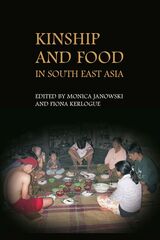
front cover of Kinship and Food in South East Asia
Kinship and Food in South East Asia
Edited by Monica Janowski and Fiona G. Kerlogue
National University of Singapore Press, 2007
Food has an important role in establishing and structuring social and kin relations in Southeast Asian societies. For this reason, there is growing interest within anthropology in understanding how the production, processing and consumption of food is one important basis for the construction of ties of relatedness, so-called ‘kin’ ties. These are often based at least partly on ‘shared substance’. In this respect, a book on Southeast Asia is especially interesting in understanding kinship since the region is generally taken to include a number of distinct types of kin structure. This book offers eleven chapters covering a range of societies in different parts of Southeast Asia. It examines ways in which food is used to think about and bring about ties between generations and within generations – including between the living and the dead – in particular through the feeding relationship. Significant parallels emerge between the societies covered: in the role of rice especially; in gender complementarity in relation to different foods; in the belief that food and drink carry fertility, ‘blessings’ or ‘life force’ from ascending to descending generations; and in the use of the feeding relationship to generate hierarchy. These parallels suggest that there may be underlying similarities in cosmology between these widely varying societies. A significant contribution to the ongoing debate on the nature of kinship in Southeast Asia, this volume will be useful as a textbook for courses within anthropology, including on the anthropology of food and environmental anthropology.
[more]

front cover of Kitchen Literacy
Kitchen Literacy
How We Lost Knowledge of Where Food Comes from and Why We Need to Get It Back
Ann Vileisis
Island Press, 2008
Ask children where food comes from, and they’ll probably answer: “the supermarket.” Ask most adults, and their replies may not be much different. Where our foods are raised and what happens to them between farm and supermarket shelf have become mysteries. How did we become so disconnected from the sources of our breads, beef, cheeses, cereal, apples, and countless other foods that nourish us every day?
 
Ann Vileisis’s answer is a sensory-rich journey through the history of making dinner. Kitchen Literacy takes us from an eighteenth-century garden to today’s sleek supermarket aisles, and eventually to farmer’s markets that are now enjoying a resurgence. Vileisis chronicles profound changes in how American cooks have considered their foods over two centuries and delivers a powerful statement: what we don’t know could hurt us.
 
As the distance between farm and table grew, we went from knowing particular places and specific stories behind our foods’ origins to instead relying on advertisers’ claims. The woman who raised, plucked, and cooked her own chicken knew its entire life history while today most of us have no idea whether hormones were fed to our poultry. Industrialized eating is undeniably convenient, but it has also created health and environmental problems, including food-borne pathogens, toxic pesticides, and pollution from factory farms.
 
Though the hidden costs of modern meals can be high, Vileisis shows that greater understanding can lead consumers to healthier and more sustainable choices. Revealing how knowledge of our food has been lost and how it might now be regained, Kitchen Literacy promises to make us think differently about what we eat.

[more]


Send via email Share on Facebook Share on Twitter