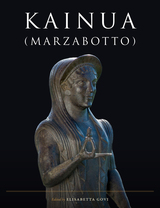
front cover of Kainua (Marzabotto)
Kainua (Marzabotto)
Edited by Elisabetta Govi
University of Texas Press, 2023

This volume brings together leading scholars of Etruria to provide up-to-date findings from the key archaeological site of Kainua. Located in what is now the Italian town of Marzabotto, Kainua is the only Etruscan site whose complete urban layout has been preserved, making it possible to trace houses, roads, drainage systems, cemeteries, craft workshops, and an acropolis.

Under excavation since the 1850s, Kainua offers a trove of insights into Etruscan culture and society. The volume’s editor, Elisabetta Govi, and her fellow experts examine the material evidence underlying our understanding of the history, economy, religion, and social structures of Kainua, including trade routes that linked the city with the wider Mediterranean. Particularly exciting are recent discoveries of sanctuaries dedicated to Tinia and Uni, analogous to the Greek Zeus and Hera, which provide new information about Etruscan cults. Kainua (Marzabotto) also draws on the latest research to reconstruct the city’s foundation rites, a sacred charter, and urban plan. Finally, the authors explore the site’s archaeological history, discussing new knowledge made possible since the introduction of modern techniques of remote sensing and 3D modeling.


[more]

front cover of Knots, or the Violence of Desire in Renaissance Florence
Knots, or the Violence of Desire in Renaissance Florence
Emanuele Lugli
University of Chicago Press, 2023
An interdisciplinary study of hair through the art, philosophy, and science of fifteenth-century Florence.

In this innovative cultural history, hair is the portal through which Emanuele Lugli accesses the cultural production of Lorenzo il Magnifico’s Florence. Lugli reflects on the ways writers, doctors, and artists expressed religious prejudices, health beliefs, and gender and class subjugation through alluring works of art, in medical and political writings, and in poetry. He considers what may have compelled Sandro Botticelli, the young Leonardo da Vinci, and dozens of their contemporaries to obsess over braids, knots, and hairdos by examining their engagement with scientific, philosophical, and theological practices.
 
By studying hundreds of fifteenth-century documents that engage with hair, Lugli foregrounds hair’s association to death and gathers insights about human life at a time when Renaissance thinkers redefined what it meant to be human and to be alive. Lugli uncovers overlooked perceptions of hair when it came to be identified as a potential vector for liberating culture, and he corrects a centuries-old prejudice that sees hair as a trivial subject, relegated to passing fashion or the decorative. He shows hair, instead, to be at the heart of Florentine culture, whose inherent violence Lugli reveals by prompting questions about the entanglement of politics and desire.
 
[more]

front cover of Knowledge Power And Discipline
Knowledge Power And Discipline
German Studies And National Identity
Pier Carlo Bontempelli
University of Minnesota Press, 2003

An essential critical history of German studies as an academic discipline

German Studies has confronted many crises, as well as severe criticism and self-criticism, and yet it has managed to maintain its disciplinary system through every upheaval—the revolution of 1848, the establishment of the Second Reich in 1871, the Weimar Republic, the Nazi Third Reich, the Second World War and the reconstruction era, the creation and reunification of the two German states. Pier Carlo Bontempelli focuses on this continuity, dating back to the early nineteenth century, when the “founding fathers” of Germanistik secured its status by grounding it in a set of fixed principles, revived by each successive generation of scholars in order to legitimize their position of power—and to ensure their capacity for cultural reproduction.

Using the works of Michel Foucault and Pierre Bourdieu, Bontempelli investigates the institution and principles of German Studies and critically reconstructs its history. Mindful of the mechanisms of choice and domination operating at every turn, his book exposes the repressed social and political history of German Studies.
[more]


Send via email Share on Facebook Share on Twitter