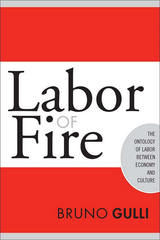
front cover of Labor of Fire
Labor of Fire
The Ontology of Labor between Economy and Culture
Bruno Gullì
Temple University Press, 2005
In Labor of Fire, Bruno Gullì offers a timely and much needed re-examination of the concept of labor. Distinguishing between "productive labor" (working for money or subsistence) and "living labor" (working for artistic creation), Gullì convincingly argues for a definition of work that recognizes the importance of artistic and social creativity to our definition of labor and the self.

Gullì lays the groundwork for his book by offering a critique of productive labor, and then maps out his productive/living labor distinction in detail, reviewing the work of Marx and others.
[more]

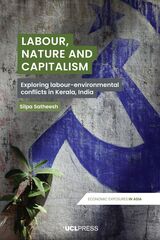
front cover of Labour, Nature and Capitalism
Labour, Nature and Capitalism
Exploring Labour-Environmental Conflicts in Kerala, India
Silpa Satheesh
University College London, 2025
In the fight for environmental justice, who speaks for the working class? A look at the uneasy alliance between labor and industry in Kerala.

Set against the industrial belt of Eloor-Edayar, Labour, Nature and Capitalism investigates the uneasy tensions between trade unions and environmental movements in Kerala, complicating the celebrated “Kerala Model” of development. Through ethnographic research and document analysis, Silpa Satheesh studies how capitalist interests shape and divide movements that appear to share common ground. The book challenges the simplistic “environment versus development” binary, depicting how industrial labor and grassroots environmental activism frequently find themselves at odds, despite both being embedded in struggles for justice.

By foregrounding the lived experiences of movement actors and examining the ideological fractures that emerge in postcolonial capitalism, Satheesh provides a much-needed intervention into debates on labor and ecology in the Global South. This interdisciplinary work is particularly valuable for scholars and activists working at the intersection of environmental justice and working-class mobilization, shedding light on the possibilities and limits of solidarity in the fight for just transitions.
 
[more]

front cover of Land Hunger
Land Hunger
Ohio and the Western Frontiers
Mansel G. Blackford
Ohio University Press, 2025
In Land Hunger, Mansel G. Blackford explores the central role of land use in the experiences of Native Americans, African Americans, and Euro Americans as the new nation expanded westward from Ohio to the Oregon Country. Blackford emphasizes how people adapted to new and changed environments and focuses on key themes related to environmental and frontier studies: the land-use interactions between Native Americans and outsiders, the influence of government policies, and the impact of earlier concepts about the ownership and use of land and water that continue to affect us today in the face of climate change. The first part of the book delves into Euro American and African American settlement in the Ohio Country during the late 1700s and early 1800s. Driven by “Ohio fever” and influenced by a blend of pragmatic, romantic, and capitalistic ideals, tens of thousands crossed the Appalachian Mountains to settle and farm in an unfamiliar land. It was in Ohio and the Midwest that many Americans developed their views on land and the environment, and where the new federal government devised methods for surveying and selling claimed lands. Subsequent chapters analyze how Ohioans and others attempted to apply Midwest-born ideas and practices in the Oregon Country and the Great Plains—regions with significantly different environments—with limited success. Land Hunger defines “frontiers” as zones of interaction between distinct groups of people, offering a broad interpretation of these contested spaces. The book explores how frontiers were depicted in fiction, where their portrayal helped establish their meaning and significance to incoming Americans. Blackford examines diaries, letters, and reminiscences, as well as a broad range of scholarly studies in this historical synthesis.
[more]

front cover of The Land of the Dead Is Open for Business
The Land of the Dead Is Open for Business
Jacob Strautmann
Four Way Books, 2020
The Land of the Dead Is Open for Business is an extended elegy for Jacob Strautmann’s home state of West Virginia and its generations of inhabitants sold out by the false promise of the American Dream. Throughout the book, voices rise up from the page to describe a landscape eroded and plundered by runaway capitalism—its mountain tops leveled by the extractive industries, its waters polluted by runoff from mines—and the fallout from that waste. Those who remain are consigned to life in a ravaged land denuded of nature where birds die and “Sheep / birth limp two-headed things and some / that speak like men if they speak at all.”
[more]

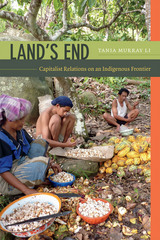
front cover of Land's End
Land's End
Capitalist Relations on an Indigenous Frontier
Tania Murray Li
Duke University Press, 2014
Drawing on two decades of ethnographic research in Sulawesi, Indonesia, Tania Murray Li offers an intimate account of the emergence of capitalist relations among indigenous highlanders who privatized their common land to plant a boom crop, cacao. Spurred by the hope of ending their poverty and isolation, some prospered, while others lost their land and struggled to sustain their families. Yet the winners and losers in this transition were not strangers—they were kin and neighbors. Li's richly peopled account takes the reader into the highlanders' world, exploring the dilemmas they faced as sharp inequalities emerged among them.

The book challenges complacent, modernization narratives promoted by development agencies that assume inefficient farmers who lose out in the shift to high-value export crops can find jobs elsewhere. Decades of uneven and often jobless growth in Indonesia meant that for newly landless highlanders, land's end was a dead end. The book also has implications for social movement activists, who seldom attend to instances where enclosure is initiated by farmers rather than coerced by the state or agribusiness corporations. Li's attention to the historical, cultural, and ecological dimensions of this conjuncture demonstrates the power of the ethnographic method and its relevance to theory and practice today.
[more]

front cover of Landscaping Indigenous Mexico
Landscaping Indigenous Mexico
The Liberal State and Capitalism in the Purépecha Highlands
Fernando Pérez Montesinos
University of Texas Press, 2025

A history of the Purépecha people's survival amid environmental and political changes.

Landscapes are more than geological formations; they are living records of human struggles. Landscaping Indigenous Mexico unearths the history of Juátarhu, an Indigenous landscape shaped and nurtured by the Purépecha—a formidable Mesoamerican people whose power once rivaled that of the Aztecs. Although cataclysmic changes came with European contact and colonization, Juátarhu’s enduring agroecology continued to sustain local life through centuries of challenges.

Contesting essentialist narratives of Indigenous penury, Pérez Montesinos shows how Purépechas thrived after Mexican independence in 1821, using Juátarhu’s diverse agroecology to negotiate continued autonomy amid waves of national economic and political upheaval. After 1870, however, autonomy waned under the pressure of land privatization policies, state intervention, and industrial logging. On the eve of the Mexican Revolution in 1910, Purépechas stood at a critical juncture: Would the Indigenous landscape endure or succumb? Offering a fresh perspective on a seemingly well-worn subject, Pérez Montesinos argues that Michoacán, long considered a peripheral revolutionary region, saw one of the era’s most radical events: the destruction of the liberal order and the timber capitalism of Juátarhu.
[more]

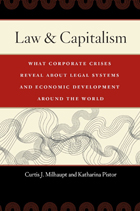
front cover of Law & Capitalism
Law & Capitalism
What Corporate Crises Reveal about Legal Systems and Economic Development around the World
Curtis J. Milhaupt and Katharina Pistor
University of Chicago Press, 2008
Recent high-profile corporate scandals—such as those involving Enron in the United States, Yukos in Russia, and Livedoor in Japan—demonstrate challenges to legal regulation of business practices in capitalist economies. Setting forth a new analytic framework for understanding these problems, Law and Capitalism examines such contemporary corporate governance crises in six countries, to shed light on the interaction of legal systems and economic change. This provocative book debunks the simplistic view of law’s instrumental function for financial market development and economic growth.
            Using comparative case studies that address the United States, China, Germany, Japan, Korea, and Russia, Curtis J. Milhaupt and Katharina Pistor argue that a disparate blend of legal and nonlegal mechanisms have supported economic growth around the world. Their groundbreaking findings show that law and markets evolve together in a “rolling relationship,” and legal systems, including those of the most successful economies, therefore differ significantly in their organizational characteristics. Innovative and insightful, Law and Capitalism will change the way lawyers, economists, policy makers, and business leaders think about legal regulation in an increasingly global market for capital and corporate governance.
 
[more]

logo for Pluto Press
Law of Accumulation and Breakdown of the Capitalist System
Henryk Grossmann
Pluto Press, 1992

front cover of Leave Me Alone and I'll Make You Rich
Leave Me Alone and I'll Make You Rich
How the Bourgeois Deal Enriched the World
Deirdre Nansen McCloskey and Art Carden
University of Chicago Press, 2020
The economist and historian Deirdre Nansen McCloskey has been best known recently for her Bourgeois Era trilogy, a vigorous defense, unrivaled in scope, of commercially tested betterment.  Its massive volumes, The Bourgeois Virtues, Bourgeois Dignity, and Bourgeois Equality, solve Adam Smith’s puzzle of the nature and causes of the wealth of nations, and of the moral sentiments of modernity.   The world got rich, she argues, not chiefly by material causes but by an idea and a sentiment, a new admiration for the middle class and its egalitarian liberalism.  

For readers looking for a distillation of McCloskey’s magisterial work, Leave Me Alone and I’ll Make You Rich is what you’ve been waiting for. In this lively volume, McCloskey and the economist and journalist Carden bring together the trilogy’s key ideas and its most provocative arguments. The rise of the west, and now the rest, is the story of the rise of ordinary people to a dignity and liberty inspiring them to have a go. The outcome was an explosion of innovation after 1800, and a rise of real income by an astounding 3,000 percent.  The Great Enrichment, well beyond the conventional Industrial Revolution, did not, McCloskey and Carden show, come from the usual suspects, capital accumulation or class struggle.  It came from the idea of economic liberty in Holland and the Anglosphere, then Sweden and Japan, then Italy and  Israel and China and India, an idea that bids fair in the next few generations to raise up the wretched of the earth.  The original shift to liberalism arose from 1517 to 1789 from theological and political revolutions in northwest Europe, upending ancient hierarchies.  McCloskey and Carden contend further that liberalism and “innovism” made us better humans as well as richer ones.  Not matter but ideas.  Not corruption but improvement.

Leave Me Alone and I’ll Make You Rich draws in entertaining fashion on history, economics, literature, philosophy, and popular culture, from growth theory to the Simpsons. It is the perfect introduction for a broad audience to McCloskey’s influential explanation of how we got rich.  At a time when confidence in the economic system is under challenge, the book mounts an optimistic and persuasive defense of liberal innovism, and of the modern world it has wrought.
 
[more]

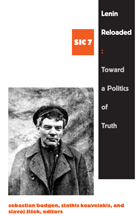
front cover of Lenin Reloaded
Lenin Reloaded
Toward a Politics of Truth, sic vii
Sebastian Budgen, Stathis Kouvelakis, and Slavoj Žižek, eds.
Duke University Press, 2007
Lenin Reloaded is a rallying call by some of the world’s leading Marxist intellectuals for renewed attention to the significance of Vladimir Lenin. The volume’s editors explain that it was Lenin who made Karl Marx’s thought explicitly political, who extended it beyond the confines of Europe, who put it into practice. They contend that a focus on Lenin is urgently needed now, when global capitalism appears to be the only game in town, the liberal-democratic system seems to have been settled on as the optimal political organization of society, and it has become easier to imagine the end of the world than a modest change in the mode of production. Lenin retooled Marx’s thought for specific historical conditions in 1914, and Lenin Reloaded urges a reinvention of the revolutionary project for the present. Such a project would be Leninist in its commitment to action based on truth and its acceptance of the consequences that follow from action.

These essays, some of which are appearing in English for the first time, bring Lenin face-to-face with the problems of today, including war, imperialism, the imperative to build an intelligentsia of wage earners, the need to embrace the achievements of bourgeois society and modernity, and the widespread failure of social democracy. Lenin Reloaded demonstrates that truth and partisanship are not mutually exclusive as is often suggested. Quite the opposite—in the present, truth can be articulated only from a thoroughly partisan position.

Contributors. Kevin B. Anderson, Alain Badiou, Etienne Balibar, Daniel Bensaïd, Sebastian Budgen, Alex Callinicos, Terry Eagleton, Fredric Jameson, Stathis Kouvelakis, Georges Labica, Sylvain Lazarus, Jean-Jacques Lecercle, Lars T. Lih, Domenico Losurdo, Savas Michael-Matsas, Antonio Negri, Alan Shandro, Slavoj Žižek

[more]

logo for Pluto Press
Let Them Eat Junk
How Capitalism Creates Hunger and Obesity
Robert Albritton
Pluto Press, 2009

Respected economist Robert Albritton argues that the capitalist system, far from delivering on the promise of cheap, nutritious food for all, has created a world where 25% of the world population are over-fed and 25% are hungry. This malnourishment of 50% of the world's population is explained systematically, a refreshing change from accounts that focus on cultural factors and individual greed. Albritton details the economic relations and connections that have put us in a situation of simultaneous oversupply and undersupply of food.

This explosive book provides yet more evidence that the human cost of capitalism is much bigger than those in power will admit.
[more]

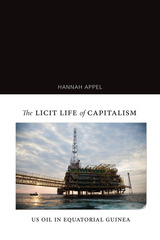
front cover of The Licit Life of Capitalism
The Licit Life of Capitalism
US Oil in Equatorial Guinea
Hannah Appel
Duke University Press, 2019
The Licit Life of Capitalism is both an account of a specific capitalist project—U.S. oil companies working off the shores of Equatorial Guinea—and a sweeping theorization of more general forms and processes that facilitate diverse capitalist projects around the world. Hannah Appel draws on extensive fieldwork with managers and rig workers, lawyers and bureaucrats, the expat wives of American oil executives and the Equatoguinean women who work in their homes, to turn conventional critiques of capitalism on their head, arguing that market practices do not merely exacerbate inequality; they are made by it. People and places differentially valued by gender, race, and colonial histories are the terrain on which the rules of capitalist economy are built. Appel shows how the corporate form and the contract, offshore rigs and economic theory are the assemblages of liberalism and race, expertise and gender, technology and domesticity that enable the licit life of capitalism—practices that are legally sanctioned, widely replicated, and ordinary, at the same time as they are messy, contested, and, arguably, indefensible.
[more]

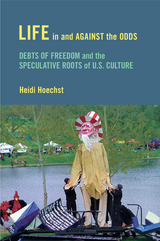
front cover of Life in and against the Odds
Life in and against the Odds
Debts of Freedom and the Speculative Roots of U.S. Culture
Heidi Hoechst
Temple University Press, 2015

Somehow people continue to imagine a world of justice against the odds of a deck that has been stacked against them. In her urgent and perceptive book, Life in and against the Odds, Hoechst focuses on the particular circumstances and conditions of different phases of speculative expansion in the United States. She traces the roots of the nation-state to nineteenth-century land markets and slave exchanges. Hoechst also chronicles how these racial foundations extend through corporate capitalism from the 1920s and ´30s to the present era of financialized capitalism and the recent housing bubble.

Life in and against the Odds identifies where and how speculative nationalism creates roadblocks to freedom. Hoechst retells the history of the United States with a perspective on how human lives are made, destroyed, reconfigured, and claimed under the systemic violence of a nation that is rooted in the racializing futurity of speculative capitalism.
[more]

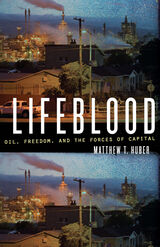
front cover of Lifeblood
Lifeblood
Oil, Freedom, and the Forces of Capital
Matthew T. Huber
University of Minnesota Press, 2013

If our oil addiction is so bad for us, why don’t we kick the habit? Looking beyond the usual culprits—Big Oil, petro-states, and the strategists of empire—Lifeblood finds a deeper and more complex explanation in everyday practices of oil consumption in American culture. Those practices, Matthew T. Huber suggests, have in fact been instrumental in shaping the broader cultural politics of American capitalism.

How did gasoline and countless other petroleum products become so central to our notions of the American way of life? Huber traces the answer from the 1930s through the oil shocks of the 1970s to our present predicament, revealing that oil’s role in defining popular culture extends far beyond material connections between oil, suburbia, and automobility. He shows how oil powered a cultural politics of entrepreneurial life—the very American idea that life itself is a product of individual entrepreneurial capacities. In so doing he uses oil to retell American political history from the triumph of New Deal liberalism to the rise of the New Right, from oil’s celebration as the lifeblood of postwar capitalism to increasing anxieties over oil addiction.

Lifeblood rethinks debates surrounding energy and capitalism, neoliberalism and nature, and the importance of suburbanization in the rightward shift in American politics. Today, Huber tells us, as crises attributable to oil intensify, a populist clamoring for cheap energy has less to do with American excess than with the eroding conditions of life under neoliberalism.
[more]

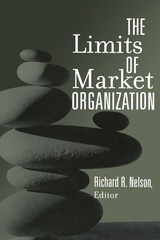
front cover of The Limits of Market Organization
The Limits of Market Organization
Richard R. Nelson
Russell Sage Foundation, 2005
The last quarter century has seen a broad, but qualified, belief in the efficacy of market organization slide into an unyielding dogma that the market, as unconstrained as possible, is the best way to govern virtually all economic activity. However, unrestricted markets can often lead to gross inequalities in access to important resources, the creation of monopolies, and other negative effects that require regulation or public subsidies to remedy. In The Limits of Market Organization, editor Richard Nelson and a group of economic experts take a more sophisticated look at the public/private debate, noting where markets are useful, where they can be effective only if augmented by non-market mechanisms, and where they are simply inappropriate. The Limits of Market Organization examines the appropriateness of markets in four areas where support for privatization varies widely: human services, public utilities, science and technology, and activities where market involvement is altogether inappropriate. Richard Murnane makes the case that a social interest in providing equal access to high quality education means that for school voucher plans to be effective, substantial government oversight is necessary. Federal involvement in a transcontinental railroad system was initially applauded, but recent financial troubles at Amtrak have prompted many to call for privatization of the rails. Yet contributor Elliot Sclar argues that public subsidies are the only way to maintain this vital part of the American transportation infrastructure. While market principles can promote competition and foster innovation, applying them in certain areas can actually stifle progress. Nelson argues that aggressive patenting has hindered scientific research by restricting access to tools and processes that could be used to generate new findings. He suggests that some kind of exception to patent law should be made for scientists who seek to build off of patented findings and then put their research results into the public domain. In other spheres, market organization is altogether unsuitable. Legal expert Richard Briffault looks at one such example—the democratic political process—and profiles the successes and failures of campaign finance reform in preventing parties from buying political influence. This important volume shows that market organization has its virtues, but also its drawbacks. Just as regulation can be over-applied, so too can market principles. The Limits of Market Organization encourages readers to think more discriminately about the march toward privatization, and to remember the importance of public institutions.
[more]


Send via email Share on Facebook Share on Twitter