
 A SCHOLARLY BOOK REPOSITORY
7 start with L start with L
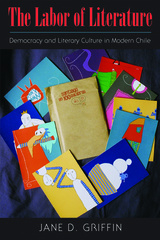
By examining alternative literary publications, Griffin recasts the seventeen-year Pinochet dictatorship as a time of editorial experimentation despite widespread cultural oppression and shows how grassroots cultural activism has challenged government-approved corporate publishing models throughout the postdictatorship period. Griffin's work also points to the growing importance of autogestión, or do-it-yourself cultural production, where individuals combine artisanal forms with new technologies to make and share creative work on a global scale.
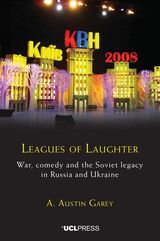
Leagues of Laughter traces the evolution of a Soviet-created youth game called KVN (Klub veselykh i nakhodchivykh or Club of the Cheerful and Clever) over sixty years as students’ nation-states collapsed, competed, and eventually went to war. Through cross-border narratives, the book shows how humor persists—and transforms—amid authoritarianism, censorship, and conflict. With insight and compassion, author A. Austin Garey reveals how laughter became a mode of resistance, identity, and cultural continuity in the long cultural context of the war in Ukraine. In addition to introducing a novel theory of “tradition as stance” to explain how traditions are reproduced and reinterpreted over time, the book offers a compelling comparative analysis of cultural production under political pressure.

American public schools often censor controversial student speech that the Constitution protects. Lessons in Censorship brings clarity to a bewildering array of court rulings that define the speech rights of young citizens in the school setting. Catherine J. Ross examines disputes that have erupted in our schools and courts over the civil rights movement, war and peace, rights for LGBTs, abortion, immigration, evangelical proselytizing, and the Confederate flag. She argues that the failure of schools to respect civil liberties betrays their educational mission and threatens democracy.
From the 1940s through the Warren years, the Supreme Court celebrated free expression and emphasized the role of schools in cultivating liberty. But the Burger, Rehnquist, and Roberts courts retreated from that vision, curtailing certain categories of student speech in the name of order and authority. Drawing on hundreds of lower court decisions, Ross shows how some judges either misunderstand the law or decline to rein in censorship that is clearly unconstitutional, and she powerfully demonstrates the continuing vitality of the Supreme Court’s initial affirmation of students’ expressive rights. Placing these battles in their social and historical context, Ross introduces us to the young protesters, journalists, and artists at the center of these stories.
Lessons in Censorship highlights the troubling and growing tendency of schools to clamp down on off-campus speech such as texting and sexting and reveals how well-intentioned measures to counter verbal bullying and hate speech may impinge on free speech. Throughout, Ross proposes ways to protect free expression without disrupting education.
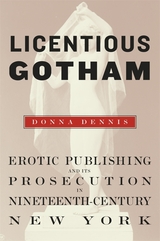
Licentious Gotham, set in the streets, news depots, publishing houses, grand jury chambers, and courtrooms of the nation’s great metropolis, delves into the stories of the enterprising men and women who created a thriving transcontinental market for sexually arousing books and pictures. The experiences of “fancy” publishers, “flash” editors, and “racy” novelists, who all managed to pursue their trade in the face of laws criminalizing obscene publications, dramatically convey nineteenth-century America’s daring notions of sex, gender, and desire, as well as the frequently counterproductive results of attempts to enforce conventional moral standards.
In nineteenth-century New York, the business of erotic publishing and legal attacks on obscenity developed in tandem, with each activity shaping and even promoting the pursuit of the other. Obscenity prohibitions, rather than curbing salacious publications, inspired innovative new styles of forbidden literature—such as works highlighting expressions of passion and pleasure by middle-class American women. Obscenity prosecutions also spurred purveyors of lewd materials to devise novel schemes to evade local censorship by advertising and distributing their products through the mail. This subterfuge in turn triggered far-reaching transformations in strategies for policing obscenity.
Donna Dennis offers a colorful, groundbreaking account of the birth of an indecent print trade and the origins of obscenity regulation in the United States. By revealing the paradoxes that characterized early efforts to suppress sexual expression in the name of morality, she suggests relevant lessons for our own day.
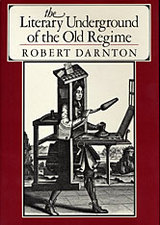
“This is splendid historical writing…Darnton [has] a well-justified reputation as one of the most original contributors to our understanding of life in pre-revolutionary Paris.” —New York Review of Books
Robert Darnton introduces us to the shadowy world of pirate publishers, garret scribblers, under-the-cloak book peddlers, smugglers, and police spies that composed the literary underground of the Enlightenment.
Here are the ambitious writers who crowded into Paris seeking fame and fortune within the Republic of Letters, but who instead sank into the miserable world of Grub Street—victims of a closed world of protection and privilege. Venting their frustrations in an illicit literature of vitriolic pamphlets, libelles, and chroniques scandaleuses, these “Rousseaus of the gutter” desecrated everything sacred in the social order of the Old Regime. Here too are the workers who printed their writings and the clandestine booksellers who distributed them.
While censorship, a monopolistic guild, and the police contained the visible publishing industry within the limits of official orthodoxies, a prolific literary underworld disseminated a vast illegal literature that conveyed a seditious ideology to readers everywhere in France. Covering their traces in order to survive, the creators of this eighteenth-century counterculture have virtually disappeared from history. By drawing on an ingenious selection of previously hidden sources, such as police ledgers and publishers’ records, Robert Darnton reveals for the first time the fascinating story of that forgotten underworld.
The activities of the underground bear on a broad range of issues in history and literature, and they directly concern the problem of uncovering the ideological origins of the French Revolution. This engaging book illuminates those issues and provides a fresh view of publishing history that will inform and delight the general reader.
READERS
Browse our collection.
PUBLISHERS
See BiblioVault's publisher services.
STUDENT SERVICES
Files for college accessibility offices.
RECENTLY PUBLISHED



UChicago Accessibility Resources
home | accessibility | search | about | contact us
BiblioVault ® 2001 - 2025
The University of Chicago Press