
 A SCHOLARLY BOOK REPOSITORY
13 start with L start with L
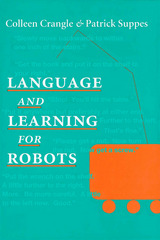
The authors develop the notion of an instructable robot—one which derives its intelligence in part from interaction with humans. Since verbal interaction with a robot requires a natural language semantics, the authors propose a natural-model semantics which they then apply to the interpretation of robot commands. Two experimental projects are described which provide natural-language interfaces to robotic aids for the physically disabled. The authors discuss the specific challenges posed by the interpretation of "stop" commands and the interpretation of spatial prepositions.
The authors also examine the use of explicit verbal instruction to teach a robot new procedures, propose ways a robot can learn from corrective commands containing qualitative spatial expressions, and discuss the machine-learning of a natural language use to instruct a robot in the performance of simple physical tasks. Two chapters focus on probabilistic techniques in learning.
A wide-ranging history of the algorithm.
Bringing together the histories of mathematics, computer science, and linguistic thought, Language and the Rise of the Algorithm reveals how recent developments in artificial intelligence are reopening an issue that troubled mathematicians well before the computer age: How do you draw the line between computational rules and the complexities of making systems comprehensible to people? By attending to this question, we come to see that the modern idea of the algorithm is implicated in a long history of attempts to maintain a disciplinary boundary separating technical knowledge from the languages people speak day to day.
Here, Jeffrey M. Binder offers a compelling tour of four visions of universal computation that addressed this issue in very different ways: G. W. Leibniz’s calculus ratiocinator; a universal algebra scheme Nicolas de Condorcet designed during the French Revolution; George Boole’s nineteenth-century logic system; and the early programming language ALGOL, short for algorithmic language. These episodes show that symbolic computation has repeatedly become entangled in debates about the nature of communication. Machine learning, in its increasing dependence on words, erodes the line between technical and everyday language, revealing the urgent stakes underlying this boundary.
The idea of the algorithm is a levee holding back the social complexity of language, and it is about to break. This book is about the flood that inspired its construction.

How generative AI systems capture a core function of language
Looking at the emergence of generative AI, Language Machines presents a new theory of meaning in language and computation, arguing that humanistic scholarship misconstrues how large language models (LLMs) function. Seeing LLMs as a convergence of computation and language, Leif Weatherby contends that AI does not simulate cognition, as widely believed, but rather creates culture. This evolution in language, he finds, is one that we are ill-prepared to evaluate, as what he terms “remainder humanism” counterproductively divides the human from the machine without drawing on established theories of representation that include both.
To determine the consequences of using AI for language generation, Weatherby reads linguistic theory in conjunction with the algorithmic architecture of LLMs. He finds that generative AI captures the ways in which language is at first complex, cultural, and poetic, and only later referential, functional, and cognitive. This process is the semiotic hinge on which an emergent AI culture depends. Weatherby calls for a “general poetics” of computational cultural forms under the formal conditions of the algorithmic reproducibility of language.
Locating the output of LLMs on a spectrum from poetry to ideology, Language Machines concludes that literary theory must be the backbone of a new rhetorical training for our linguistic-computational culture.
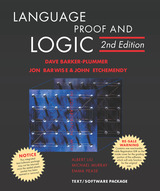
Language Proof and Logic is available as a physical book with the software included and as a downloadable package of software plus the book in PDF format. The all-electronic version is available from Openproof at gradegrinder.net.
The textbook/software package covers first-order language in a method appropriate for first and second courses in logic. An on-line grading services instantly grades solutions to hundred of computer exercises. It is designed to be used by philosophy instructors teaching a logic course to undergraduates in philosophy, computer science, mathematics, and linguistics.
Introductory material is presented in a systematic and accessible fashion. Advanced chapters include proofs of soundness and completeness for propositional and predicate logic, as well as an accessible sketch of Godel's first incompleteness theorem. The book is appropriate for a wide range of courses, from first logic courses for undergraduates (philosophy, mathematics, and computer science) to a first graduate logic course.
The software package includes four programs:
Tarski's World, a new version of the popular program that teaches the basic first-order language and its semantics;
Fitch, a natural deduction proof environment for giving and checking first-order proofs;
Boole, a program that facilitates the construction and checking of truth tables and related notions (tautology, tautological consequence, etc.);
Submit, a program that allows students to submit exercises done with the above programs to the Grade Grinder, the automatic grading service.
Grade reports are returned to the student and, if requested, to the student's instructor, eliminating the need for tedious checking of homework. All programs are available for Windows and Macintosh systems. Instructors do not need to use the programs themselves in order to be able to take advantage of their pedagogical value. More about the software can be found at gradegrinder.net.
The price of a new text/software package includes one Registration ID, which must be used each time work is submitted to the grading service. Once activated, the Registration ID is not transferable.
What kind of meaning can machines make—and why does it matter that it’s not the same as ours?
Anthropologist Paul Kockelman's Last Words offers a rigorous but accessible account of how large language models actually work—and why the meaning they produce is fundamentally different from human meaning-making. Drawing on the semiotics of C.S. Peirce, Kockelman’s witty and insightful pamphlet shows how LLMs are trained to predict word-word relations, not word-world relations, which explains both their uncanny fluency and their systematic blind spots. The result is a compact, essential guide to cutting through the hype: not a dismissal of AI, but a precise account of what it can and cannot do—and who profits from the confusion.
Exploring the influence of AI technologies on theories of reason, cognition, learning, and education
Learning Under Algorithmic Conditions presents twenty-seven concise essays that collectively chart the shifting terrain of learning in the age of artificial intelligence. Providing historical and philosophical context, this innovative volume features prominent scholars from the fields of media studies, philosophy, and education research, who shed light on how learning has become newly envisioned, machinic, and more-than-human. The contributors unravel various histories of machine intelligence and elucidate the current impact of machine learning technologies on practices of knowledge production. Teeming with theoretical and practical insights, Learning Under Algorithmic Conditions is an interdisciplinary guide for those working across the humanities and social sciences as well as anyone interested in understanding our changing social, political, and technical infrastructures.
Contributors: Craig Carson, Adelphi U; Felicity Coleman, U of the Arts London; Ed Dieterle; Shayan Doroudi, U of California, Irvine; David Gauthier, Utrecht U; Cathrine Hasse, Aarhus U; Talha Can İşsevenler, CUNY; Goda Klumbytė; Robb Lindgren, U of Illinois Urbana-Champaign; Michael Madiao; Henry Neim Osman; Luciana Parisi, Duke U; Carolyn Pedwell, Lancaster U; Arkady Plotnitsky, Purdue U; Julian Quiros, U of Pennsylvania; Sina Rismanchian; Warren Sack, U of California, Santa Cruz; R. Joshua Scannell, The New School; Gregory J. Seigworth, Millersville U; Rebecca Uliasz, U of Michigan; David Wagner, U of New Brunswick; Ben Williamson, U of Edinburgh.
Retail e-book files for this title are screen-reader friendly with images accompanied by short alt text and/or extended descriptions.
Although automatic processes are designed to be engines of rational systems, the stories in Life by Algorithms reveal how they can in fact produce absurd, inflexible, or even dangerous outcomes. Joining the call for “algorithmic transparency,” the contributors bring exceptional sensitivity to everyday sociality into their critique to better understand how the perils of modern technology affect finance, medicine, education, housing, the workplace, food production, public space, and emotions—not as separate problems but as linked manifestations of a deeper defect in the fundamental ordering of our society.
Contributors
Catherine Besteman, Alex Blanchette, Robert W. Gehl, Hugh Gusterson, Catherine Lutz, Ann Lutz Fernandez, Joseph Masco, Sally Engle Merry, Keesha M. Middlemass, Noelle Stout, Susan J. Terrio
This volume is first in a series of Knuth's collected works.
An inquiry into how livestreaming can help us meaningfully connect
Livestreaming is ubiquitous in our Covid-19-inflected era. In this book, EL Putnam takes up the implications of this technology, arguing that livestreamed internet broadcasts perform aesthetic and ethical encounters that invite distinctive means of relating to others. Treating humans and technologies as inherently relational, Putnam considers how livestreaming constitutes new patterns of being together that are complex, ambivalent, and transformative. Understood in such a way, we see how livestreaming exceeds quantifying and calculating metrics, challenges emphasis on content generation, and introduces an entirely new—and dynamic—means of social engagement.
READERS
Browse our collection.
PUBLISHERS
See BiblioVault's publisher services.
STUDENT SERVICES
Files for college accessibility offices.
RECENTLY PUBLISHED







UChicago Accessibility Resources
home | accessibility | search | about | contact us
BiblioVault ® 2001 - 2026
The University of Chicago Press