front cover of The Language of Birds
The Language of Birds
Norbert Scheuer
Haus Publishing, 2018
It is 2003, and Paul Arimond is serving as a paramedic in Afghanistan. The twenty-four-year-old has no illusions of becoming a hero. Rather, he has chosen the army to escape the tragedies of his past and his own feelings of guilt. As a result, he finds himself in the same land, now war-torn, where an ancestor of his, Ambrosius Arimond, a late eighteenth-century traveler and ornithologist, once explored and developed the theory of a universal language of birds.

As visceral horrors and everyday banalities of the war threaten to engulf Paul, he, like his great-great-grandfather, finds his very own refuge in Afghanistan’s natural world. In a diary filled with exquisite drawings of birds and ruminations on the life he left behind, Paul describes his experiences living with two comrades who are fighting their own demons and his befriending of an Afghan man, Nassim, as well as his dreams of escaping the restrictive base camp and visiting the shores of a lake visible from the lookout tower. But when he finally reaches the lake one night, he finds himself in the midst of a chain of events that, with his increasingly fragile state of mind, has dramatic—and ultimately heartbreaking—consequences.

A meditative novel that shows a new side to the conflict in Afghanistan, The Language of Birds takes a moving look at the all-too-human costs of war and questions what it truly means to fight for freedom.
 
[more]

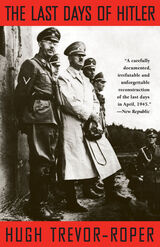
front cover of The Last Days of Hitler
The Last Days of Hitler
Hugh Trevor-Roper
University of Chicago Press, 1992
Late in 1945, Trevor-Roper was appointed by British Intelligence in Germany to investigate conflicting evidence surrounding Hitler's final days and to produce a definitive report on his death. The author, who had access to American counterintelligence files and to German prisoners, focuses on the last ten days of Hitler's life, April 20-29, 1945, in the underground bunker in Berlin—a bizarre and gripping episode punctuated by power play and competition among Hitler's potential successors.

"From exhaustive research [Trevor-Roper] has put together a carefully documented, irrefutable, and unforgettable reconstruction of the last days in April, 1945."—New Republic

"A book sound in its scholarship, brilliant in its presentation, a delight for historians and laymen alike."—A. J. P. Taylor, New Statesman
[more]

front cover of Last Works
Last Works
Moses Mendelssohn. Translated by Bruce Rosenstock
University of Illinois Press, 2012
Moses Mendelssohn (1729–1786) was the central figure in the emancipation of European Jewry. His intellect, judgment, and tact won the admiration and friendship of contemporaries as illustrious as Johann Gottfried Herder, Gotthold Ephraim Lessing, and Immanuel Kant. His enormously influential Jerusalem (1783) made the case for religious tolerance, a cause he worked for all his life.
 
Last Works includes, for the first time complete and in a single volume, the English translation of Morning Hours: Lectures on the Existence of God (1785) and To the Friends of Lessing (1786). Bruce Rosenstock has also provided an historical introduction and an extensive philosophical commentary to both texts.
 
At the center of Mendelssohn's last works is his friendship with Lessing. Mendelssohn hoped to show that he, a Torah-observant Jew, and Lessing, Germany's leading dramatist, had forged a life-long friendship that held out the promise of a tolerant and enlightened culture in which religious strife would be a thing of the past.
 
Lessing's death in 1781 was a severe blow to Mendelssohn. Mendelssohn wrote his last two works to commemorate Lessing and to carry on the work to which they had dedicated much of their lives. Morning Hours treats a range of major philosophical topics: the nature of truth, the foundations of human knowledge, the basis of our moral and aesthetic powers of judgment, the reality of the external world, and the grounds for a rational faith in a providential deity. It is also a key text for Mendelssohn's readings of Spinoza. In To the Friends of Lessing, Mendelssohn attempts to unmask the individual whom he believes to be the real enemy of the enlightened state: the Schwärmer, the religious fanatic who rejects reason in favor of belief in suprarational revelation.
[more]

front cover of The Law under the Swastika
The Law under the Swastika
Studies on Legal History in Nazi Germany
Michael Stolleis
University of Chicago Press, 1997
In the Law under the Swastika, Michael Stolleis examines the evolution of legal history, theory, and practice in Nazi Germany, paying close attention to its impact on the Federal Republic and on the German legal profession. Until the late 1960s, historians of the Nazi judicial system were mostly judges and administrators from the Nazi era. According to Stolleis, they were reluctant to investigate this legal history and maintained the ideal that law could not be affected by politics. Michael Stolleis is part of a younger generation and is determined to honestly confront the past in hopes of preventing the same injustices from happening in the future.

Stolleis studies a wide range of legal fields—constitutional, judicial, agrarian, administrative, civil, and business—arguing that all types of law were affected by the political realities of National Socialism. Moreover, he shows that legal traditions were not relinquished immediately with the onset of a new regime. For the first time we can see clearly the continuities between the Nazi period and the postwar period. The law under National Socialism did not make a complete break with the law during the Weimar Republic, nor did the law of the Federal Republic nullify all of the laws under National Socialism. Through a rich and subtle investigation, Stolleis shows how the legal profession and the political regime both reacted to the conditions of the period and molded the judicial system accordingly.

Breaking the conspiracy of silence held by the justices in the postwar period, Stolleis stresses the importance of researching Nazi law in order to confront ethical problems in today's legal profession.
[more]

front cover of Legality and Legitimacy
Legality and Legitimacy
Carl Schmitt
Duke University Press, 2004
Carl Schmitt ranks among the most original and controversial political thinkers of the twentieth century. His incisive criticisms of Enlightenment political thought and liberal political practice remain as shocking and significant today as when they first appeared in Weimar Germany. Unavailable in English until now, Legality and Legitimacy was composed in 1932, in the midst of the crisis that would lead to the collapse of the Weimar Republic and only a matter of months before Schmitt’s collaboration with the Nazis. In this important work, Schmitt questions the political viability of liberal constitutionalism, parliamentary government, and the rule of law. Liberal governments, he argues, cannot respond effectively to challenges by radical groups like the Nazis or Communists. Only a presidential regime subject to few, if any, practical limitations can ensure domestic security in a highly pluralistic society.

Legality and Legitimacy is sure to provide a compelling reference point in contemporary debates over the challenges facing constitutional democracies today. In addition to Jeffrey Seitzer’s translation of the 1932 text itself, this volume contains his translation of Schmitt’s 1958 commentary on the work, extensive explanatory notes, and an appendix including selected articles of the Weimar constitution. John P. McCormick’s introduction places Legality and Legitimacy in its historical context, clarifies some of the intricacies of the argument, and ultimately contests Schmitt’s claims regarding the inherent weakness of parliamentarism, constitutionalism, and the rule of law.
[more]

front cover of Leo Strauss and the Politics of Exile
Leo Strauss and the Politics of Exile
The Making of a Political Philosopher
Eugene Sheppard
Brandeis University Press, 2007
Born in rural Hesse, Germany, Leo Strauss (1899–1973) became an active Zionist and philosopher during the tumultuous and fractious Weimar Republic. As Eugene R. Sheppard demonstrates in this groundbreaking and engaging book, Strauss gravitated towards such thinkers as Franz Rosenzweig, Martin Heidegger, and Carl Schmitt as he sought to identify and overcome fundamental philosophical, political, and theological crises. The rise of Nazism impelled Strauss as a young Jewish émigré, first in Europe and then in America, to grapple with—and accommodate his thought to—the pressing challenges of exile. In confronting his own state of exile, Strauss enlisted premodern Jewish thinkers such as Moses Maimonides and Baruch Spinoza who earlier addressed the problem of reconciling their competing loyalties as philosophers and Jews. This is the first study to frame Strauss’s political philosophy around his critique of liberalism and the problem of exile. Sheppard follows Strauss from Europe to the United States, a journey of a conservative Weimar Jew struggling with modern liberalism and the existential and political contours of exile. Strauss sought to resolve the conflicts of a Jew unwilling to surrender loyalty to his ancestral community and equally unwilling to adhere to the strictures of orthodox observance. Strauss saw truth and wisdom as transcending particular religious and national communities, as well as the modern enlightened humanism in which he himself had been nurtured. In his efforts to navigate between the Jewish and the philosophical, the ancient and the modern, Berlin and New York, Strauss developed a distinctively programmatic way of reading and writing “between the lines.” Sheppard recaptures the complexity and intrigue of this project which has been ignored by those who both reject and claim Strauss’s legacy.
[more]

front cover of The Lesson of Carl Schmitt
The Lesson of Carl Schmitt
Four Chapters on the Distinction between Political Theology and Political Philosophy
Heinrich Meier
University of Chicago Press, 1998
This book is the culmination of Heinrich Meier's acclaimed analyses of the controversial thought of Carl Schmitt. Meier identifies the core of Schmitt's thought as political theology—that is, political theorizing that claims to have its ultimate ground in the revelation of a mysterious or supra-rational God. This radical, but half-hidden, theological foundation unifies the whole of Schmitt's often difficult and complex oeuvre, cutting through the intentional deceptions and unintentional obfuscations that have eluded previous commentators.

Relating this religious dimension to Schmitt's support for National Socialism and his continuing anti-Semitism, Meier compels the reader to come to terms with the irreconcilable differences between political theology and political philosophy. His book will give pause to those who have tended to gloss over the troubling aspects of some of Schmitt's ideas.

With editions in German, French, Italian, and now English, Meier's two books on Schmitt have dramatically reoriented the international debate about Carl Schmitt and his significance for twentieth-century political thought.

"Standing far above the rest . . . is Heinrich Meier's new study, Die Lehre Carl Schmitts, which covers all of Schmitt's writings. . . . Meier's work has forced everyone to take a second look at the assumptions underlying Schmitt's better-known writings and reconsider some that have been ignored."—Mark Lilla, reviewing the German edition in The New York Review of Books
[more]

front cover of The Lesson of Carl Schmitt
The Lesson of Carl Schmitt
Four Chapters on the Distinction between Political Theology and Political Philosophy, Expanded Edition
Heinrich Meier
University of Chicago Press, 2011
Heinrich Meier’s work on Carl Schmitt has dramatically reoriented the international debate about Schmitt and his significance for twentieth-century political thought. In The Lesson of Carl Schmitt, Meier identifies the core of Schmitt’s thought as political theology—that is, political theorizing that claims to have its ultimate ground in the revelation of a mysterious or suprarational God. This radical, but half-hidden, theological foundation underlies the whole of Schmitt’s often difficult and complex oeuvre, rich in historical turns and political convolutions, intentional deceptions and unintentional obfuscations.
 
In four chapters on morality, politics, revelation, and history, Meier clarifies the difference between political philosophy and Schmitt’s political theology and relates the religious dimension of his thought to his support for National Socialism and his continuing anti-Semitism. New to this edition are two essays that address the recently published correspondences of Schmitt—particularly with Hans Blumberg—and the light it sheds on his conception of political theology.
[more]

front cover of Lessons and Legacies, Volume XVI
Lessons and Legacies, Volume XVI
Rethinking Paradigms
Sarah Phillips Casteel and Jennifer V. Evans
Northwestern University Press, 2027

Bringing forth new perspectives previously unrepresented in Holocaust studies

Lessons and Legacies, Volume XVI: Rethinking Paradigms does the difficult but crucial work of thinking through new methods and modes of representation that speak to where we find ourselves in Holocaust studies today, responding to—and developing new tools to analyze—the shifting shape of Holocaust memory: spatially, temporally, and in and across diverse media. The collection foregrounds the challenges visual sources pose to how we think about the Holocaust, including how it is represented differently in visual media, from photography to graphic novels, and establishes translation as a crucial concept for reframing Holocaust testimony and memory. The contributing authors also model ethical, nuanced ways to conduct comparative, connective work that challenges Eurocentric narratives of the Holocaust. The volume concludes with a section on memory work and activism that approaches the subject of post-1945 memory through different lenses to surface lesser-known aspects of Holocaust history.
[more]

front cover of The Letters and Journals
The Letters and Journals
Paula Modersohn-Becker
Northwestern University Press, 1998
One of the great modern painters, Paula Modersohn-Becker was also a gifted writer who left behind journals and a sizable correspondence. This edition includes every extant letter, all carefully annotated, and is illustrated with forty-six black-and-white plates.
[more]

front cover of The Life and Thought of Hans Jonas
The Life and Thought of Hans Jonas
Jewish Dimensions
Christian Wiese
University Press of New England, 2010
Hans Jonas (1903–1993) is one of the most important philosophers of the 20th century. Born in a German Jewish community in the Rhineland, Jonas’s mentors included Edmund Husserl, Martin Heidegger, and Rudolf Bultmann. The committed Zionist fled Germany in 1933 for Jerusalem, fought in the British Army against Hitler, and then left Israel for North America in 1949. Much of Jonas’s philosophy responds to contemporary historical and political challenges: mass society, totalitarianism, the Holocaust, “nuclearism,” environmental devastation (Chernobyl), and, later, the risks of genetic engineering. Wiese’s study examines how Jonas’s Jewish background influenced his intellectual development. Wiese shows how philosophical ethics and Jewish identity were two inseparable aspects of his thinking, with the fight against Nihilism as the most important link. Drawing on a wealth of unpublished material and exploring momentous encounters with major figures of 20th century life and letters like Gershom Scholem and Hannah Arendt, Wiese demonstrates how Jonas combined religious and philosophical elements in his thought, and offers new insights into the work of this eminent thinker.
[more]

front cover of Life, Earth, Colony
Life, Earth, Colony
Friedrich Ratzel's Necropolitical Geography
Ian Klinke
University of Michigan Press, 2023
Life, Earth, Colony explores the ideas, life, and historical significance of German zoologist turned geographer Friedrich Ratzel (1844–1904), famous for developing the foundations of geopolitical thought. Ratzel produced a remarkable body of work that revolutionized the study of space, movement, colonization, and war. He also served as a source of intellectual inspiration for national socialism, particularly through his Lebensraum (living space) concept, which understood all life as being caught in an eternal struggle for space. This book closely analyzes this radical conservative intellectual, focusing on his often-overlooked ethnography, biogeography, travel, and creative writing, and colonial activism as well as his more widely-known political geography.

Life, Earth, Colony finds that there is an as yet unexplored necropolitical impulse at the heart of Ratzel’s entire oeuvre, a preoccupation with death and dying, which had a profound impact on twentieth-century history.
[more]

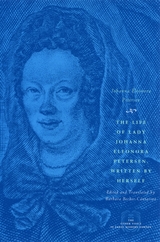
front cover of The Life of Lady Johanna Eleonora Petersen, Written by Herself
The Life of Lady Johanna Eleonora Petersen, Written by Herself
Pietism and Women's Autobiography in Seventeenth-Century Germany
Johanna Eleonora Petersen
University of Chicago Press, 2005
In a time when the Pauline dictum decreed that women be silent in matters of the Church, Johanna Eleonora Petersen (1644–1724) was a pioneering author of religious books, insisting on her right to speak out as a believer above her male counterparts. Publishing her readings of the Gospels and the Book of Revelation as well as her thoughts on theology in general, Petersen and her writings created controversy, especially in orthodox circles, and she became a voice for the radical Pietists—those most at odds with Lutheran ministers and their teachings. But she defended her lay religious calling and ultimately printed fourteen original works, including her autobiography, the first of its kind written by a woman in Germany—all in an age in which most women were unable to read or write.

Collected in The Life of Lady Johanna Eleonora Petersen are Petersen's autobiography and two shorter tracts that would become models of Pietistic devotional writing. A record of the status and contribution of women in the early Protestant church, this collection will be indispensable reading for scholars of seventeenth-century German religious and social history.
[more]

front cover of Light in Germany
Light in Germany
Scenes from an Unknown Enlightenment
T. J. Reed
University of Chicago Press, 2015
Germany’s political and cultural past from ancient times through World War II has dimmed the legacy of its Enlightenment, which these days is far outshone by those of France and Scotland. In this book, T. J. Reed clears the dust away from eighteenth-century Germany, bringing the likes of Kant, Goethe, Friedrich Schiller, and Gotthold Lessing into a coherent and focused beam that shines within European intellectual history and reasserts the important role of Germany’s Enlightenment.
           
Reed looks closely at the arguments, achievements, conflicts, and controversies of these major thinkers and how their development of a lucid and active liberal thinking matured in the late eighteenth century into an imaginative branching that ran through philosophy, theology, literature, historiography, science, and politics. He traces the various pathways of their thought and how one engendered another, from the principle of thinking for oneself to the development of a critical epistemology; from literature’s assessment of the past to the formulation of a poetic ideal of human development. Ultimately, Reed shows how the ideas of the German Enlightenment have proven their value in modern secular democracies and are still of great relevance—despite their frequent dismissal—to us in the twenty-first century. 
[more]

front cover of Light of Reason, Light of Faith
Light of Reason, Light of Faith
Joseph Ratzinger and the German Enlightenment
Maurice Ashley Agbaw-Ebai
St. Augustine's Press, 2021
Fr. Maurice Ashley Agbaw-Ebai, a native of Cameroon, has written a fresh, exciting new study of the lifelong engagement of Josef Ratzinger, later Pope Benedict XVI, with the German Enlightenment and its contemporary manifestations and heirs. Contemporary European disdain for organized religion and the rise in secularism on that continent has deep roots in the German Enlightenment. To understand contemporary Europe, one must return to this crucial epoch in its history, to those who shaped the European mind of this era, and to a study of the ideas they espoused and propagated. These ideas, for good or for ill, have taken hold in other parts of the modern world, being incarnated in many minds and institutions in contemporary society and threatening to enthrone a disfigured rationality without faith or a sense of Transcendence.

Ratzinger’s extraordinary and sympathetic understanding of the sources of contemporary secularism equipped him to appreciate the gains of the Enlightenment, while still being a fierce critic of the losses humanity has suffered when reason falsely excludes faith. Fr. Agbaw-Ebai’s account reveals Ratzinger, in relation to his various interlocutors, to be the truly “enlightened” one because he demonstrates a truly balanced understanding of the human mind. To be truly rational one must be able to hold to faith and reason both, reason informed by faith in Jesus Christ.

A particular merit of this book is Agbaw-Ebai’s presentation of Ratzinger’s treatment of the  German Enlightenment’s greatest contributors: Kant, Nietzche, Hegel and Habermas, among others. In the postscript George Weigel characterizes what this study accomplishes in the larger framework of scholarship. “[Ratzinger’s] position remains too often misunderstood, and sometimes deliberately misinterpreted, throughout the whole Church. And to misunderstand, or misinterpret, Ratzinger is to misunderstand or misinterpret both the modern history of theology and the Second Vatican Council.” Agbaw-Ebai masterfully positions Ratzinger correctly in the history of ideas, and exhibits why Ratzinger will be remembered as one of its main players. Pure rationalists and true believers are equally indebted to him.

[more]

front cover of Listening Awry
Listening Awry
Music And Alterity In German Culture
David Schwarz
University of Minnesota Press, 2006
In his first book, Listening Subjects, David Schwarz succeeded in fusing post-Lacanian psychoanalytic, musical-theoretical, and musical-historical perspectives. In Listening Awry, he expands his project to “tell a story of historical modernism writ large”—how German music spanning two centuries refracts changes in society and culture, as well as the impacts of concepts introduced by psychoanalysis.Schwarz shows how post-Lacanian psychoanalysis can be applied to ideological interpellation that connects psychoanalysis to culture and how music theory can ground these considerations in precise details of musical textuality. He “listens awry” in several ways: by understanding musical meaning in both objective and socially structured ways, by embracing historical and also aesthetic approaches, by addressing high art as well as popular music, and by listening “around” conventional forms of musical meaning to reach toward that which evades signification.Structured around four themes—trauma, the other/Other, the look/gaze binary, and Judaism—Listening Awry explores five key moments in post-Enlightenment music: the rise of the singular orchestral conductor and the emergence of a new form of alterity, the Art Song and “the sublime of the delicate” (a correlate of the Kantian mathematical and dynamical sublime), the birth of psychoanalysis and the twentieth-century turn toward atonality, German war songs and the subversion of German music by the Nazis, and two different versions of Wagner’s Parsifal that were performed one hundred years apart and in radically different contexts.This highly original work, filled with imaginative readings and disquieting observations, links trauma with the culture and history of modernity and German music, deftly tying the experience of the body to the sounds it hears: how it reaches us slowly, penetrates the skin, and resonates.David Schwarz is assistant professor of music at the University of North Texas. He is the author of Listening Subjects: Music, Psychoanalysis, Culture.
[more]

logo for University of Chicago Press
Literary Intellectuals and the Dissolution of the State
Professionalism and Conformity in the GDR
Edited by Robert von Hallberg
University of Chicago Press, 1996
For two generations, writers in the German Democratic Republic enjoyed a massive audience in their own country, a readership dependent on their works for a measure of utopian solace amid the grimness of life under Communism. But after the fall of the Berlin Wall, these writers were abandoned by their readers and stripped of the professional structures that had supported them. Their literary culture destroyed, they were rebuked for compliant service to the discredited state; and some were reviled for collaborating with the East German secret police, the Stasi.

What drove leading thinkers, including those of the avant-garde who publicly embraced intellectual freedom, to serve as government informants? Why were they content to work within a repressive system rather than challenging it outright? This collection of interviews with more than two dozen writers and literary scholars, including several Stasi informants, provides a gripping, often dismaying picture of the motivations, compromises, and illusions of East German intellectual life.

In conversations with Robert von Hallberg, writers such as best-selling novelist Hermann Kant, playwright Christoph Hein, and avant-garde poet-publisher Sascha Anderson talk about their lives and work before the fall of the wall in 1989—about the constraints and privileges of Communist Party membership, experiences of government censorship and self-censorship, and relations with their readers. They reflect on why the possibilities of opposition to the state seemed so limited, and on how they might have found ways to resist more aggressively. Turning to the controversies that have emerged since reunification, including the Stasi scandals involving Anderson and Christa Wolf, they discuss their feelings of complicity and the need for further self-examination. Two interviews with Anderson—one conducted before he was exposed as a Stasi collaborator and one conducted afterward—offer unique insight into the double life led by many writers and scholars in the German Democratic Republic.
[more]

front cover of Little Tools of Knowledge
Little Tools of Knowledge
Historical Essays on Academic and Bureaucratic Practices
Peter Becker and William Clark, Editors
University of Michigan Press, 2001
This volume brings historians of science and social historians together to consider the role of "little tools"--such as tables, reports, questionnaires, dossiers, index cards--in establishing academic and bureaucratic claims to authority and objectivity. From at least the eighteenth century onward, our science and society have been planned, surveyed, examined, and judged according to particular techniques of collecting and storing knowledge. Recently, the seemingly self-evident nature of these mundane epistemic and administrative tools, as well as the prose in which they are cast, has demanded historical examination. The essays gathered here, arranged in chronological order by subject from the late seventeenth to the late twentieth century, involve close readings of primary texts and analyses of academic and bureaucratic practices as parts of material culture. The first few essays, on the early modern period, largely point to the existence of a "juridico-theological" framework for establishing authority. Later essays demonstrate the eclipse of the role of authority per se in the modern period and the emergence of the notion of "objectivity." Most of the essays here concern the German cultural space as among the best exemplars of the academic and bureaucratic practices described above. The introduction to the volume, however, is framed at a general level; the closing essays also extend the analyses beyond Germany to broader considerations on authority and objectivity in historical practice. The volume will interest scholars of European history and German studies as well as historians of science. Peter Becker is Professor of Central European History, European University Institute. William Clark is Lecturer in History and Philosophy of Science, Cambridge University.
[more]

front cover of Living in the Tenth Century
Living in the Tenth Century
Mentalities and Social Orders
Heinrich Fichtenau
University of Chicago Press, 1991
"Fichtenau delivers a fascinating view of tenth-century Europe on the eve of the second millenium. He writes this hoping we, on the eve of the third millennium, will take time also to look at who we are and at our world. . . . This engaging book lucidly carries the reader through an amazing amount of material. Medieval scholars will find it resourceful and challenging; the nonscholar will find it fascinating and enlightening."—A. L. Kolp, Choice

"Living in the Tenth Century resembles an anthropological field study more than a conventional historical monograph, and represents a far more ambitious attempt to see behind the surface of avowals and events than others have seriously attempted even for much more voluminously documented periods. . . . It is remarkably rich and readable."—R.I. Moore, Times Higher Education Supplement

"Fichtenau offers a magnificent survey of all the main spheres of life: the social order, the rural economy, schooling and religious belief and practice in both the secular and monastic church. His command, especially of the narrative sources, their fine nuances of attitude emotion and underlying norms, is masterly and he employs them here with all the sensitiveness and feel for the subject that have always been the hallmarks of his work."—Karl Leyser, Francia
[more]

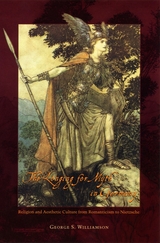
front cover of The Longing for Myth in Germany
The Longing for Myth in Germany
Religion and Aesthetic Culture from Romanticism to Nietzsche
George S. Williamson
University of Chicago Press, 2004
Since the dawn of Romanticism, artists and intellectuals in Germany have maintained an abiding interest in the gods and myths of antiquity while calling for a new mythology suitable to the modern age. In this study, George S. Williamson examines the factors that gave rise to this distinct and profound longing for myth. In doing so, he demonstrates the entanglement of aesthetic and philosophical ambitions in Germany with some of the major religious conflicts of the nineteenth century.

Through readings of key intellectuals ranging from Herder and Schelling to Wagner and Nietzsche, Williamson highlights three crucial factors in the emergence of the German engagement with myth: the tradition of Philhellenist neohumanism, a critique of contemporary aesthetic and public life as dominated by private interests, and a rejection of the Bible by many Protestant scholars as the product of a foreign, "Oriental" culture. According to Williamson, the discourse on myth in Germany remained bound up with problems of Protestant theology and confessional conflict through the nineteenth century and beyond.

A compelling adventure in intellectual history, this study uncovers the foundations of Germany's fascination with myth and its enduring cultural legacy.
[more]

logo for Diaphanes
Lookalikes
Thomas Meinecke
Diaphanes, 2026

A literary tour de force through the symbolic landscapes of recent cultural history, Lookalikes is a text in which everything is as it seems and nothing is as it is.

Thomas Meinecke’s lookalikes resemble many people––Marlon Brando, Shakira, Justin Timberlake, or Josephine Baker to name a few––but never themselves. Illusion is their capital; imitation is their business. They stroll through Düsseldorf's posh Königsallee, reading, quoting, and plagiarizing their way through the history of pop culture and philosophy, exploring categories of realness in parallel worlds and digital chat forums. At the same time, yet another Thomas wanders Brazil in disguise, tracing the journey of Hubert Fichte and his doppelgänger Jäcki. In this endless play of similarities, all identity is lost. 

Between literary and sexual genres, mimesis and authenticity, fiction and reality, these lookalikes only ever find the Other, just as Meinecke’s text duplicates itself in the furor of allusions and reference systems, constantly branching out anew, never remaining the same, always changing these so-called original signs.
[more]

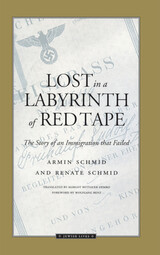
front cover of Lost in a Labyrinth of Red Tape
Lost in a Labyrinth of Red Tape
The Story of an Immigration that Failed
Armin Schmid and Renate Schmid
Northwestern University Press, 1996
Lost in a Labyrinth of Red Tape is the story of one family's desperate attempts to emigrate from Nazi Germany. The Frühaufs faced enormous obstacles with the German and foreign authorities when they attempted to take advantage of matriarch Hilde Frühauf's U.S. citizenship. At the mercy of various agencies and shippers, they became more and more entangled in the red tape of the title. The daughter went into hiding and fled to Belgium, where she was hidden by the Resistance and survived the war. Tragically, the remaining members of her family failed to emigrate, and were killed by the Nazis.
[more]

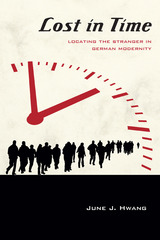
front cover of Lost in Time
Lost in Time
Locating the Stranger in German Modernity
June J. Hwang
Northwestern University Press, 2014
June J. Hwang’s provocative Lost in Time explores discourses of timelessness in the works of central figures of German modernity such as Walter Benjamin, Georg Simmel, Siegfried Kracauer, and Helmuth Plessner, as well as those of Alfred Döblin, Joseph Roth, and Hugo Bettauer. Hwang argues that in the Weimar Republic the move toward ahistoricization is itself a historical phenomenon, one that can be understood by exploring the intersections of discourses about urban modernity, the stranger, and German Jewish identity.
 
These intersections shed light on conceptions of German Jewish identity that rely on a negation of the specific and temporal as a way to legitimize a historical outsider position, creating a dynamic position that simultaneously challenges and acknowledges the limitations of an outsider’s agency. She reads these texts as attempts to transcend the particular, attempts that paradoxically reveal the entanglement of the particular and the universal.
[more]

front cover of Love Is Strong as Death
Love Is Strong as Death
A Biography of Franz Rosenzweig
Paul Mendes-Flohr
University of Chicago Press, 2026
A brilliant and engaging biography of one of the great modern Jewish thinkers.
 
Franz Rosenzweig (1886–1929) was one of the central figures of the Jewish cultural and intellectual renaissance in Weimar Germany. His masterwork, The Star of Redemption (1921), is a classic of existential thought and Jewish philosophy, and his considerable legacy also includes his collaboration with Martin Buber on a key translation of the Hebrew Bible into German and the establishment of an education center in Frankfurt that brought together the most important young German-Jewish intellectuals of its time.

Rosenzweig’s personal biography is no less fascinating than his ideas and accomplishments. Drawing on unprecedented access to Rosenzweig’s unpublished personal correspondence, Paul Mendes-Flohr skillfully weaves together the threads of Rosenzweig’s life to give us a moving portrait of this towering figure—from his near-conversion to Christianity to his tragic diagnosis with ALS. Mendes-Flohr also closely explores Rosenzweig’s relationship with Margrit Huessy, who was a vital intellectual partner for Rosenzweig, as well as a muse and lover. He worked out many of his ideas about love both in conversation and consort with her, and Mendes-Flohr shows the importance of intimacy—both romantic and platonic—in the development of Rosenzweig’s thought.
 
Love Is Strong as Death provides a unique and insightful look at one of the most important modern Jewish thinkers.

[more]

front cover of Love Writ Large
Love Writ Large
Navid Kermani
Seagull Books, 2018
Now in paperback, a story of teenage love in Cold War-era Germany.

For a fifteen-year-old, falling in love can eclipse everything else in the world, and make a few short weeks feel like a lifetime of experience. In Love Writ Large, Navid Kermani captures those intense feelings, from the emotional explosion of a first kiss to the staggering loss of a first breakup. As his teenage protagonist is wrapped up in these all-consuming feelings, however, Germany is in the crosshairs of the Cold War—and even the personal dramas of a small-town grammar school are shadowed by the threat of the nuclear arms race. Kermani’s novel manages to capture these social tensions without sacrificing any of the all-consuming passion of first love and, in a unique touch, sets the boy’s struggles within the larger frame of the stories and lives of numerous Arabic and Persian mystics. His becomes a timeless tale that reflects on the multiple ways love, loss, and risk weigh on our everyday lives.
[more]

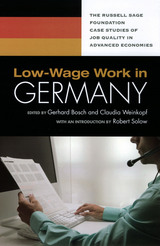
front cover of Low-Wage Work in Germany
Low-Wage Work in Germany
Gerhard Bosch
Russell Sage Foundation, 2008
In recent years, the German government has intentionally expanded the low-wage work sector in an effort to reduce exceptionally high levels of unemployment. As a result, the share of the German workforce employed in low-paying jobs now rivals that of the United States. Low Wage Work in Germany examines both the federal policies and changing economic conditions that have driven this increase in low-wage work. The new "mini-job" reflects the federal government's attempt to make certain low-paying jobs attractive to both employers and employees. Employers pay a low flat rate for benefits, and employees, who work a limited number of hours per week, are exempt from social security and tax contributions. Other factors, including slow economic growth, a declining collective bargaining system, and the influx of foreign workers, also contribute to the growing incidence of low-wage work. Yet while both Germany and the United States have large shares of low-wage workers, German workers receive health insurance, four weeks of paid vacation, and generous old age support—benefits most low-wage workers in the United States can only dream of. The German experience offers an important opportunity to explore difficult trade-offs between unemployment and low-wage work. A Volume in the Russell Sage Foundation Case Studies of Job Quality in Advanced Economies
[more]


Send via email Share on Facebook Share on Twitter