
 A SCHOLARLY BOOK REPOSITORY
4 start with L start with L
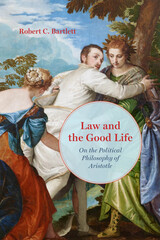
A fresh reading of the relationship between moral and political philosophy in Aristotle’s thought.
Our democracies promise the rights to life, liberty, and the pursuit of happiness—at least, within the confines of the law. Yet the law is an ineffective guide to the good life; laws can be arbitrary, even immoral. What other limit, then, should direct us as we pursue our own fulfillment?
In Law and the Good Life, philosopher Robert C. Bartlett examines Aristotle’s consideration of this question. Rather than defer to authority, Aristotle invites us to ground ourselves in moral virtue and intellectual fulfillment, an argument he develops in both Politics and Nicomachean Ethics. As political creatures, Aristotle tells us, we are capable of moral action and therefore must embrace that capacity; at the same time, as rational creatures, we must understand what is true, even without regard to action. In taking these insights together, Bartlett offers a new reading of Aristotle’s political philosophy, one he hopes might serve as a prudent lodestar in our own turbulent times.

Leo Strauss’s final seminar on Thomas Hobbes, representing the culmination of more than four decades of close engagement.
Leo Strauss spent more than four decades studying the work of Thomas Hobbes. In Strauss’s distinctive genealogy of political thought, Hobbes emerges as a decisive counterpoint, not only to the Ancients, but also to Strauss’s own project. Strauss saw Hobbes as both the founder of modern natural rights and the modern esoteric writer par excellence.
Strauss’s final seminar on Hobbes from 1964 is the culmination of his engagement with Hobbes’s corpus and contains the richest account of Strauss’s final insight into the nerve of Hobbes’s thought, linking human consciousness to power and passion. The seminar reflects on the tension between Hobbes’s scientific and political frameworks, Hobbes’s emphasis on rights over duties, Hobbes’s atheism, and Hobbes’s attention to causal thinking as the core capacity that sets humans apart from other animals. It also includes Strauss’s most sustained exchange with the Marxist political theorist, C. B. Macpherson. Their rival interpretations of why the state of nature takes the form of a war of all against all led Strauss to reconsider his earlier writings on Hobbes, including those parts that pertain to other thinkers, such as Aristotle, Locke, and Spinoza.
With an introductory essay by Karl Dahlquist that traces the evolution of Strauss’s thinking on Hobbes and frames Strauss’s dialogue with Macpherson, this 1964 seminar on Hobbes is a vital contribution to political thought and intellectual history.

A fresh and vivid reappraisal of one of the most influential intellects of the modern era
Alexandre Kojève is one of the twentieth century’s most seductive and intriguing figures. A product of the Russian merchant bourgeoisie, he became, depending on one’s point of view, either an overzealous bureaucrat or a secret agent who infiltrated the upper echelons of French state bureaucracy, spending the last twenty years of his life working in international diplomacy and high finance. Marco Filoni describes each facet of Kojève’s different lives in crystalline detail: the cultural circles of his youth, his studies, his philosophical passions, his fundamental theoretical choices, and his intellectual network, as well as the students who would become part of the intellectual elite, including Lacan, Bataille, and Merleau-Ponty. Drawing on rich archival material, unpublished texts, correspondence, and written and oral testimonies, The Life and Thought of Alexandre Kojève is a major benchmark for scholars of Kojève and of twentieth-century intellectual and political history. Filoni paints a vibrant portrait of one of the most influential intellectuals of the modern era, deftly composing Kojève’s personal, political, and philosophical lives.
READERS
Browse our collection.
PUBLISHERS
See BiblioVault's publisher services.
STUDENT SERVICES
Files for college accessibility offices.
RECENTLY PUBLISHED


UChicago Accessibility Resources
home | accessibility | search | about | contact us
BiblioVault ® 2001 - 2026
The University of Chicago Press