
 A SCHOLARLY BOOK REPOSITORY
8 start with L start with L
The LDS Church officially abandoned polygamy in 1890, but evidence that the practice was still tolerated (if not officially sanctioned) by the church circulated widely, resulting in intense investigations by the U.S. Senate. In 1896 Abraham Owen Woodruff, a rising star in LDS leadership and an ardent believer in polygamy, was appointed to head the LDS Colonization Company. Maxwell explores whether under Woodruff’s leadership the Bighorn Basin colony was intended as a means to insure the secret survival of polygamy and if his untimely death in 1904, together with the excommunication of two equally dedicated proponents of polygamy—Apostles John Whitaker Taylor and Matthias Foss Cowley—led to its collapse.
Maxwell also details how Mormon settlers in Wyoming struggled with finance, irrigation, and farming and how they brought the same violence to indigenous peoples over land and other rights as did non-Mormons.
The 1900 Bighorn Basin colonization provides an early twentieth-century example of a Mormon syndicate operating at the intersection of religious conformity, polygamy, nepotism, kinship, corporate business ventures, wealth, and high priesthood status. Maxwell offers evidence that although in many ways the Bighorn Basin colonization failed, Owen Woodruff’s prophecy remains unbroken: “No year will ever pass, from now until the coming of the Savior, when children will not be born in plural marriage.”

As half the church fell away in Ohio, the Taylors escaped to Missouri with the faithful, just in time for the 1838 Mormon War. John’s role became that of an advocate with Congress—to convince them that it was the non-Mormons who had sacked the county seat and burned their own homes, for instance. As a literary experience, this was good preparation for later editorships of church newspapers in Illinois, New York, and Liverpool.
From his personal letters and speeches, and from the diaries and reminiscences of associates, vivid images of Taylor’s life appear: his children crossing the Missouri River on the backs of oxen “bulls”; one of his ten plural wives packing a piano instead of a cookstove for the trip and then later regretting it; and Native Americans teaching him how to burn a cricket-infested field, gather the roasted insects, and grind the carcasses into flour.
Taylor’s eventual tenure as church president was spent “on the dodge” from federal marshals, and prior to that he often lived out of a suitcase, rotating from one of his sixteen families to the next. Among his greatest achievements was the settlement of as much territory as was colonized by his more famous predecessor, Brigham Young. Taylor was also a visionary man. His personal spirituality led the church through one of its most turbulent times; his revelations later inspired the Mormon fundamentalist schism, as well. This controversy, mingled with the drama of internecine power struggles and interpersonal conflict, makes The Last Pioneer suspenseful and largely unforgettable.
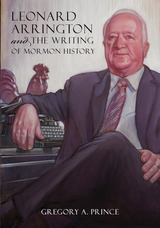
Leonard Arrington is considered by many the foremost twentieth-century historian of Mormonism. He played a key role in establishing the Western History Association and the Mormon History Association, and more than a half-century after its publication, his revised doctoral dissertation, Great Basin Kingdom: An Economic History of the Latter-day Saints 1830-1900, remains a standard. But Arrington’s career was not without controversy. Gregory Prince takes an in-depth look at this respected historian and, in telling Arrington’s story, gives readers insight into the workings of the LDS Church in the late twentieth century.
In 1972, during a major reorganization of the LDS Church, Arrington was asked to serve as the official church historian, thereby becoming the first—and thus far the only—professional historian to hold that title. He immediately set out to professionalize the entire Church History Division and open its extensive archives to scholarly researching. While the output of and from that division moved Mormon studies to a new level, the shift of historiography from faith promotion ecclesiastical, to scholarly and professional research and analysis was unacceptable to a handful of powerful senior apostles. In 1980 the History Division was disassembled and moved to Brigham Young University. That led to a shift in the professionalization of the Church History Division and Archives and in Arrington’s career but not to a loss of his broad influence.
This biography is the first to draw upon the remarkable Arrington diaries (over 20,000 pages); it is supplemented by the author’s interviews of more than 100 people who knew or worked with Arrington. The book is of additional significance given continuing battles between the LDS Church and scholars, which frequently gains national attention because of excommunications of prominent intellectuals.
Winner of the Evans Biography Award and the John Whitmer Historical Association's Brim Biography Book Award.
Joseph F. Smith was born in 1838 to Hyrum Smith and Mary Fielding Smith. Six years later both his father and his uncle, Joseph Smith Jr., the founding prophet of the Church of Jesus Christ of Latter-day Saints, were murdered in Carthage, Illinois. The trauma of that event remained with Joseph F. for the rest of his life, affecting his personal behavior and public tenure in the highest tiers of the LDS Church, including the post of president from 1901 until his death in 1918. Joseph F. Smith laid the theological groundwork for modern Mormonism, especially the emphasis on temple work. This contribution was capped off by his “revelation on the redemption of the dead,” a prophetic glimpse into the afterlife. Taysom’s book traces the roots of this vision, which reach far more deeply into Joseph F. Smith’s life than other scholars have previously identified.
In this first cradle-to-grave biography of Joseph F. Smith, Stephen C. Taysom uses previously unavailable primary source materials to craft a deeply detailed, insightful story of a prominent member of a governing and influential Mormon family. Importantly, Taysom situates Smith within the historical currents of American westward expansion, rapid industrialization, settler colonialism, regional and national politics, changing ideas about family and masculinity, and more. Though some writers tend to view the LDS Church and its leaders through a lens of political and religious separatism, Taysom does the opposite, pushing Joseph F. Smith and the LDS Church closer to the centers of power in Washington, DC, and elsewhere.
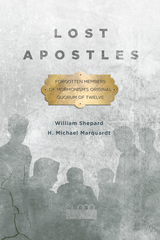
Of the twelve men selected, nine would eventually be pruned from the vineyard themselves, to varying degrees. Seven were excommunicated, one of whom was reinstated to his position in the Twelve. Of the other six, the subjects of this book, none returned to the apostleship and four never came back to the Church at all. Those who left faded into obscurity except for when they are occasionally still mentioned in sermons as cautionary tales. But two of them made their marks in other areas of society, John Boynton becoming a successful dentist, a popular lecturer, geologist, and inventor with dozens of important patents to his name, while Lyman Johnson became a prominent attorney and business owner. Even though Luke Johnson, Thomas B. Marsh, William McLellin, and William Smith became religious wanderers and tried unsuccessfully to adjust to life outside of the Church, their experiences were interesting and comprise valuable case studies in belief and disaffection.
READERS
Browse our collection.
PUBLISHERS
See BiblioVault's publisher services.
STUDENT SERVICES
Files for college accessibility offices.
RECENTLY PUBLISHED



UChicago Accessibility Resources
home | accessibility | search | about | contact us
BiblioVault ® 2001 - 2026
The University of Chicago Press