
 A SCHOLARLY BOOK REPOSITORY
106 books about Race discrimination and 4
start with L
106 books about Race discrimination and 4
106 books about Race discrimination
4 start with L start with L
4 start with L start with L
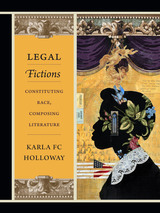
Legal Fictions
Constituting Race, Composing Literature
Karla FC Holloway
Duke University Press, 2014
In Legal Fictions, Karla FC Holloway both argues that U.S. racial identity is the creation of U.S. law and demonstrates how black authors of literary fiction have engaged with the law's constructions of race since the era of slavery. Exploring the resonance between U.S. literature and U.S. jurisprudence, Holloway reveals Toni Morrison's Beloved and Charles Johnson's Middle Passage as stories about personhood and property, David Bradley's The Chaneysville Incident and Ralph Ellison's Invisible Man as structured by evidence law, and Nella Larsen's Passing as intimately related to contract law. Holloway engages the intentional, contradictory, and capricious constructions of race embedded in the law with the same energy that she brings to her masterful interpretations of fiction by U.S. writers. Her readings shed new light on the many ways that black U.S. authors have reframed fundamental questions about racial identity, personhood, and the law from the nineteenth into the twenty-first centuries. Legal Fictions is a bold declaration that the black body is thoroughly bound by law and an unflinching look at the implications of that claim.
[more]
Like a Loaded Weapon
The Rehnquist Court, Indian Rights, and the Legal History of Racism in America
Robert Williams Jr.
University of Minnesota Press, 2005
Robert A. Williams Jr. boldly exposes the ongoing legal force of the racist language directed at Indians in American society. Fueled by well-known negative racial stereotypes of Indian savagery and cultural inferiority, this language, Williams contends, has functioned “like a loaded weapon” in the Supreme Court’s Indian law decisions.
Beginning with Chief Justice John Marshall’s foundational opinions in the early nineteenth century and continuing today in the judgments of the Rehnquist Court, Williams shows how undeniably racist language and precedent are still used in Indian law to justify the denial of important rights of property, self-government, and cultural survival to Indians. Building on the insights of Malcolm X, Thurgood Marshall, and Frantz Fanon, Williams argues that racist language has been employed by the courts to legalize a uniquely American form of racial dictatorship over Indian tribes by the U.S. government.
Williams concludes with a revolutionary proposal for reimagining the rights of American Indians in international law, as well as strategies for compelling the current Supreme Court to confront the racist origins of Indian law and for challenging bigoted ways of talking, thinking, and writing about American Indians.
Robert A. Williams Jr. is professor of law and American Indian studies at the James E. Rogers College of Law, University of Arizona. A member of the Lumbee Indian Tribe, he is author of The American Indian in Western Legal Thought: The Discourses of Conquest and coauthor of Federal Indian Law.
Beginning with Chief Justice John Marshall’s foundational opinions in the early nineteenth century and continuing today in the judgments of the Rehnquist Court, Williams shows how undeniably racist language and precedent are still used in Indian law to justify the denial of important rights of property, self-government, and cultural survival to Indians. Building on the insights of Malcolm X, Thurgood Marshall, and Frantz Fanon, Williams argues that racist language has been employed by the courts to legalize a uniquely American form of racial dictatorship over Indian tribes by the U.S. government.
Williams concludes with a revolutionary proposal for reimagining the rights of American Indians in international law, as well as strategies for compelling the current Supreme Court to confront the racist origins of Indian law and for challenging bigoted ways of talking, thinking, and writing about American Indians.
Robert A. Williams Jr. is professor of law and American Indian studies at the James E. Rogers College of Law, University of Arizona. A member of the Lumbee Indian Tribe, he is author of The American Indian in Western Legal Thought: The Discourses of Conquest and coauthor of Federal Indian Law.
[more]

Living as Equals
How Three White Communities Struggled to Make Interracial Connections During the Civil Rights Era
Phyllis Palmer
Vanderbilt University Press, 2008
Using interviews with leaders and participants, as well as historical archives, the author documents three interracial sites where white Americans put themselves into unprecedented relationships with African Americans, Mexican Americans, and Asian Americans. In teen summer camps in the New York City and Los Angeles areas, students from largely segregated schools worked and played together; in Washington, DC, families fought blockbusting and white flight to build an integrated neighborhood; and in San Antonio, white community activists joined in coalition with Mexican American groups to advocate for power in a city government monopolized by Anglos. Women often took the lead in organizations that were upsetting patterns of men's protective authority at the same time as white people's racial dominance.
[more]
The Long Walk to Equality
Perspectives on Racial Inequality, Injustice and the Law
Avis Whyte, Patricia Tuitt and Judith Bourne
University of Westminster Press, 2024
In 1965 the UK enacted the Race Relations Act while the International Convention on the Elimination of all Forms of Racial Discrimination (ICERD) opened for signature and ratification. In the US, the changes that brought down the walls of segregation, conveying some equality to black people essentially began with the Civil Rights Act of 1964. These ground-breaking instruments marked a commitment—domestically and internationally by the state parties to the ICERD—to address racial injustice and inequality through legal means.Yet, the intervening years reveal the challenges of pursuing racial justice and equality through the medium of law. In recent years, allegations of institutional racism have been levelled against numerous public institutions in the UK, while the rise of populism globally has challenged the ability of law to effect change.This edited collection draws attention to the need to reflect on the persistence of racial inequalities and injustices despite law’s intervention and arguably because of its ‘unconscious’ role in their promotion. It does so from a multiplicity of perspectives ranging from the doctrinal, socio-legal, critical and theoretical, thereby generating different kinds of knowledge about race and law. By exploring contemporary issues in racial justice and equality, contributors examine the role of law—whether domestic or international, hard or soft—in advancing racial equality and justice and consider whether it can effect substantive change.
[more]
READERS
Browse our collection.
PUBLISHERS
See BiblioVault's publisher services.
STUDENT SERVICES
Files for college accessibility offices.
RECENTLY PUBLISHED





UChicago Accessibility Resources
home | accessibility | search | about | contact us
BiblioVault ® 2001 - 2026
The University of Chicago Press