front cover of La Gazza Ladra
La Gazza Ladra
Melodramma in Two Acts by Giovanni Gherardini
Gioachino Rossini
University of Chicago Press, 1979

logo for University of Iowa Press
Ladie Borlase's Receiptes Booke
David E. Schoonover
University of Iowa Press, 1998
Ladie Borlaise's Receiptes Booke, an English manorial and culinary manuscript, has been in existence for at least 333 years. This manuscript, bearing dates from 1665 to 1822, provides a unique compendium of culinary history that opens a window to the aristocratic, social, agricultural, horticultural, economic, and medicinal aspects of English country life.
The Borlase manuscript is a kind of miscellany. Included are recipes not only for all kinds of foods but also for distilled waters, remedies, dyes, soaps, and perfumes. A housewife of that period was responsible for keeping her family healthy and her house clean and sweet smelling, and so the manuscript features directions for preparing medicinal “oyles,” waters, “glysters,” powders, “ballsoms,”a “true Majistery,” and a julep, with healing powers for a number of ailments from apoplexy and gout to cancer and the plague.
The cookery recipes concentrate almost entirely on sweets and meats with only a few mentions of vegetables. More than half of the recipes included in this manuscript are for sweets. This was important as sugar was entering Britain in greater quantities and because people believed in sugar's supposed health benefits. Several recipes for preserved fruits reflect a changing diet and appetite among the British as the availability of fruits and vegetables increased in both quantity and variety.
David Schoonover's informative introduction places the Borlase manuscript in its historical context with special attention to the economic and social changes of the sixteenth and seventeenth centuries, which brought about a new emphasis on housewifery and the management of households. He also provides a brief summary of the Borlase family history—born in 1621, Alice Bankes, Lady Borlase, died in 1683 at the age of sixty-two years—and a description of their home at Bockmer Manor at Medmenham, Buckinghamshire.
[more]

front cover of Laughing to Keep from Dying
Laughing to Keep from Dying
African American Satire in the Twenty-First Century
Danielle Fuentes Morgan
University of Illinois Press, 2020
By subverting comedy's rules and expectations, African American satire promotes social justice by connecting laughter with ethical beliefs in a revolutionary way. Danielle Fuentes Morgan ventures from Suzan-Lori Parks to Leslie Jones and Dave Chappelle to Get Out and Atlanta to examine the satirical treatment of race and racialization across today's African American culture. Morgan analyzes how African American artists highlight the ways that society racializes people and bolsters the powerful myth that we live in a "post-racial" nation. The latter in particular inspires artists to take aim at the idea racism no longer exists or the laughable notion of Americans "not seeing" racism or race. Their critique changes our understanding of the boundaries between staged performance and lived experience and create ways to better articulate Black selfhood.

Adventurous and perceptive, Laughing to Keep from Dying reveals how African American satirists unmask the illusions and anxieties surrounding race in the twenty-first century.

[more]

front cover of Life in a Northern Town
Life in a Northern Town
Cooking, Eating, and Other Adventures along Lake Superior
Mary Dougherty
Wisconsin Historical Society Press, 2017
"Generations of men and women have stood on these beaches, listened to water rushing over these basalt rocks, and picked wild blueberries here well before I sailed into the Bayfield harbor. The families of those men and women are still here, tethered to a place where they can slip behind their ancestor’s eyes and take in essentially the same view."
—from the Introduction
In 2007, Mary Dougherty and her family moved from St. Paul to the tiny Bayfield Peninsula, surrounded by the waters of Lake Superior and Chequamegon Bay in far northwestern Wisconsin. There they set out to live their lives against a backdrop of waterfalls, beaches, farm stands, and a quintessential small town of 487 people. Through recipes, stories, and photos, this book explores what it means to nourish a family and a community. As Mary Dougherty incorporates what is grown and raised in northern Wisconsin into her family’s favorite dishes, she continues a cultural tradition begun by immigrants hundreds of years ago. The result is a one-of-a-kind collection of globally and regionally inspired recipes featuring local cheeses, meats, and produce from the farmers in and around Bayfield—pho made with beef bones from a farm in Mellen, Indian meatballs with curry powder made in Washburn, chowder with corn and potatoes from a farm stand in Ashland. As she knits herself into the Bayfield community, Dougherty comes to more fully grasp the intricate relationship between food and community.

[more]

front cover of Listening to China
Listening to China
Sound and the Sino-Western Encounter, 1770-1839
Thomas Irvine
University of Chicago Press, 2020
From bell ringing to fireworks, gongs to cannon salutes, a dazzling variety of sounds and soundscapes marked the China encountered by the West around 1800. These sounds were gathered by diplomats, trade officials, missionaries, and other travelers and transmitted back to Europe, where they were reconstructed in the imaginations of writers, philosophers, and music historians such as Jean-Philippe Rameau, Johann Nikolaus Forkel, and Charles Burney. Thomas Irvine gathers these stories in Listening to China, exploring how the sonic encounter with China shaped perceptions of Europe’s own musical development.
 
Through these stories, Irvine not only investigates how the Sino-Western encounter sounded, but also traces the West’s shifting response to China. As the trading relationships between China and the West broke down, travelers and music theorists abandoned the vision of shared musical approaches, focusing instead on China’s noisiness and sonic disorder and finding less to like in its music. At the same time, Irvine reconsiders the idea of a specifically Western music history, revealing that it was comparison with China, the great “other,” that helped this idea emerge. Ultimately, Irvine draws attention to the ways Western ears were implicated in the colonial and imperial project in China, as well as to China’s importance to the construction of musical knowledge during and after the European Enlightenment. Timely and original, Listening to China is a must-read for music scholars and historians of China alike.

[more]

front cover of Lives in Chinese Music
Lives in Chinese Music
Edited by Helen Rees
University of Illinois Press, 2008
Until recently, most scholarly work on Chinese music in both Chinese and Western languages has focused on genres, musical structure, and general history and concepts, rather than on the musicians themselves. This volume breaks new ground by focusing on individual musicians active in different amateur and professional music scenes in mainland China, Hong Kong, and Chinese communities in Europe.

Using biography to deepen understanding of Chinese music, contributors present richly contextualized portraits of rural folk singers, urban opera singers, literati, and musicians on both geographic and cultural frontiers. The topics investigated by these authors provide fresh insights into issues such as the urban-rural divide, the position of ethnic minorities within the People's Republic of China, the adaptation of performing arts to modernizing trends of the twentieth century, and the use of the arts for propaganda and commercial purposes.

The social and political history of China serves as a backdrop to these discussions of music and culture, as the lives chronicled here illuminate experiences from the pre-Communist period through the Cultural Revolution to the present. Showcasing multiple facets of Chinese musical life, this collection is especially effective in taking advantage of the liberalization of mainland China that has permitted researchers to work closely with artists and to discuss the interactions of life and local and national histories in musicians' experiences.

Contributors are Nimrod Baranovitch, Rachel Harris, Frank Kouwenhoven, Tong Soon Lee, Peter Micic, Helen Rees, Antoinet Schimmelpenninck, Shao Binsun, Jonathan P. J. Stock, and Bell Yung.
[more]

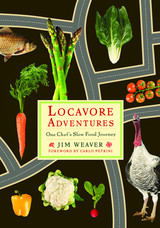
front cover of Locavore Adventures
Locavore Adventures
One Chef's Slow Food Journey
Weaver, Jim
Rutgers University Press, 2012

America’s fast food culture reflects not only what we eat—foods that are processed and packaged for convenience—but also how we eat—munching as we multitask and not really tasting the super-sized meals we ingest. But in recent years, a more thoughtful philosophy about food has emerged. Developed in Italy, where fresh ingredients and artisanal techniques are prized, the Slow Food movement has rapidly gained a following in North America. The skeptics among us might wonder if it is possible truly to enjoy a Slow Food lifestyle—one based around local, seasonal ingredients—in our fast-paced world.

In Locavore Adventures, acclaimed New Jersey chef and restaurateur Jim Weaver shares his personal story of how he came to solve this problem—building a local slow food culture that is ecologically responsible and also yields delicious results. Weaver tells of his odyssey founding the Central New Jersey chapter of Slow Food, connecting local farmers, food producers, and chefs with the public to forge communities that value the region’s unique bounty. More than forty recipes throughout the book, from Hot Smoked Brook Trout with Asparagus Puree and Pickled Cippollini Onions to Zuppa di Mozzarella, will inspire readers to be creative in their own kitchens. Locavore Adventures is a thoughtful memoir about growing a sustainable food culture and a guide to slowing down, savoring locally grown food, and celebrating life.

[more]

front cover of Los Romeros
Los Romeros
Royal Family of the Spanish Guitar
Walter Aaron Clark
University of Illinois Press, 2018
Spanish émigré guitarist Celedonio Romero gave his American debut performance on a June evening in 1958. In the sixty years since, the Romero Family—Celedonio, his wife Angelita, sons Celín, Pepe, and Angel, as well as grandsons Celino and Lito—have become preeminent in the world of Spanish flamenco and classical guitar in the United States. Walter Aaron Clark's in-depth research and unprecedented access to his subjects have produced the consummate biography of the Romero family. Clark examines the full story of their genius for making music, from their outsider's struggle to gain respect for the Spanish guitar to the ins and outs of making a living as musicians. As he shows, their concerts and recordings, behind-the-scenes musical careers, and teaching have reshaped their instrument's very history. At the same time, the Romeros have organized festivals and encouraged leading composers to write works for guitar as part of a tireless, lifelong effort to promote the guitar and expand its repertoire. Entertaining and intimate, Los Romeros opens up the personal world and unfettered artistry of one family and its tremendous influence on American musical culture.
[more]


Send via email Share on Facebook Share on Twitter