
 A SCHOLARLY BOOK REPOSITORY
18 start with L start with L

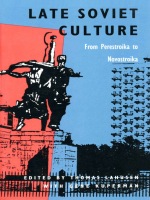
Leading scholars from the former Soviet Union and the West gather here to consider the fate of the people and institutions that constituted Soviet culture. Whether the speculative glance goes back (to czarist Russia or Soviet Freudianism, to the history of aesthetics or the sociology of cinema in the 1930s) or forward (to the "market Stalinism" one writer predicts or the "open text of history" another advocates), a sense of immediacy, or history-in-the-making animates this volume. Will social and cultural institutions now develop organically, the authors ask, or is the society faced with the prospect of even more radical reforms? Does the present rupture mark the real moment of Russia's encounter with modernity? The options explored by literary historians, film scholars, novelists, and political scientists make this book a heady tour of cultural possibilities. An expanded version of a special issue of South Atlantic Quarterly (Spring 1991), with seven new essays, Late Soviet Culture will stimulate scholar and general reader alike.
Contributors. Katerina Clark, Paul Debreczeny, Evgeny Dobrenko, Mikhail Epstein, Renata Galtseva, Helena Goscilo, Michael Holquist, Boris Kagarlitsky, Mikhail Kuraev, Thomas Lahusen, Valery Leibin, Sidney Monas, Valery Podoroga, Donald Raleigh, Irina Rodnyanskaya, Maya Turovskaya
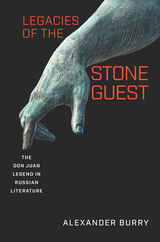
The story of Don Juan first appeared in writing in seventeenth-century Spain, reaching Russia about a century later. Its real impact, however, was delayed until Russia’s most famous poet, Alexander Pushkin, put his own, unique, and uniquely inspirational, spin on the tale. Published in 1830, TheStone Guest is now recognized, with other Pushkin masterpieces, as part of the Russian literary canon. Alexander Burry traces the influence of Pushkin’s brilliant innovations to the legend, which he shows have proven repeatedly fruitful through successive ages of Russian literature, from the Realist to the Silver Age, Soviet, and contemporary periods. Burry shows that, rather than creating a simple retelling of an originally religious tale about a sinful, consummate seducer, Pushkin offered open-ended scenes, re-envisioned and complicated characters, and new motifs that became recursive and productive parts of Russian literature, in ways that even Pushkin himself could never have predicted.
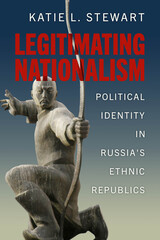
Even in the current autocratic system, however, Russia’s multiethnic nature and fractured political history mean that not all political symbols work the same way everywhere; not every story finds the same audience in the same way. The message may emanate from Moscow, but regional actors—including local governments, civic organizations, and cultural institutions—have some agency in how they spread the message: some regionalization of identity work is permitted to ensure that Russian national symbols and narratives resonate with people, and to avoid protest. This book investigates how nation building works on the ground through close studies of three of Russia’s ethnic republics: Karelia, Tatarstan, and Buryatia. Understanding how the project of legitimating nationalism, in support of a unified country and specifically Putin’s regime, works in practice offers crucial context in understanding the shape and story of contemporary Russia.

Lenin’s politics continue to reverberate around the world even after the end of the USSR. His name elicits revulsion and reverence, yet Lenin the man remains largely a mystery. This biography shows us Lenin as we have never seen him, in his full complexity as revolutionary, political leader, thinker, and private person.
Born Vladimir Ilyich Ulyanov in 1870, the son of a schools inspector and a doctor’s daughter, Lenin was to become the greatest single force in the Soviet revolution—and perhaps the most influential politician of the twentieth century. Drawing on sources only recently discovered, Robert Service explores the social, cultural, and political catalysts for Lenin’s explosion into global prominence. His book gives us the vast panorama of Russia in that awesome vortex of change from tsarism’s collapse to the establishment of the communist one-party state. Through the prism of Lenin’s career, Service focuses on dictatorship, the Marxist revolutionary dream, civil war, and interwar European politics. And we are shown how Lenin, despite the hardships he inflicted, was widely mourned upon his death in 1924.
Service’s Lenin is a political colossus but also a believable human being. This biography stresses the importance of his supportive family and of its ethnic and cultural background. The author examines his education, upbringing, and the troubles of his early life to explain the emergence of a rebel whose devotion to destruction proved greater than his love for the “proletariat” he supposedly served. We see how his intellectual preoccupations and inner rage underwent volatile interaction and propelled his career from young Marxist activist to founder of the communist party and the Soviet state—and how he bequeathed to Russia a legacy of political oppression and social intimidation that has yet to be expunged.

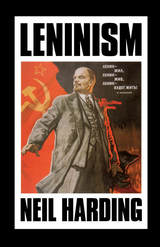
Rather than tracing the roots of Leninism to the details of Lenin’s biography, Harding shows how it emerged as a revolutionary Marxist response to the First World War and to the perceived treachery—the support of that war—by social democratic leaders. The economics, politics, and philosophy of Leninism, he argues, were rapidly theorized between 1914 and 1918 and deeply imprinted with the peculiarities of the wartime experience. Its complementary metaphysics of history and science was as intrinsic to its confidence and sureness of purpose as it was to its contempt for democratic practice and tolerance. But, as Harding also shows, although Leninism articulated a complex and coherent critique of capitalist civilization and held a powerful appeal to a variety of constituencies, it was itself caught in a timewarp that fatally limited its capacity to adapt. This book will engage not only Russian and Soviet specialists, but also readers concerned with the varieties of twentieth-century socialism.
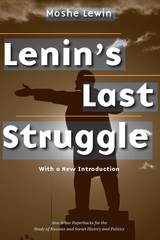
One of the great political strategists of his era, V. I. Lenin continues to attract historical interest, yet his complex personality eludes full understanding. This new edition of Moshe Lewin's classic political biography, including an afterword by the author, suggests new approaches for studying the Marxist visionary and founder of the Soviet state. Lenin's Last Struggle offers invaluable insights into the rise of the Bolshevik party and the Soviet Union, a saga complicated by complex strategic battles among the leaders of Lenin's generation: leaders whose names are universally known, but whose personalities and motivations are even now not sufficiently understood.
Moshe Lewin was a collective farm worker in the USSR and a soldier in the Soviet army. He later became director of studies at the Ecole Pratique des Hautes Etudes in Paris, a fellow of the Kennan Institute, a senior fellow of Columbia University's Russian Institute, and is now emeritus professor of history at The University of Pennsylvania.
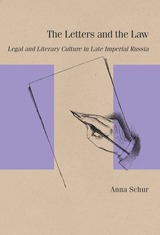
Anna Schur combines historical research and literary analysis to argue that the first generations of Russian trial lawyers shaped their professional identity with an eye to the celebrated figure of the writer and that they considered their own activities to be a form of verbal art. A fuller understanding of writers’ antipathy to the law, Schur contends, must take into account this overlooked cultural backdrop. Laced with the better‑known critique of the lawyer’s legalistic proclivities and lack of moral principle are the writer’s reactions to a whole network of explicit and implicit claims of similarity between the two professions’ goals, methods, and missions that were central to the lawyer’s professional ideal. Viewed in this light, writers’ critiques of the law and lawyers emerge as a concerted effort at protecting literature’s exclusive cultural status in the context of modernization and the rapidly expanding public sphere.
The study draws upon a mix of well-known and rarely studied nineteenth-century authors and texts—with particular attention paid to Fyodor Dostoevsky and Mikhail Saltykov-Shchedrin—and on a wide range of nonliterary sources, including courtroom speeches, guides to forensic oratory, legal treatises, and specialized press.
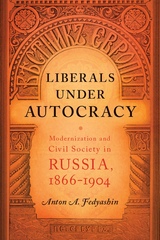
With its rocky transition to democracy, post-Soviet Russia has made observers wonder whether a moderating liberalism could ever succeed in such a land of extremes. But in Liberals under Autocracy, Anton A. Fedyashin looks back at the vibrant Russian liberalism that flourished in the country’s late imperial era, chronicling its contributions to the evolution of Russia’s rich literary culture, socioeconomic thinking, and civil society.
For five decades prior to the revolutions of 1917, The Herald of Europe (Vestnik Evropy) was the flagship journal of Russian liberalism, garnering a large readership. The journal articulated a distinctively Russian liberal agenda, one that encouraged social and economic modernization and civic participation through local self-government units (zemstvos) that defended individual rights and interests—especially those of the peasantry—in the face of increasing industrialization. Through the efforts of four men who turned The Herald into a cultural nexus in the imperial capital of St. Petersburg, the publication catalyzed the growing influence of journal culture and its formative effects on Russian politics and society.
Challenging deep-seated assumptions about Russia’s intellectual history, Fedyashin’s work casts the country’s nascent liberalism as a distinctly Russian blend of self-governance, populism, and other national, cultural traditions. As such, the book stands as a contribution to the growing literature on imperial Russia's nonrevolutionary, intellectual movements that emphasized the role of local politics in both successful modernization and the evolution of civil society in an extraparliamentary environment.


Living the High Life in Minsk looks at the sources of stability and instability in post-Soviet authoritarian states through the case study of President Lukashenka’s firm hold on power in Belarus. In particular, it seeks to understand the role of energy relations, policies, and discourses in the maintenance of this power. The central empirical question Balmaceda seeks to answer is what has been the role of energy policies in the maintenance of Lukashenka’s power in Belarus? In particular, it analyzes the role of energy policies in the management of Lukashenka’s relationship with three constituencies crucial to his hold on power: Russian actors, the Belarusian nomenklatura, and the Belarusian electorate.
In terms of foreign relations, the book focuses on the factors explaining Lukashenka’s ability to project Belarus’ power in its relationship with Russia in such a way as to compensate for its objective high level of dependency, assuring high levels of energy subsidies and rents continuing well beyond the initial worsening of the relationship in c. 2004. In terms of domestic relations, Balmaceda examines Lukashenka’s specific use of those energy rents in such a way as to assure the continuing support of both the Belarusian nomenklatura and the Belarusian electorate.
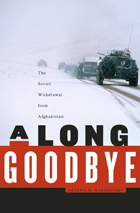
The conflict in Afghanistan looms large in the collective consciousness of Americans. What has the United States achieved, and how will it withdraw without sacrificing those gains? The Soviet Union confronted these same questions in the 1980s, and Artemy Kalinovsky’s history of the USSR’s nine-year struggle to extricate itself from Afghanistan and bring its troops home provides a sobering perspective on exit options in the region.
What makes Kalinovsky’s intense account both timely and important is its focus not on motives for initiating the conflict but on the factors that prevented the Soviet leadership from ending a demoralizing war. Why did the USSR linger for so long, given that key elites recognized the blunder of the mission shortly after the initial deployment?
Newly available archival material, supplemented by interviews with major actors, allows Kalinovsky to reconstruct the fierce debates among Soviet diplomats, KGB officials, the Red Army, and top Politburo figures. The fear that withdrawal would diminish the USSR’s status as leader of the Third World is palpable in these disagreements, as are the competing interests of Afghan factions and the Soviet Union’s superpower rival in the West. This book challenges many widely held views about the actual costs of the conflict to the Soviet leadership, and its findings illuminate the Cold War context of a military engagement that went very wrong, for much too long.
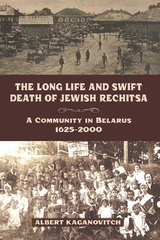
Based on extensive use of Soviet and Israeli archives, interviews, memoirs, and secondary sources, Kaganovitch’s acclaimed work, originally published in Russian, is presented here in a significantly revised English translation by the author. Details of demographic, social, economic, and cultural changes in Rechitsa’s evolution, presented over the sweep of centuries, reveal a microcosm of daily Jewish life in Rechitsa and similar communities. Kaganovitch looks closely at such critical developments as the spread of Chabad Hasidism, the impact of multiple political transformations and global changes, and the mass murder of Rechitsa’s remaining Jews by the German army in November to December 1941.
Kaganovitch also documents the evolving status of Jews in the postwar era, starting with the reconstitution of a Jewish community in Rechitsa not long after liberation in 1943 and continuing with economic, social, and political trends under Stalin, Khrushchev, and Brezhnev, and finally emigration from post-Soviet Belarus. The Long Life and Swift Death of Jewish Rechitsa is a major achievement.
Winner, Helen and Stan Vine Canadian Jewish Book Award for Scholarship, Koffler Centre of the Arts
In his celebrated short story "The Prisoner of the Caucasus," two Russian soldiers take a Chechen prisoner during the war, and as events unfold, Makanin reveals the casual brutality of the war but also the secret truths of the character's lives. In the novella The Loss, Pekalov, a drunkard and dreamer obsessed with the idea of building a tunnel under the Ural River, disappears in a ditch while working and is made a saint by the people of his village. "Klyucharyov and Alimushkin" tells the story of what happens when one man becomes remarkably lucky while the other loses all his luck.
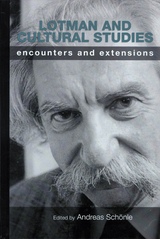
In this volume, edited by Andreas Schönle, contributors extend Lotman's theories to a number of fields. Focusing on his less frequently studied later period, Lotman and Cultural Studies engages with such ideas as the "semiosphere," the fluid, dynamic semiotic environment out of which meaning emerges; "auto-communication," the way in which people create narratives about themselves that in turn shape their self-identity; change, as both gradual evolution and an abrupt, unpredictable "explosion"; power; law and mercy; Russia and the West; center and periphery.
As William Mills Todd observes in his afterword, the contributors to this volume test Lotman's legacy in a new context: "Their research agendas-Iranian and American politics, contemporary Russian and Czech politics, sexuality and the body-are distant from Lotman's own, but his concepts and awareness yield invariably illuminating results."
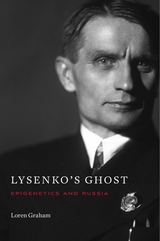
The Soviet agronomist Trofim Lysenko became one of the most notorious figures in twentieth-century science after his genetic theories were discredited decades ago. Yet some scientists, even in the West, now claim that discoveries in the field of epigenetics prove that he was right after all. Seeking to get to the bottom of Lysenko’s rehabilitation in certain Russian scientific circles, Loren Graham reopens the case, granting his theories an impartial hearing to determine whether new developments in molecular biology validate his claims.
In the 1930s Lysenko advanced a “theory of nutrients” to explain plant development, basing his insights on experiments which, he claimed, showed one could manipulate environmental conditions such as temperature to convert a winter wheat variety into a spring variety. He considered the inheritance of acquired characteristics—which he called the “internalization of environmental conditions”—the primary mechanism of heredity. Although his methods were slipshod and his results were never duplicated, his ideas fell on fertile ground during a time of widespread famine in the Soviet Union.
Recently, a hypothesis called epigenetic transgenerational inheritance has suggested that acquired characteristics may indeed occasionally be passed on to offspring. Some biologists dispute the evidence for this hypothesis. Loren Graham examines these arguments, both in Russia and the West, and shows how, in Russia, political currents are particularly significant in affecting the debates.
READERS
Browse our collection.
PUBLISHERS
See BiblioVault's publisher services.
STUDENT SERVICES
Files for college accessibility offices.
RECENTLY PUBLISHED



UChicago Accessibility Resources
home | accessibility | search | about | contact us
BiblioVault ® 2001 - 2025
The University of Chicago Press