
 A SCHOLARLY BOOK REPOSITORY
11 start with L start with L
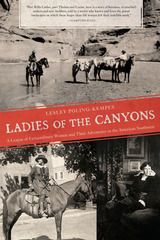
Educated, restless, and inquisitive, Natalie Curtis, Carol Stanley, Alice Klauber, and Mary Cabot Wheelwright were plucky, intrepid women whose lives were transformed in the first decades of the twentieth century by the people and the landscape of the American Southwest. Part of an influential circle of women that included Louisa Wade Wetherill, Alice Corbin Henderson, Mabel Dodge Luhan, Mary Austin, and Willa Cather, these ladies imagined and created a new home territory, a new society, and a new identity for themselves and for the women who would follow them.
Their adventures were shared with the likes of Theodore Roosevelt and Robert Henri, Edgar Hewett and Charles Lummis, Chief Tawakwaptiwa of the Hopi, and Hostiin Klah of the Navajo. Their journeys took them to Monument Valley and Rainbow Bridge, into Canyon de Chelly, and across the high mesas of the Hopi, down through the Grand Canyon, and over the red desert of the Four Corners, to the pueblos along the Rio Grande and the villages in the mountains between Santa Fe and Taos.
Although their stories converge in the outback of the American Southwest, the saga of Ladies of the Canyons is also the tale of Boston’s Brahmins, the Greenwich Village avant-garde, the birth of American modern art, and Santa Fe’s art and literary colony.
Ladies of the Canyons is the story of New Women stepping boldly into the New World of inconspicuous success, ambitious failure, and the personal challenges experienced by women and men during the emergence of the Modern Age.
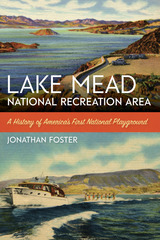
First named the Boulder Dam Recreation Area, this parkland was created in 1936 by a memorandum of agreement between the National Park Service and the U.S. Bureau of Reclamation. Over the course of its existence, the area has served as a model for a subsequent system of National Recreation Areas. The area’s extreme popularity has, in combination with changing public attitudes regarding preservation and safety, presented the National Park Service with tremendous challenges in recent decades. Jonathan Foster’s examination of these challenges and the responses to them reveal an increasingly anxious relationship between the government, the public, and special interest groups in the American West.
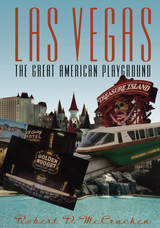
Las Vegas: The Great American Playground, illustrated with many fine historical photographs, traces the city’s history from its first Native American occupants more than 10,000 years ago to its present status as a premier tourist destination. It is the story of a group of colorful, enterprising individuals who made the desert bloom with undreamed-of possibilities.
Hughes traces the transformations of tobacco and its use over time, from its role as a hallucinogen in Native American shamanistic ritual to its use as a prophylactic against the plague and a cure for cancer by early Europeans, and finally to the current view of smoking as a global pandemic. He then analyzes tobacco from the perspective of the individual user, exploring how its consumption relates to issues of identity and life changes. Comparing sociocultural and personal experiences, Hughes ultimately asks what the patterns of tobacco use mean for the clinical treatment of smokers and for public policy on smoking. Pointing the way, then, to a more learned and sophisticated understanding of tobacco use, this study will prove to be essential reading for anyone interested in the history of smoking and the sociology of addiction.
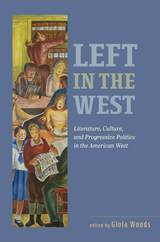
From the early 19th century to the present, a remarkably complex and varied body of literary and cultural production has emerged out of progressive social movements. While the literary left in the West shared many interests with other regional expressions—labor, class, anti-fascism, and anti-imperialism, the influence of Manifest Destiny—the distinct history of settler colonialism in western territories caused western leftists to develop concerns unique to the region.
Chapters in the volume provide an impressive range of analysis, covering artists and movements from suffragist writers to bohemian Californian photographers, from civil rights activists to popular folk musicians, from Latinx memoirists to Native American experimental writers, to name just a few.
The unique consideration of the West as a socio-political region establishes a framework for political critique that moves beyond class consequences, anti-fascism, and civil liberties, and into distinct Western concerns such as Native American sovereignty, environmental exploitation, and the legacies of settler colonialism. What emerges is a deeper understanding of the region and its unique people, places, and concerns.

Letter writing was a dominant form of communication for Western-educated elites in colonial Africa, especially in Nigeria. Exposure to the modern world and a growing sense of nationalism were among the factors that led people to begin exchanging letters, particularly in their interactions with British colonial authorities. Through careful textual analysis and broad contextualization, Vaughan reconstructs dominant storylines, including themes such as kinship, social mobility, Western education, modernity, and elite consolidation in colonial and post-colonial Nigeria. Vaughan brings his prodigious skills as an interdisciplinary scholar to bear on this wealth of information, bringing to life a portrait, at once intimate and expansive, of a community during a transformative period in African history.
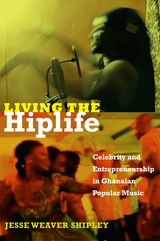
Shipley shows how young hiplife musicians produce and transform different kinds of value—aesthetic, moral, linguistic, economic—using music to gain social status and wealth, and to become respectable public figures. In this entrepreneurial age, youth use celebrity as a form of currency, aligning music-making with self-making and aesthetic pleasure with business success. Registering both the globalization of electronic, digital media and the changing nature of African diasporic relations to Africa, hiplife links collective Pan-Africanist visions with individualist aspiration, highlighting the potential and limits of social mobility for African youth.
The author has also directed a film entitled Living the Hiplife and with two DJs produced mixtapes that feature the music in the book available for free download.

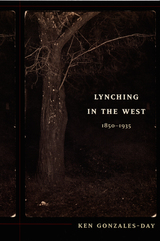
An artist and writer, Gonzales-Day began this study by photographing lynching sites in order to document the absences and empty spaces that are emblematic of the forgotten history of lynching in the West. Drawing on newspaper articles, periodicals, court records, historical photographs, and souvenir postcards, he attempted to reconstruct the circumstances surrounding the lynchings that had occurred in the spaces he was photographing. The result is an unprecedented textual and visual record of a largely unacknowledged manifestation of racial violence in the United States. Including sixteen color illustrations, Lynching in the West juxtaposes Gonzales-Day’s evocative contemporary photographs of lynching sites with dozens of historical images.
Gonzales-Day examines California’s history of lynching in relation to the spectrum of extra-legal vigilantism common during the nineteenth century—from vigilante committees to lynch mobs—and in relation to race-based theories of criminality. He explores the role of visual culture as well, reflecting on lynching as spectacle and the development of lynching photography. Seeking to explain why the history of lynching in the West has been obscured until now, Gonzales-Day points to popular misconceptions of frontier justice as race-neutral and to the role of the anti-lynching movement in shaping the historical record of lynching in the United States.

What does it mean to be a person? One might think of the possession of certain rights, having the capacity for love, or being self-determined. But if words like “person” or “love” seem to carry an internal meaning, where does this meaningfulness come from? Lyric Personhood contends that to be encultured in the modern West is to learn, on top of everything else, an unspoken and mostly felt sense of what it means to be someone, a sense transmitted not only in language but also through encounters with aesthetic form. Through close readings that span nineteenth-century European opera, commercial cinema, and amateur YouTube proposal videos, Dan Wang shows that a “person” has become an aesthetic concept—and not just a legal, moral, political, or philosophical one—in the last two hundred years of Western culture.
It’s hard to let go of the organizing promise of romantic love, the dream of therapeutic “health,” and the aspiration to belong to national culture, Wang argues, because these longings have been shaped by an archive of sentimental and melodramatic works that trains people's expectations for life, genre, and even the knowing promised in theory itself. Tracing a surprisingly continuous imagination of personhood through opera and film aesthetics, Lyric Personhood introduces modes of reading audiovisual works that allow a longer story to be told about the forms that make personhood sensible in the West.
READERS
Browse our collection.
PUBLISHERS
See BiblioVault's publisher services.
STUDENT SERVICES
Files for college accessibility offices.
RECENTLY PUBLISHED



UChicago Accessibility Resources
home | accessibility | search | about | contact us
BiblioVault ® 2001 - 2026
The University of Chicago Press